The interplay between sintering temperature and reactant particle size is the master control dial for reaction sintering.
In high-temperature furnaces, these two parameters do much more than simply drive consolidation—they determine whether densification or chemical reaction dominates the process at any given moment. Finer particles dramatically boost densification relative to reaction because densification rate scales with the inverse cube or fourth power of particle size, while reaction rate depends only weakly on size. Because densification typically carries a higher activation energy, raising the furnace temperature further tilts the balance toward faster densification. Managing this competition is the key to achieving full conversion, high density, and a defect‑free microstructure.
Sintering temperature and reactant particle size act as coupled levers: decreasing particle size accelerates densification far more than reaction, while increasing temperature selectively speeds up densification due to its higher activation energy. Controlling both allows you to dictate the trajectory from loose powder to a fully densified, fully reacted ceramic—preventing incomplete reactions, microcracks, or excessive grain growth.
The Dual Nature of Reaction Sintering: Densification vs. Reaction
Reaction sintering is a race between two thermally activated processes: the chemical reaction that forms the desired compound, and the physical densification that eliminates porosity. The outcome depends on how you set the temperature ramp and the size of your starting particles.
The Competition Between Two Mechanisms
During thermal processing, particles react at contact points while simultaneously trying to sinter into a solid body. If densification outruns the reaction, the compact may close off porosity before gas‑forming reactions complete, trapping voids or leaving unreacted cores. If the reaction is too fast, rapid volume changes can disrupt the particle network and create cracks.
Particle Size: A Stronger Lever for Densification
Densification by lattice diffusion depends on particle size (G) to the third power (∼1/G³), and grain‑boundary‑diffusion‑driven densification scales as ∼1/G⁴. In contrast, solid‑state reaction rates scale far more gently—typically ∼1/G or 1/G². This means a ten‑fold reduction in particle size can multiply the densification rate by hundreds or thousands of times while the reaction rate changes only modestly.
Temperature: Boosting Densification Selectively
The activation energy for densification is generally higher than that of the reaction. As you raise the furnace setpoint, the exponential gain in densification rate is therefore larger than the gain in reaction rate. High temperatures, especially during the final soak, will finish the sintering job quickly, but if ramped too fast early on, they can prematurely seal the structure before the reaction completes.
Particle Size Scaling: Why Finer Powders Accelerate Densification More
The overwhelmingly stronger size dependence of densification is the central design rule for reaction sintering. Supplementary findings confirm that nanoscale powders can slash both the required sintering temperature and dwell time.
Herring’s Scaling Law and the Densification Rate Exponents
Herring’s law states that the time to reach a given neck‑to‑particle ratio scales as ( \left(\frac{D}{G}\right)^m ), where m = 3 for volume diffusion and m = 4 for grain‑boundary diffusion. For a ceramic processed from 0.1 µm powders instead of 1 µm powders, the time to achieve an identical degree of neck growth can drop by more than a factor of 1000. This is why precisely engineered submicron powders allow you to operate high‑temperature furnaces at 350 °C to 600 °C lower and with dramatically shorter holds.
The Reaction Rate’s Weaker Dependence on Particle Size
Solid‑state reactions are usually limited by interfacial area or short‑range diffusion, giving them exponents of only 1 or 2. Consequently, when you switch from micron‑scale to nano‑scale reactants, the densification advantage far outstrips any increase in reaction speed. This gives you a powerful tool: you can lower the furnace temperature to a regime where reaction still proceeds well but densification is just fast enough to avoid porosity entrapment.
Practical Implications: Lower Sintering Temperatures
Supplemental data show that chemically prepared submicron powders (0.1–0.4 µm) can reach >99% relative density at 800–1050 °C with about 1.5 hours of dwell. Coarser, standard powders often require 1400 °C and 10‑hour holds, and still leave residual porosity with grain sizes that have blown out of control. In reaction sintering, using finer starting particles buys you the ability to fully densify at a temperature where the reaction can still complete smoothly.
The Role of Sintering Temperature in Steering Reaction Sintering
Temperature is not just a volume knob for kinetics; it changes the relative balance between densification and reaction.
The Higher Activation Energy of Densification
Because densification has a steeper Arrhenius slope, a given increase in furnace temperature amplifies the densification rate more than the reaction rate. Early in the thermal cycle, moderate temperatures encourage reaction while keeping densification in check. As you dwell at peak temperature, the heightened densification kinetic advantage then kicks in to achieve full density. Precise temperature ramping is what separates a successful reaction‑sintered body from one with trapped by‑products.
Thermal Profiles: Multi‑Stage Dwells for Controlled Microstructure
When powders have unequal particle sizes or when a reaction generates gaseous species, a single‑stage ramp‑and‑hold often fails. Multi‑stage dwells—for example, a soak at an intermediate temperature where reaction occurs predominantly, followed by a high‑temperature finish for rapid densification—help balance interdiffusion rates and relieve internal stresses. Atmosphere‑controlled furnaces allow you to manage gas evacuation during these profiles.
Temperature Onset and Nano‑Powder Effects
As particle size descends into the nanoscale (below 20 nm), the sintering onset temperature drops significantly due to melting point depression and extreme surface energy. This allows initial neck formation and early densification at furnace settings that would leave micron‑sized powders completely inert. However, it also means you must design the thermal program to avoid reaction‑limiting pore closure before the chemical conversion finishes.
Understanding the Trade‑offs and Hidden Pitfalls
No single combination of particle size and temperature is perfect. Several often‑overlooked factors can undermine even a well‑thought‑out reaction sintering schedule.
Agglomeration: The Nano‑Powder Trap
Nano‑powders carry a hidden risk: agglomeration. Supplementary research shows that while unagglomerated 16 nm TiO₂ can reach 95% density at 850 °C in 30 minutes, 9 nm primary particles agglomerated into 340 nm clusters demand temperatures above 1150 °C. Agglomerates create large inter‑cluster pores that act as sintering‑resistant defects, erasing the particle‑size advantage. Use proper dispersion and gentle compaction to avoid this trap.
Unequal Particle Sizes: Constraining Stresses and Defects
When your powder mixture contains large, chemically inert particles in a fine matrix, the large particles constrain shrinkage, creating local tensile stresses that can open microcracks. If the large particles are chemically active, differential reaction rates and volume changes can cause void growth and swelling. Counter these effects with multi‑stage dwell times and optimized heating profiles that allow interdiffusion to relax stresses before major densification occurs.
Volumetric Shrinkage and Contamination Risks
Finer powders pack to a lower green density, so the total volumetric shrinkage is larger. This can lead to warping or cracking if the furnace profile does not allow gradual stress relief. Additionally, the huge surface area of nanoscale powders makes the compact highly susceptible to contamination from furnace atmosphere impurities. Using high‑purity vacuum or controlled‑atmosphere furnaces is often mandatory.
Incomplete Reactions When Densification Outruns Reaction
The central dilemma of reaction sintering is that high temperatures and ultra‑fine particles can advance densification so quickly that the reaction gets choked off. The result is a densified body with unreacted cores, off‑stoichiometry phases, or trapped gas bubbles. To avoid this, you must deliberately slow down the initial densification—by using slightly coarser particles or a lower intermediate hold temperature—so the reaction can complete within an open pore network.
How to Apply This to Your High‑Temperature Furnace Process
Your process recipe should be designed around the specific reaction‑densification competition you face. Tailor particle size and thermal cycles to the outcome you need.
- If your primary focus is complete chemical conversion with minimal defects: Use an intermediate‑temperature dwell to drive the reaction while keeping densification moderate, then ramp to a final temperature that seals the structure only after gases have escaped. Opt for particle sizes that offer a balance—fine enough to lower the final required temperature, but not so fine that densification dominates early.
- If your primary focus is achieving near‑theoretical density: Choose submicron or nanoscale powders to exploit the 1/G³–1/G⁴ densification advantage, but implement a multi‑stage profile with an initial reaction‑completion plateau. This prevents pore closure before full conversion.
- If your primary focus is minimizing furnace time and energy: Use chemically prepared, narrow‑size‑distribution powders below 0.5 µm, and match them with a precisely controlled soak at the lowest temperature that achieves both reaction and densification in a single consolidated step—but only if the reaction kinetics are fast enough to finish before pore pinch‑off.
- If your primary focus is avoiding microcracks in mixed‑size powder beds: Pre‑react or pre‑alloy the large particles to make them inert, then apply slow-ramp heating with intermediate dwells to allow stress relaxation, especially if the large particles are reactive.
Your furnace’s thermal intelligence and your powder’s size distribution are not independent variables; they are the two halves of a single control strategy. Master their interplay, and you will transform reaction sintering from a trial‑and‑error process into a predictable, defect‑free manufacturing route.
Summary Table:
| Parameter | Densification Kinetic Effect | Solid-State Reaction Effect | Process Optimization Strategy |
|---|---|---|---|
| Particle Size Reduction ($G$) | Scales as $\sim 1/G^3$ to $1/G^4$ (Exponential boost) | Scales as $\sim 1/G$ to $1/G^2$ (Modest increase) | Use submicron powders to dramatically lower peak temperatures and dwell times. |
| Temperature Elevation | Higher activation energy; exponentially speeds up consolidation | Lower activation energy; moderate kinetic speedup | Utilize multi-stage dwells so reaction completes before pores seal. |
| Powder Agglomeration | Forms large, resistant inter-cluster pores | Minimal impact | Ensure proper dispersion to prevent severe defect formation and void entrapment. |
Achieve theoretical density and defect-free ceramic microstructures with KINTEK's advanced thermal processing solutions. KINTEK specializes in high-performance laboratory equipment and consumables, offering fully customizable high-temperature furnaces—including muffle, tube, vacuum, controlled-atmosphere, CVD, and induction melting systems—engineered for exact multi-stage temperature profiles and atmosphere control. Take full control of your reaction-densification kinetics today. Contact KINTEK to customize your furnace
Related Products
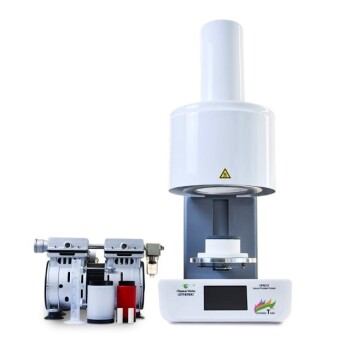
- Dental Porcelain Zirconia Sintering Ceramic Vacuum Press Furnace
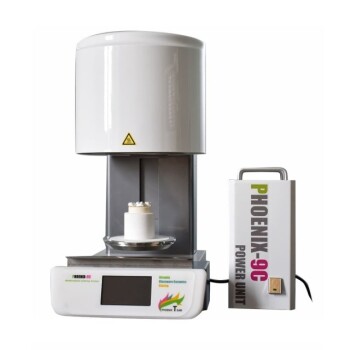
- Chairside Dental Porcelain Zirconia Sintering Furnace with Transformer for Ceramic Restorations
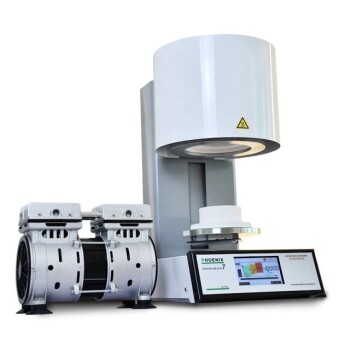
- Vacuum Dental Porcelain Sintering Furnace for Dental Laboratories
- Spark Plasma Sintering SPS Furnace
- High Temperature Muffle Oven Furnace for Laboratory Debinding and Pre Sintering
People Also Ask
- What factors determine the quality of sintered zirconia restorations? Master Material, Equipment, and Technique
- How do conventional vs rapid sintering in dental furnaces affect zirconia? Optimize Efficiency Without Sacrificing Strength
- What is the purpose of dental sintering furnaces? Transform Zirconia into Durable, High-Quality Dental Restorations
- What precautions should be taken when sintering zirconia in the Fast Slow Dental Sintering Furnace? Master Key Steps for Perfect Results
- What temperature range is used for sintering zirconia ceramics? Achieve Optimal Strength and Translucency