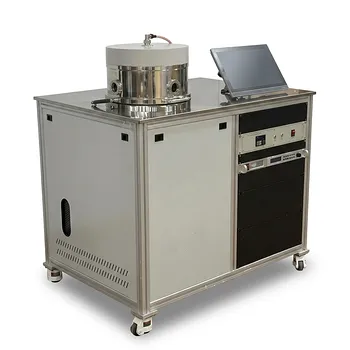
The tube atmosphere furnace serves as the foundational reactor for hydrogen reduction roasting in battery recycling. It provides a hermetically sealed environment that allows for precise control over thermal energy and gas composition. This setup is essential for converting complex battery cathode materials into simpler, soluble forms, enabling high-efficiency metal recovery.
The tube atmosphere furnace acts as a chemical transformation chamber where hydrogen interacts with waste battery materials under strict temperature control to selectively reduce valuable metals for downstream leaching and separation.
Facilitating Chemical Phase Transitions
Conversion of Transition Metals
The primary role of the furnace is to facilitate the reduction of high-valence transition metals. Metals such as cobalt(III), manganese(IV), and nickel(III) found in spent batteries are difficult to leach in their original state.
The furnace introduces a hydrogen-rich atmosphere to convert these into low-valence oxides (like cobalt(II) oxide and nickel(II) oxide). These resulting oxides are significantly more soluble in acid, which is a critical requirement for efficient leaching recovery.
Selective Lithium Extraction
Beyond transition metals, the furnace enables the selective separation of lithium. By controlling the roasting temperature (often around 500°C) and the hydrogen concentration, lithium can be converted into water-soluble LiOH·H2O.
This allows for a "lithium-first" recovery strategy. Because the other reduced metals remain in water-insoluble metallic or oxide forms, the lithium can be washed away and recovered before the more intensive acid leaching of other metals begins.
Atmospheric Integrity and Process Control
Maintenance of a Reductive Environment
A tube furnace is uniquely suited for this process because it can be completely purged of oxygen using inert gases like nitrogen or argon. This prevents the re-oxidation of metals and eliminates the risk of combustion when introducing high-purity hydrogen.
The sealed nature of the tube ensures that the gas-to-solid ratio remains consistent throughout the reaction. This stability is vital for achieving uniform reduction across the entire batch of battery material.
Thermal Precision and Microstructure Management
Precise management of the heating rate and dwelling time is necessary to prevent the sintering or agglomeration of metal particles. If the temperature is too high or uncontrolled, the metal precursors may fuse, reducing the surface area available for subsequent chemical processing.
Programmable furnaces allow for specific temperature gradients, ensuring that the reduction occurs at the thermodynamic sweet spot. This maintains the high dispersion of active sites, which is particularly important if the recycled materials are being repurposed for new catalysts.
Understanding the Trade-offs
Scalability vs. Precision
While tube furnaces offer unparalleled control for laboratory and pilot-scale recycling, they are primarily batch-processing tools. Scaling this technology to industrial volumes often requires transitioning to rotary atmosphere furnaces to handle continuous material flow.
Safety and Energy Consumption
Operating a hydrogen-rich environment at high temperatures presents significant safety risks, requiring advanced leak detection and pressure relief systems. Additionally, the energy required to maintain high temperatures for extended dwelling times can impact the overall economic viability of the recycling process.
Material Sensitivity
Different battery chemistries (e.g., LFP vs. NCM) require vastly different reduction parameters. A furnace setting optimized for nickel recovery may lead to over-reduction or undesirable phase changes in other materials, necessitating rigorous pre-sorting of battery waste.
How to Apply This to Your Recycling Project
Selecting the Right Parameters
To maximize the efficiency of your hydrogen reduction roasting, your furnace protocol should be tailored to your specific recovery goals.
- If your primary focus is Selective Lithium Recovery: Set the furnace to approximately 500°C with a high-purity hydrogen flow to ensure lithium converts to water-soluble hydroxides.
- If your primary focus is Transition Metal Leaching: Prioritize the conversion of high-valence oxides to low-valence states (Co/Ni/Mn II) using a stable H2/N2 mix to ensure maximum acid solubility.
- If your primary focus is Catalyst Precursor Production: Utilize a programmable heating ramp to prevent metal particle agglomeration and maintain a highly dispersed microstructure.
By mastering the atmospheric and thermal variables within the tube furnace, you transform hazardous battery waste into a high-value stream of battery-grade raw materials.
Summary Table:
| Process Objective | Furnace Function | Key Benefit |
|---|---|---|
| Metal Conversion | Lowers valence of Co, Ni, Mn | Increases acid solubility for leaching |
| Lithium Recovery | Precise 500°C thermal control | Enables selective water-soluble extraction |
| Atmosphere Control | Inert gas purging (N2/Ar) | Prevents oxidation and ensures safety |
| Microstructure | Programmable heating ramps | Prevents sintering of active metal sites |
Optimize Your Battery Recycling with KINTEK Precision
Ready to enhance your metal recovery rates? KINTEK specializes in high-performance laboratory equipment and consumables, offering a comprehensive range of customizable high-temperature furnaces, including tube, muffle, rotary, vacuum, and CVD atmosphere furnaces.
Whether you are refining selective lithium extraction or scaling transition metal leaching, our furnaces provide the atmospheric integrity and thermal precision required for advanced hydrogen reduction roasting.
Contact our technical experts today to design a furnace solution tailored to your unique research and recycling needs!
References
- Jiayin Zhou, Xiaofei Guan. The critical role of H <sub>2</sub> reduction roasting for enhancing the recycling of spent Li-ion battery cathodes in the subsequent neutral water electrolysis. DOI: 10.1039/d3su00201b
This article is also based on technical information from Kintek Furnace Knowledge Base .
Related Products
- 1200℃ Controlled Inert Nitrogen Atmosphere Furnace
- Mesh Belt Controlled Atmosphere Furnace Inert Nitrogen Atmosphere Furnace
- 1400℃ Controlled Inert Nitrogen Atmosphere Furnace
- 1700℃ Controlled Inert Nitrogen Atmosphere Furnace
- Controlled Inert Nitrogen Hydrogen Atmosphere Furnace
People Also Ask
- What controlled-atmosphere furnace conditions are required for sintering powder metallurgy copper alloy compacts? Ideal Setup
- How does introducing reactive gases into a controlled atmosphere furnace affect ceramic densification and coarsening?
- What Roles Do a Controlled Atmosphere Furnace and Oil Quenching Tank Play in AISI 5140 Steel Heat Treatment?
- What are the four main types of controlled atmospheres used in these furnaces? Optimize Your Heat Treatment Processes
- How Sintering Temp Affects Density & Resistivity of Cu-Oxide Composites