
The high-temperature muffle furnace serves as the primary separation tool in determining fiber volume fraction via pyrolysis. It creates a stable, 800°C air environment that selectively removes the matrix material through complete oxidative degradation. By burning away the organic phenolic resin while preserving the inorganic glass fibers, the furnace enables the precise gravimetric analysis required to calculate the material's composition.
Core Takeaway The muffle furnace exploits the difference in thermal stability between organic resins and inorganic fibers. By ensuring the total combustion of the matrix without damaging the reinforcement, it provides the fundamental data needed to validate the quality of composite curing and compaction.
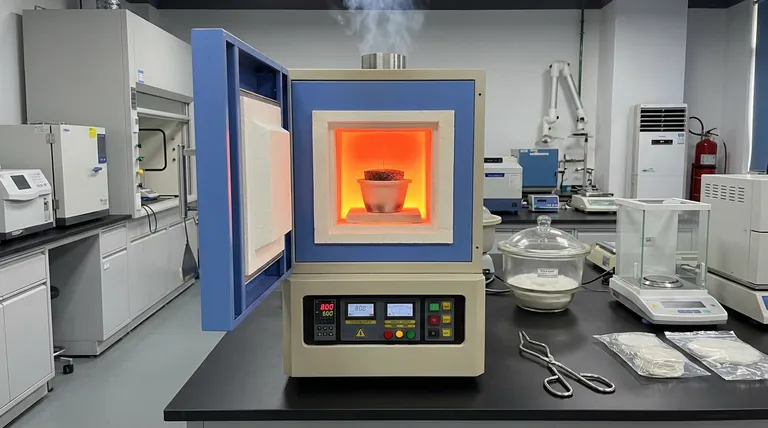
The Mechanism of Separation
Selective Degradation
The core function of the furnace is not simply heating, but selective destruction.
The composite consists of two distinct phases: an organic matrix (phenolic resin) and inorganic reinforcement (glass fibers).
The furnace creates an environment where the organic matrix cannot survive, causing it to decompose and oxidize completely.
Preservation of Reinforcement
Simultaneously, the furnace environment must be safe for the reinforcement material.
Inorganic glass fibers possess high thermal stability and remain intact at 800°C.
This selective process isolates the fibers, allowing them to be weighed without interference from the binder.
Operational Requirements
Precise Thermal Control
Accuracy depends on maintaining a specific, uniform temperature.
The primary reference specifies an operating temperature of 800°C.
Fluctuations below this point may result in incomplete resin burn-off, while excessive spikes could potentially alter the physical state of the glass.
Atmospheric Conditions
The process requires an air atmosphere within the chamber.
Oxygen is necessary to facilitate oxidative degradation, converting the solid resin into gaseous byproducts.
Without this airflow, the resin might char rather than burn away, leading to inaccurate weight measurements.
Evaluating Manufacturing Quality
Determining Fiber-to-Matrix Ratio
Once the resin is removed, the remaining mass represents the fiber content alone.
Comparing this final weight to the initial sample weight allows for a direct calculation of the fiber volume fraction.
Validating the Process
This measurement is a critical quality control metric.
It reveals the effectiveness of the curing and compaction process used during manufacturing.
Data derived from the furnace cycle helps engineers ensure the material meets the necessary strength and weight specifications.
Understanding the Trade-offs
Material Limitations
This method is strictly limited by the thermal properties of the constituents.
It is effective only because the glass fibers are inorganic and thermally stable in air at 800°C.
If the reinforcement fibers were organic (like aramid) or prone to oxidation (like carbon fiber) in an air atmosphere, the furnace would destroy the fibers along with the resin, rendering the test invalid.
Destructive Testing
The pyrolysis method is inherently destructive.
The sample used for analysis is physically altered and cannot be used for mechanical testing afterward.
This requires the sacrifice of representative material samples to gain insight into the batch quality.
Making the Right Choice for Your Goal
To obtain accurate fiber volume data, you must align your furnace parameters with the material limitations.
- If your primary focus is Measurement Accuracy: Ensure the furnace maintains a stable 800°C with sufficient airflow to guarantee the complete removal of organic impurities and resin.
- If your primary focus is Material Suitability: Verify that your reinforcement fibers are inorganic and capable of withstanding 800°C without degradation before selecting this method.
The high-temperature muffle furnace is the arbiter of truth for composite composition, provided the reinforcement material can survive the heat that destroys the matrix.
Summary Table:
| Feature | Specification/Requirement | Role in Pyrolysis |
|---|---|---|
| Operating Temperature | 800°C (Stable) | Ensures complete oxidative degradation of phenolic resins. |
| Atmosphere | Air (Oxygen-rich) | Facilitates combustion of organic matrix into gaseous byproducts. |
| Material Compatibility | Inorganic Fibers (e.g., Glass) | Must remain thermally stable while the matrix is destroyed. |
| Key Outcome | Gravimetric Analysis | Provides precise fiber-to-matrix ratios for quality validation. |
| Process Impact | Destructive Testing | Validates curing and compaction effectiveness in composites. |
Optimize Your Composite Analysis with KINTEK
Precision in pyrolysis begins with superior thermal control. KINTEK provides industry-leading muffle furnaces designed for the rigorous demands of material science and quality control. Backed by expert R&D and manufacturing, we offer Muffle, Tube, Rotary, Vacuum, and CVD systems—all fully customizable to meet your specific lab requirements.
Whether you are validating curing processes or determining fiber volume fractions, our high-temperature solutions deliver the stability and uniformity you need. Contact KINTEK today to discuss your unique heating needs with our specialists!
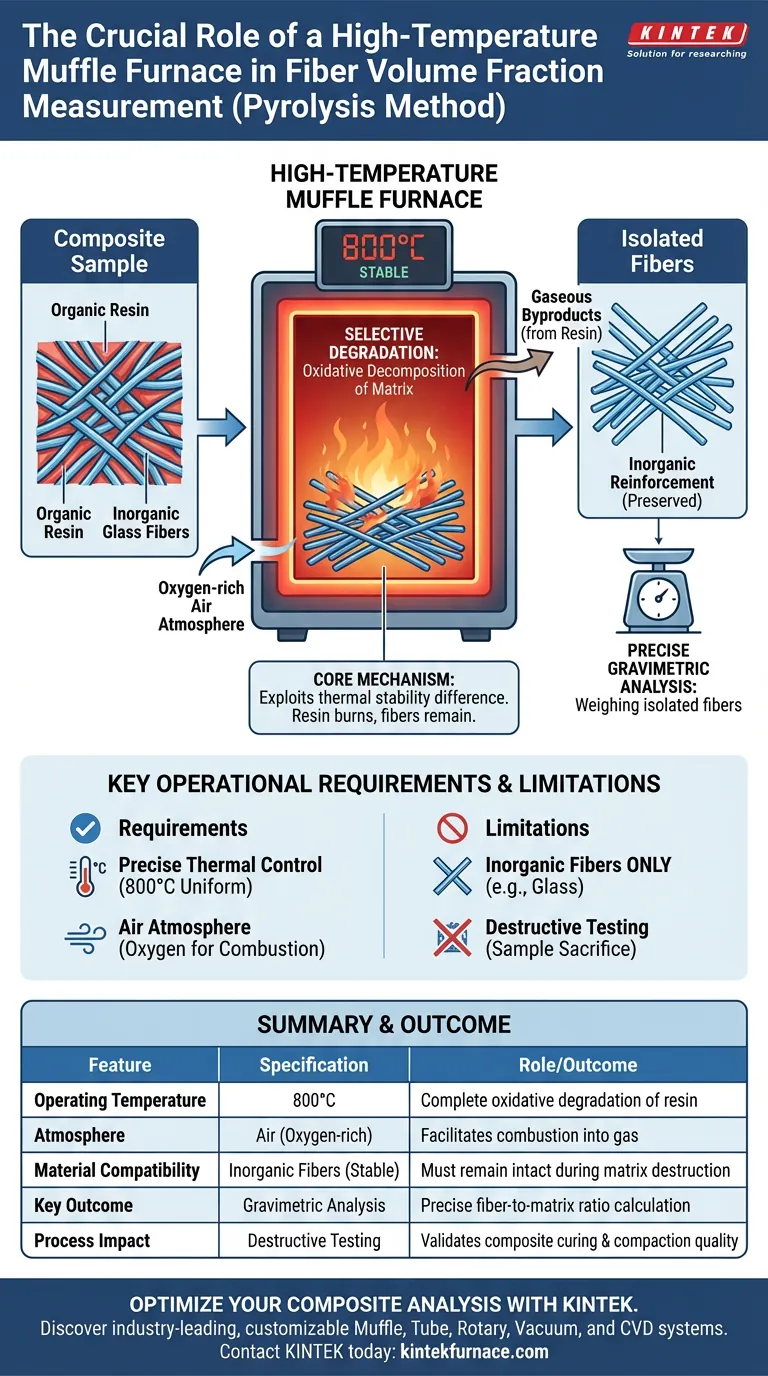
Visual Guide
References
- Xiaodong He, Hualian Li. A Study on the Compaction Behavior and Parameter Sensitivity of Curing Phenolic Thermal Protection Material Strips. DOI: 10.3390/polym17081045
This article is also based on technical information from Kintek Furnace Knowledge Base .
Related Products
- 1700℃ High Temperature Muffle Oven Furnace for Laboratory
- 1800℃ High Temperature Muffle Oven Furnace for Laboratory
- 1200℃ Muffle Oven Furnace for Laboratory
- 1400℃ Muffle Oven Furnace for Laboratory
- High Temperature Muffle Oven Furnace for Laboratory Debinding and Pre Sintering
People Also Ask
- What is the primary function of a high-temperature laboratory muffle furnace in chemical synthesis? Achieve Precision.
- How does a high-temperature laboratory muffle furnace affect material properties? Transform Anodic Oxide Films Fast
- What role does a muffle furnace play in BCZY712 electrolyte powder production? Achieve Perfect Phase Purity
- How does a muffle furnace impact Ni/MgAl2O4 catalysts? Optimize Stability and Catalytic Performance
- What role does a muffle furnace play in sintering photocathodes? Enhance Electrode Conductivity & Catalytic Activity



















