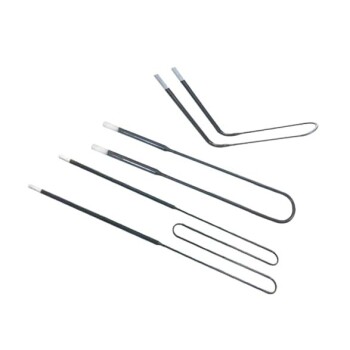
The high-temperature muffle furnace serves as the fundamental reactor for 4Cr5MoSiV1 steel boriding. It provides the controlled thermal environment—specifically within the range of 1133 K to 1253 K—required for boron atoms to overcome energy barriers and diffuse into the metal substrate. By maintaining precise isothermal conditions, this equipment allows researchers to accurately measure the growth patterns of the borided layer over time, which is the core objective of kinetics research.
The muffle furnace is the primary tool for activating solid-state diffusion in 4Cr5MoSiV1 steel, enabling the precise quantification of layer growth and the subsequent mathematical modeling of boriding kinetics.
Enabling the Mechanism of Boron Diffusion
Activating Surface Reactions
The boriding process requires a significant input of thermal energy to trigger the chemical reaction between the boriding agent and the steel surface. The muffle furnace provides this energy, facilitating the release of active boron atoms that initiate the formation of iron borides. Without this stable heat source, the surface would remain inert, preventing the transition from a mechanical mixture to a metallurgical bond.
Overcoming Diffusion Barriers
Once boron atoms are active, they must penetrate the 4Cr5MoSiV1 steel lattice to form a protective layer. The furnace maintains the high temperatures necessary for these atoms to overcome diffusion barriers, allowing them to move into the interstitial sites of the crystal structure. This temperature-dependent movement is the physical basis for all kinetic calculations in the study.
Facilitating Kinetic Modeling and Measurement
Maintaining Isothermal Stability
Kinetics research relies on the assumption of a constant temperature to isolate the variable of time. The high-precision control systems of modern muffle furnaces ensure that the samples remain in a stable thermal state, satisfying the requirements for calculating diffusion coefficients and activation energy. Any fluctuation in temperature would introduce errors into the mathematical models used to predict layer thickness.
Quantifying Layer Growth Patterns
By subjecting samples to specific temperatures for varying durations, researchers use the furnace to map the growth kinetics of the boride layer. This allows for the determination of the relationship between time and thickness, typically following a parabolic growth law. The furnace acts as the "clock" and "environment" that makes this systematic measurement possible.
Understanding the Trade-offs and Limitations
Thermal Gradients and Sample Placement
While muffle furnaces are highly effective, they can suffer from internal thermal gradients where the temperature near the heating elements differs from the center of the chamber. If samples are not placed strategically or if the furnace is overloaded, the kinetic data may become inconsistent across different test batches. This requires careful calibration and the use of uniform sample sizes.
Atmospheric Control and Surface Oxidation
In many muffle furnaces, the internal atmosphere is not vacuum-sealed, which can lead to unwanted oxidation of the steel if the boriding agent does not provide sufficient protection. Oxidation can interfere with the boron diffusion path and compromise the integrity of the kinetic data. Researchers must often use sealed crucibles or specific packing techniques within the furnace to mitigate this risk.
Making the Right Choice for Your Research Goal
Depending on the specific objectives of your material science project, the utilization of the muffle furnace should be tailored to ensure data reliability.
- If your primary focus is determining activation energy: Prioritize the use of a furnace with a high-precision PID controller to minimize temperature oscillations during long isothermal holds.
- If your primary focus is industrial scalability: Use a larger chamber muffle furnace to study how "load density" and sample arrangement affect the uniformity of the borided layer kinetics.
- If your primary focus is phase composition: Ensure the furnace can reach and stabilize at the upper limits of the 1133 K to 1253 K range to facilitate the formation of specific boride phases like FeB or Fe2B.
The high-temperature muffle furnace remains the indispensable engine of boriding research, transforming theoretical diffusion models into measurable physical reality.
Summary Table:
| Function | Role in Boriding Kinetics | Critical Requirement |
|---|---|---|
| Thermal Activation | Provides energy for boron diffusion (1133K-1253K) | High-precision PID control |
| Isothermal Stability | Ensures constant temperature for kinetic modeling | Minimal thermal oscillation |
| Layer Quantification | Enables measurement of parabolic growth patterns | Uniform sample placement |
| Atmosphere Control | Prevents surface oxidation during boriding | Sealed crucibles or inert gas |
Elevate Your Metallurgical Research with KINTEK
Precision is the backbone of kinetics research. KINTEK specializes in high-performance laboratory equipment and consumables, offering a comprehensive range of high-temperature furnaces—including muffle, tube, rotary, vacuum, CVD, atmosphere, and induction melting furnaces—all fully customizable to meet your unique research parameters.
Whether you are studying boriding kinetics or advanced material synthesis, our equipment ensures the isothermal stability and uniform heating required for reliable, reproducible data.
Ready to optimize your laboratory's thermal processes?
Contact KINTEK experts today to discuss your specific requirements and discover how our advanced furnace solutions can drive your research success!
References
- Katia Benyakoub, M. Kulka. Kinetic Modelling of Powder-Pack Boronized 4Cr5MoSiV1 Steel by Two Distinct Approaches. DOI: 10.3390/coatings13061132
This article is also based on technical information from Kintek Furnace Knowledge Base .
Related Products
- 1800℃ High Temperature Muffle Oven Furnace for Laboratory
- 1700℃ High Temperature Muffle Oven Furnace for Laboratory
- 1200℃ Muffle Oven Furnace for Laboratory
- High Temperature Muffle Oven Furnace for Laboratory Debinding and Pre Sintering
- 1400℃ Muffle Oven Furnace for Laboratory
People Also Ask
- What is the primary function of a high-temperature laboratory muffle furnace in chemical synthesis? Achieve Precision.
- How does a high-temperature laboratory muffle furnace affect material properties? Transform Anodic Oxide Films Fast
- Why is a laboratory high-temperature muffle furnace required for LaNixFe1-xO3 catalysts? Optimize Two-Stage Synthesis
- What is the critical role of a laboratory high-temperature muffle furnace in TiO2/LDH? Unlock Superior Crystallization
- Why is a laboratory high-temperature muffle furnace used for BaTiO3? Achieve Optimal Tetragonal Crystalline Phases