
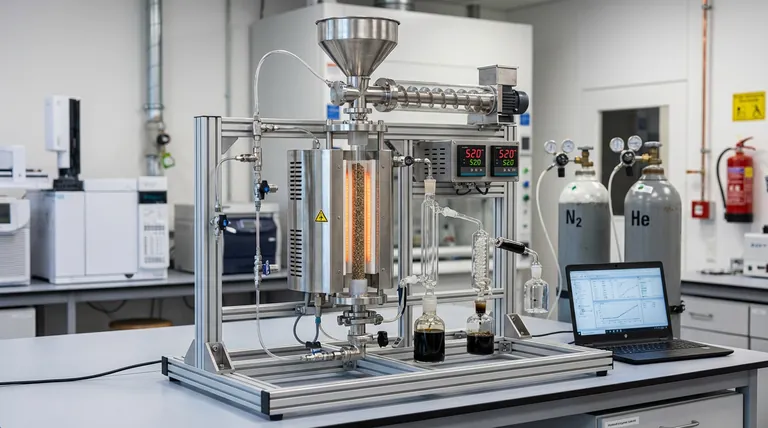
A continuous bench-scale drop tube pyrolyzer functions as a precision instrument designed to maximize the yield and quality of Fast Pyrolysis Bio-oil (FPBO). It achieves this by facilitating the rapid thermal degradation of biomass particles under strictly controlled conditions. Crucially, it utilizes a carrier gas to swiftly evacuate vapors, preventing them from degrading in the high-heat environment.
The system's primary advantage is its ability to effectively reduce secondary cracking reactions. By rapidly removing in situ vapors, it maximizes the recovery of high-quality primary pyrolysis products.
The Mechanics of Quality Preservation
To understand the role of this pyrolyzer, one must look at how it manipulates the reaction environment to favor specific chemical outcomes.
Precise Thermal Regulation
The apparatus provides exact control over the pyrolysis temperature, a critical variable in bio-oil production.
Standard operations typically maintain the reactor at 520 °C. This specific temperature point is targeted to facilitate the rapid thermal degradation of the biomass material.
Controlled Continuous Feeding
Unlike batch reactors, this system operates continuously, requiring steady input.
It manages material feeding rates with precision, such as 60 g h⁻¹. This ensures that the biomass is exposed to the heat source uniformly, preventing inconsistencies in the degradation process.
Mitigating Chemical Degradation
The most significant role of the drop tube pyrolyzer is protecting the vapor once it is generated.
Rapid Vapor Removal
The system utilizes a carrier gas flow explicitly to sweep the reaction zone.
This gas flow is responsible for quickly removing in situ vapors from the high-temperature zone. Speed is essential here to change the thermal environment of the product immediately after formation.
Reducing Secondary Cracking
If vapors remain in the high-temperature zone, they undergo secondary cracking, breaking down into less desirable compounds.
By evacuating the vapors instantly, the pyrolyzer effectively reduces these secondary reactions. This preservation leads to a higher recovery rate of primary pyrolysis products, which constitutes high-quality FPBO.
Understanding the Operational Trade-offs
While the drop tube pyrolyzer excels at quality control, its design imposes specific operational constraints related to scale.
Throughput vs. Precision
The device is explicitly defined as a bench-scale unit.
With feeding rates around 60 g h⁻¹, the volume of production is low compared to industrial systems. This makes the unit ideal for high-fidelity preparation and research where quality is paramount, but less suitable for scenarios requiring bulk mass production.
Making the Right Choice for Your Goal
When utilizing a drop tube pyrolyzer for FPBO preparation, focus on the following parameters to ensure success:
- If your primary focus is maximizing oil quality: Optimize the carrier gas flow rate to ensure in situ vapors are evacuated immediately, minimizing secondary cracking.
- If your primary focus is process repeatability: strictly maintain the standard operating temperature of 520 °C and a consistent feed rate of 60 g h⁻¹ to ensure uniform thermal degradation.
By leveraging rapid vapor removal and precise thermal control, this tool transforms raw biomass into high-value primary products with minimal degradation.
Summary Table:
| Feature | Operational Parameter | Role in FPBO Production |
|---|---|---|
| Operating Temperature | Standard 520 °C | Facilitates rapid thermal degradation of biomass |
| Feeding Rate | 60 g h⁻¹ (Bench-scale) | Ensures uniform heat exposure and process consistency |
| Vapor Management | Carrier Gas Sweep | Rapidly evacuates in situ vapors to prevent degradation |
| Primary Outcome | Reduced Secondary Cracking | Maximizes recovery of high-value primary pyrolysis products |
Elevate Your Bio-energy Research with KINTEK Precision
Are you looking to optimize your Fast Pyrolysis Bio-oil (FPBO) yields? KINTEK provides industry-leading thermal solutions designed for high-fidelity research and production. Backed by expert R&D and manufacturing, we offer a comprehensive range of Muffle, Tube, Rotary, Vacuum, and CVD systems, all fully customizable to meet your specific laboratory requirements.
Whether you need precise temperature regulation or specialized atmosphere control, our high-temperature furnaces empower you to reduce secondary reactions and achieve superior material results.
Ready to refine your pyrolysis process? Contact our technical experts today to find the perfect system for your unique needs.
References
- Hoda Shafaghat, Olov Öhrman. Customized Atmospheric Catalytic Hydropyrolysis of Biomass to High-Quality Bio-Oil Suitable for Coprocessing in Refining Units. DOI: 10.1021/acs.energyfuels.3c05078
This article is also based on technical information from Kintek Furnace Knowledge Base .
Related Products
- Electric Rotary Kiln Continuous Working Small Rotary Furnace Kiln for Pyrolysis Plant Heating
- Custom Made Versatile CVD Tube Furnace Chemical Vapor Deposition CVD Equipment Machine
- Electric Rotary Kiln Pyrolysis Furnace Plant Machine Small Rotary Kiln Calciner
- Slide PECVD Tube Furnace with Liquid Gasifier PECVD Machine
- Vacuum Sealed Continuous Working Rotary Tube Furnace Rotating Tube Furnace
People Also Ask
- What are the advantages of electric rotary kilns compared to fuel-fired ones? Boost Precision and Efficiency in Your Process
- What materials can be processed in an electric rotary kiln? Versatile Solutions for Advanced Materials
- What advantages do electric rotary kilns offer over fuel-based kilns? Boost Efficiency and Purity in Your Process
- What are the primary applications of electric rotary kilns? Precision Thermal Processing for High-Value Materials
- In what ways are electric rotary kilns more environmentally friendly? Achieve Zero On-Site Emissions









