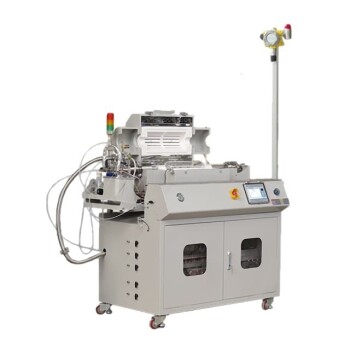
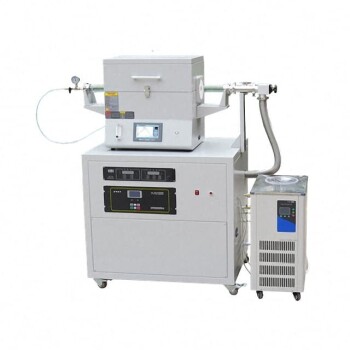
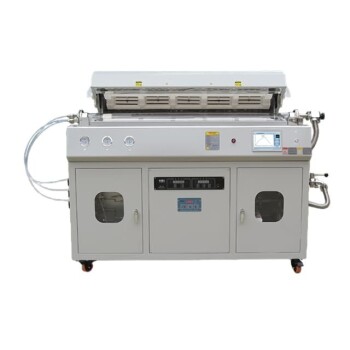
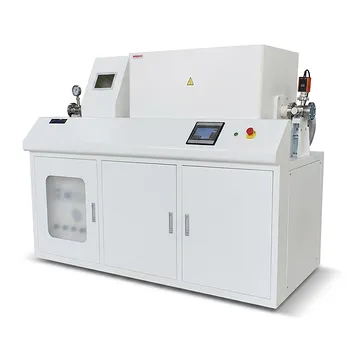
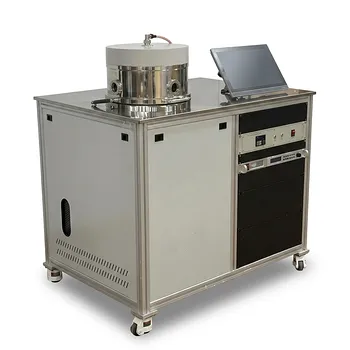
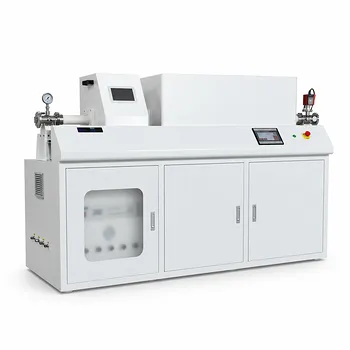
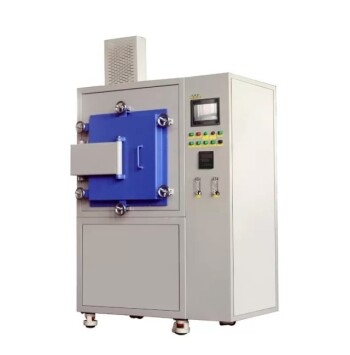
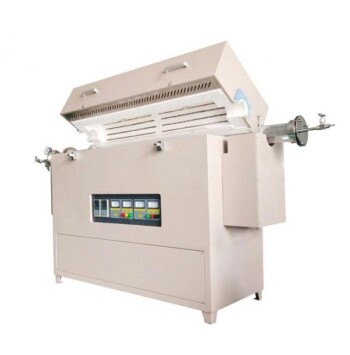
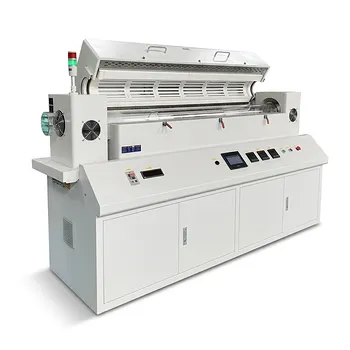
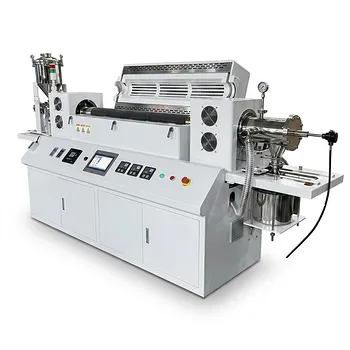
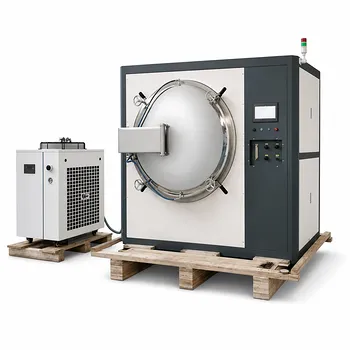
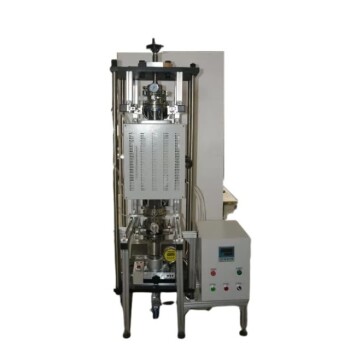
The core function of a CVD furnace system is to act as a precision-engineered chemical reactor. It provides the meticulously controlled high-temperature and low-pressure environment where gaseous precursors transform into high-performance solid ceramics. For ceramic matrix composites (CMCs), this means infiltrating fiber preforms to create a dense matrix; for diamond-like carbon (DLC) coatings, it means depositing a hard, wear-resistant film directly onto a substrate.
Understanding a CVD furnace’s role requires seeing it not as a simple oven, but as a platform for orchestrating gas-phase chemistry at the atomic level. Its true value lies in controlling the fundamental battle between deposition rate, film quality, and uniformity, which determines the final material's performance and survival in extreme environments.
The Furnace as a Precision Synthesis Environment
The primary reference defines the CVD furnace’s role by its operating window: a sealed system maintaining 600 °C to 1000 °C. This heat provides the activation energy for gaseous precursors like SiCl4/CH4 or CH3SiCl3 to react and form solid silicon carbide (SiC).
Without this controlled environment, the volatile precursors would either not react or would form incomplete, contaminated deposits. The furnace ensures the reaction pathway proceeds to completion, yielding a dense, thermally stable ceramic layer.
Mastering the Parameters for Atomic Control
The furnace is the instrument that plays the symphony of process parameters. Its integrated systems regulate the three critical variables: gas flow, pressure, and thermal profile.
Tight regulation of gas flow ensures the correct stoichiometric ratio of reactants reaches the substrate at a controlled rate. Pressure control, often in a vacuum regime, dictates the mean free path of gas molecules, which is the key to infiltrating tight spaces or coating complex shapes uniformly.
The Distinction Between CVD and CVI
A specialized sub-role emerges in the creation of ceramic matrix composites. The supplementary references highlight a process called Chemical Vapor Infiltration (CVI) .
In this mode, the furnace’s job shifts from coating a surface to infiltrating a porous fiber preform. The same gaseous precursors diffuse deep into the network of fibers, decomposing and slowly building the matrix material from the inside out, fiber by fiber.
Synthesizing Ceramic Matrix Composites (CMCs)
For CMCs, the furnace is the foundational tool for converting a fragile fiber skeleton into a tough, load-bearing structure. The primary reference explicitly states the precursors react to "infiltrate porous fiber preforms" to form the SiC matrix.
The supplementary references expand this role to include depositing functional interphases like pyrolytic carbon or boron nitride. These thin coatings on the fibers are what give CMCs their non-brittle, damage-tolerant behavior by deflecting cracks.
The Critical Role of the Interphase
Precise thermal and gas control is non-negotiable when applying these interphase layers. They fill micro-cracks and reduce stress concentrations on the fiber surface.
A poorly applied interphase, resulting from a temperature fluctuation or incorrect gas ratio in the furnace, will lead to a brittle composite. The furnace system’s role is therefore directly linked to enabling the composite’s core design philosophy: crack deflection and graceful failure.
Engineering Diamond-Like Carbon (DLC) Coatings
For DLC coatings, the furnace’s role is to deliver extreme surface performance. The primary reference states the outcome as "dense, wear-resistant, and thermally stable ceramic layers."
These amorphous carbon films, with a mix of diamond-like (sp3) and graphite-like (sp2) bonds, derive their properties directly from the deposition energy. The furnace controls this by managing the decomposition of a hydrocarbon gas and the bombardment of the growing film.
Tuning Hardness and Tribology
A secondary reference discusses controlling parameters like filament and substrate temperature to grow high-quality diamond films. For DLC, a similar principle applies, where the furnace environment directly dictates the sp3-to-sp2 ratio.
By adjusting temperature and gas chemistry, a single furnace system can produce films ranging from soft, lubricious coatings to ultra-hard, scratch-resistant barriers. This tunability is the furnace’s decisive role in fulfilling a wide spectrum of engineering demands.
Understanding the Trade-offs
Process perfection is an unattainable ideal. The furnace operator’s role is to manage inherent conflicts, primarily between speed and quality.
A universally desired property like deep infiltration depth conflicts directly with process time. To prevent the precursor gases from reacting prematurely at the preform’s surface and sealing off the interior—a failure known as "canning"—the CVI process must be run at very low pressures and temperatures. This forces a trade-off: a perfectly uniform matrix that can take weeks or months to complete, dramatically impacting manufacturing cost and throughput.
The Challenge of Uniformity and Stress
Achieving uniform deposition on a complex, three-dimensional substrate is a major pitfall. Thermal gradients within the furnace can cause variations in coating thickness and composition.
Furthermore, a mismatch in the coefficient of thermal expansion between the deposited DLC film and a metal substrate can cause catastrophic delamination upon cooling. The furnace’s role extends to managing this cooling ramp-down phase to mitigate stress.
Making the Right Choice for Your Goal
The path to successful synthesis is not defined by a single set of "best" parameters but by the performance priorities of the final application.
- If your primary focus is maximizing composite toughness: Prioritize the CVI process regime that allows for slow, uniform deposition of a compliant interphase like pyrolytic carbon, even at the expense of lengthy process times.
- If your primary focus is achieving the highest wear resistance in a DLC coating: Optimize your furnace parameters for a high sp3 bond fraction, using high ion bombardment energy and carefully managing substrate temperature to prevent graphitization.
- If your primary focus is minimizing cost and maximizing throughput: Target the fastest workable deposition rate that still yields an acceptable, rather than perfect, level of uniformity and matrix density.
The CVD furnace system is not just a tool but the primary architect of a material's final identity, translating precise environmental control into enduring performance.
Summary Table:
| Application / Feature | Ceramic Matrix Composites (CMCs / CVI) | Diamond-Like Carbon (DLC) Coatings |
|---|---|---|
| Deposition Mode | Chemical Vapor Infiltration (CVI) | Surface Chemical Vapor Deposition (CVD) |
| Core Function | Infiltrates porous fiber preforms & builds interphases | Deposits dense, wear-resistant carbon film on substrate |
| Critical Variables | Low pressure, gas stoichiometry, 600–1000 °C temp | Ion bombardment energy, substrate temp, sp³/sp² ratio |
| Primary Objective | High fracture toughness & non-brittle matrix failure | Extreme hardness, low friction & scratch resistance |
Elevate Your Advanced Material Synthesis with KINTEK
Achieving flawless coating uniformity, precise interphase deposition, and dense matrix infiltration requires uncompromised thermal and atmospheric control. At KINTEK, we specialize in cutting-edge laboratory equipment and fully customizable high-temperature furnace systems—including advanced CVD, vacuum, tube, muffle, atmosphere, and rotary furnaces designed to meet the rigorous demands of material scientists and manufacturers.
Whether you are engineering next-generation ceramic matrix composites or ultra-hard DLC films, our technical experts are ready to tailor the ideal system for your research needs.
👉 Contact KINTEK today to discuss your custom CVD furnace solution!
Related Products
- Custom Made Versatile CVD Tube Furnace Chemical Vapor Deposition CVD Equipment Machine
- Split Chamber CVD Tube Furnace with Vacuum Station CVD Machine
- Multi Heating Zones CVD Tube Furnace Machine for Chemical Vapor Deposition Equipment
- Slide PECVD Tube Furnace with Liquid Gasifier PECVD Machine
- Inclined Rotary Plasma Enhanced Chemical Deposition PECVD Tube Furnace Machine
People Also Ask
- What is a CVD tube furnace and what is its primary function? Discover Precision Thin-Film Deposition
- Why are CVD tube furnace sintering systems indispensable for 2D material research and production? Unlock Atomic-Scale Precision
- Which industries and research fields benefit from CVD tube furnace sintering systems for 2D materials? Unlock Next-Gen Tech Innovations
- How does CVD tube furnace sintering enhance graphene growth? Achieve Superior Crystallinity and High Electron Mobility
- What are the key features of CVD tube furnaces for 2D material processing? Unlock Precision Synthesis for Superior Materials