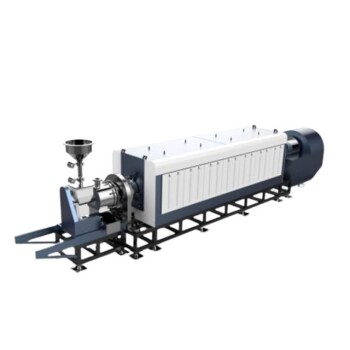
At their core, rotary tube furnaces are used for thermal processes where continuous mixing is essential for a uniform result. They excel at applications like calcination for thermal decomposition, oxidation and reduction for chemical modification, and sintering for densifying powdered materials, making them indispensable in materials science, metallurgy, and chemical production.
The defining advantage of a rotary tube furnace is its ability to combine precise high-temperature control with continuous, gentle tumbling. This unique pairing ensures that every particle of a granular or powdered material is treated uniformly, leading to superior consistency and process efficiency compared to static furnace designs.
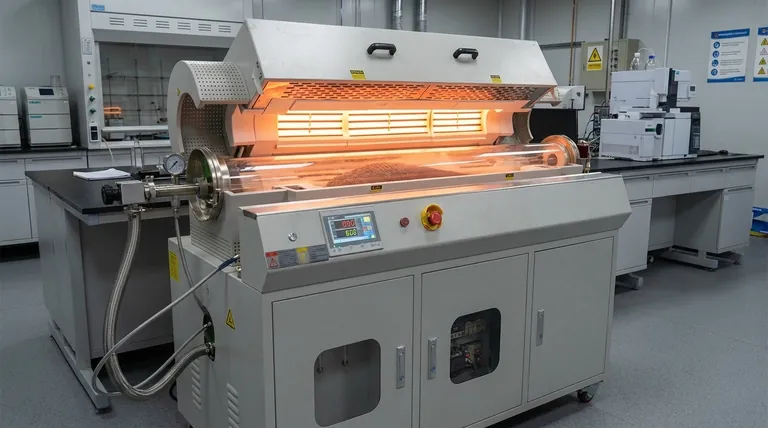
Foundational Thermal Processes
Rotary tube furnaces are engineered to execute fundamental material transformations that rely on the interplay of heat, atmosphere, and physical agitation.
Calcination and Thermal Decomposition
Calcination is a high-temperature process used to remove volatile components or trigger phase transformations in a material. The rotation ensures even heating, preventing localized overheating.
This is critical for producing materials like cement clinker from limestone or converting precursors into stable oxides.
Oxidation and Roasting
These processes involve heating a material in the presence of an oxidizing gas, typically air. The goal is to induce a chemical change, such as converting a sulfide ore to an oxide during roasting.
The furnace's rotation constantly exposes new material surfaces to the process gas, dramatically increasing reaction efficiency.
Gaseous Reduction of Ores
This is the chemical opposite of oxidation, where a reducing gas (like hydrogen or carbon monoxide) is used to remove oxygen from metal oxides.
This is a cornerstone of modern metallurgy for producing materials like iron ore pellets by reducing iron oxide to metallic iron without melting it.
Sintering and Densification
Sintering involves heating a powder below its melting point to cause the particles to fuse together. This increases the material's density, strength, and integrity.
The gentle tumbling action in a rotary furnace helps create denser, more uniform pellets and granules compared to static sintering methods.
Advanced Material Synthesis & Modification
Beyond basic processing, these furnaces are crucial tools for creating advanced materials with highly specific properties.
Catalyst and Pigment Manufacturing
The performance of catalysts and pigments often depends on their specific surface area and crystal structure.
Rotary tube furnaces provide the uniform heating and gas-solid interaction needed to synthesize these materials with consistent quality, ensuring every batch meets precise specifications.
Doping of Ceramics and Powders
Doping involves introducing trace amounts of impurities into a material to alter its properties, such as conductivity or optical behavior.
The continuous mixing ensures that dopants are distributed evenly throughout the host material, which is essential for manufacturing high-performance ceramics and electronic materials.
Understanding the Trade-offs
While powerful, the unique design of a rotary tube furnace introduces specific considerations that make it unsuitable for certain tasks.
Not for Single, Large Objects
The primary advantage of a rotary furnace is mixing loose materials. It is fundamentally unsuited for heat-treating a single, large, or solid component. For that, a static box furnace is the appropriate tool.
Potential for Particle Attrition
The tumbling motion, while gentle, can cause abrasion and breakdown (attrition) of very delicate or brittle materials. This must be evaluated for your specific sample.
Mechanical and Sealing Complexity
Compared to a simple box furnace, the rotating tube, seals, and drive mechanism add mechanical complexity. Achieving a perfectly sealed, controlled atmosphere can also be more challenging than in a static tube furnace.
Is a Rotary Tube Furnace Right for Your Goal?
To make the right choice, you must align the furnace's core capability—uniform processing of loose materials—with your primary objective.
- If your primary focus is high-volume, continuous production of bulk materials: A rotary furnace is ideal for industrial processes like manufacturing cement, alumina, or iron ore pellets.
- If your primary focus is achieving maximum batch uniformity for powders: A rotary furnace is the superior choice for R&D or production of catalysts, doped ceramics, and other advanced materials where every particle must be identical.
- If your primary focus is processing large solid parts or a small static sample: A box furnace or a standard (non-rotating) tube furnace is a simpler, more effective, and more economical solution.
Ultimately, your decision hinges on whether the uniform treatment provided by continuous motion is essential to achieving your desired material properties.
Summary Table:
| Process | Key Applications | Benefits |
|---|---|---|
| Calcination | Cement clinker production, oxide conversion | Even heating, prevents localized overheating |
| Oxidation/Roasting | Sulfide ore to oxide conversion | Increased reaction efficiency with gas exposure |
| Reduction | Iron ore pellet production | Efficient oxygen removal with reducing gases |
| Sintering | Powder densification for ceramics, metals | Denser, uniform pellets and granules |
| Catalyst/Pigment Manufacturing | Synthesis of consistent quality materials | Uniform heating and gas-solid interaction |
| Doping | Ceramics and electronic materials | Even distribution of impurities for property alteration |
Ready to enhance your material processing with precision and uniformity? At KINTEK, we leverage exceptional R&D and in-house manufacturing to provide advanced high-temperature furnace solutions tailored to your needs. Our product line, including Rotary Furnaces, Muffle Furnaces, Tube Furnaces, Vacuum & Atmosphere Furnaces, and CVD/PECVD Systems, is complemented by strong deep customization capabilities to precisely meet unique experimental requirements. Whether you're in materials science, metallurgy, or chemical production, contact us today to discuss how our solutions can optimize your processes and deliver superior results. Get in touch now!
Visual Guide

Related Products
- Vacuum Sealed Continuous Working Rotary Tube Furnace Rotating Tube Furnace
- Laboratory Vacuum Tilt Rotary Tube Furnace Rotating Tube Furnace
- Split Multi Heating Zone Rotary Tube Furnace Rotating Tube Furnace
- Inclined Rotary Plasma Enhanced Chemical Deposition PECVD Tube Furnace Machine
- Inclined Rotary Plasma Enhanced Chemical Deposition PECVD Tube Furnace Machine
People Also Ask
- What is the purpose of rotary tube furnaces? Achieve Uniform Heat Treatment for Powders and Granules
- What are the key advantages of using a rotary tube furnace? Achieve Dynamic, Uniform Heating for Powders
- How does the amount of material processed vary between batch and continuous rotary tube furnaces? Scale Your Production Efficiently
- What are the advantages of rotary tube furnaces in fuel compatibility? Boost Efficiency and Cut Costs
- What is the temperature range of some rotary tube furnaces? Achieve Uniform Heating Up to 1200°C