
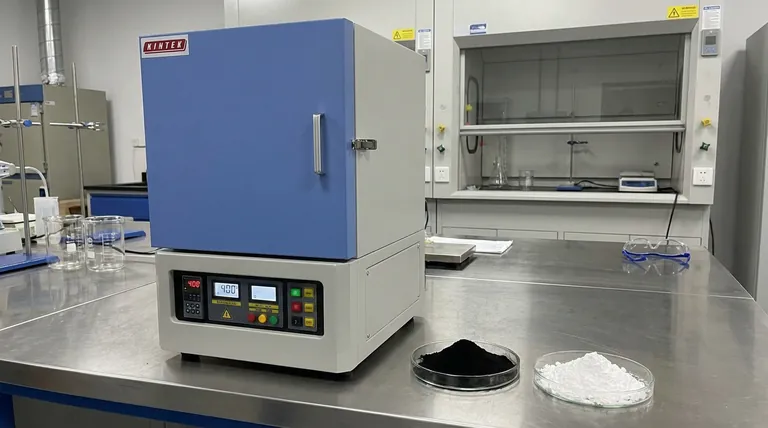
The primary role of a laboratory muffle furnace in this context is to create a stable, high-temperature oxidative environment used to verify material composition. Specifically, by maintaining a temperature of approximately 400°C in an air atmosphere, the furnace enables oxygen-deficient black indium oxide particles to recombine with environmental oxygen. This facilitates a transition back to a stoichiometric white indium oxide state.
Core Takeaway This process serves fundamentally as a comparative experiment for structural verification. By successfully reverting the material to white indium oxide through oxidation, the furnace confirms that the initial black coloration is caused by oxygen vacancies, rather than by carbonization impurities or particle size effects.
The Mechanism of Oxidative Annealing
Restoring Stoichiometry
The muffle furnace provides the thermal energy required to overcome the activation barrier for oxidation. Black indium oxide is inherently unstable and rich in oxygen vacancies. By exposing these particles to a consistent 400°C environment, the furnace drives a reaction where the lattice defects absorb oxygen from the surrounding air, effectively "healing" the vacancies.
The Color Change Indicator
The transition within the furnace produces a distinct visual marker. The shift from black to white is the direct result of the material returning to its stoichiometric form (In₂O₃). This color change is the primary data point indicating that the electronic structure of the material has normalized.
Validating Material Properties
Ruling Out Carbonization
A critical function of this experiment is to distinguish between lattice defects and impurities. If the black color were due to carbon contamination (carbonization), the thermal treatment might incinerate the carbon, but the underlying oxide mechanics would differ. The specific reversion to white indium oxide proves the starting material was chemically pure but structurally deficient.
Differentiating from Size Effects
Materials often change color based on nanoparticle size (quantum confinement). However, this annealing process specifically targets chemical composition. By altering the oxygen content rather than the particle size, the furnace confirms that oxygen vacancies are the dominant factor regarding the material's optical properties.
Understanding the Trade-offs
Oxidative vs. Inert Atmospheres
It is vital to distinguish this specific application from standard semiconductor annealing. In semiconductor manufacturing, muffle furnaces often operate at much higher temperatures (1000°C) to prevent oxidation and optimize conductivity. In the case of black indium oxide, the goal is the opposite: you are intentionally inducing oxidation to destroy the conductive oxygen vacancies for verification purposes.
Temperature Sensitivity
While 400°C is the target for this verification, deviation can alter results.
- Too Low: The activation energy for oxygen recombination may not be met, resulting in incomplete annealing.
- Too High: Excessive heat can lead to rapid grain growth or sintering (as seen in other nanoparticle synthesis methods), which could permanently alter the morphology of the sample beyond simple oxidation.
Interpreting Your Annealing Results
If your primary focus is Material Verification:
- Ensure the atmosphere is oxygen-rich (standard air) to allow the black-to-white transition to occur; if the material remains black, the coloration is likely due to impurities or permanent structural features.
If your primary focus is Conductivity Preservation:
- Avoid this oxidative annealing process entirely, as refilling the oxygen vacancies will return the material to a semi-insulating or standard semiconductor state, reducing the high conductivity associated with the black variant.
If your primary focus is Structural Analysis:
- Use the furnace to isolate variables; if the optical properties change without significant change to particle size, you have confirmed the role of lattice defects over geometry.
The muffle furnace acts as a definitive diagnostic tool, using heat and oxygen to differentiate between transient electronic defects and permanent material characteristics.
Summary Table:
| Feature | Oxidative Annealing Impact |
|---|---|
| Target Temp. | ~400°C |
| Atmosphere | Ambient Air (Oxygen-rich) |
| Visual Result | Color shift from Black to White |
| Key Outcome | Confirms Oxygen Vacancies vs. Impurities |
| Mechanism | Lattice defect healing via stoichiometric restoration |
Elevate Your Material Research with KINTEK
Precise control over thermal environments is the difference between a failed experiment and a breakthrough discovery. Backed by expert R&D and world-class manufacturing, KINTEK offers high-performance Muffle, Tube, Rotary, Vacuum, and CVD systems tailored for advanced laboratory applications. Whether you are performing oxidative annealing to verify lattice defects or sintering high-purity ceramics, our customizable high-temp furnaces provide the thermal stability you need.
Ready to optimize your lab’s heating processes? Contact KINTEK today to discuss your unique needs.
References
- Cameron M. Armstrong, Emil A. Hernández-Pagán. Unraveling the molecular and growth mechanism of colloidal black In<sub>2</sub>O<sub>3−<i>x</i></sub>. DOI: 10.1039/d3nr05035a
This article is also based on technical information from Kintek Furnace Knowledge Base .
Related Products
- Laboratory Muffle Oven Furnace with Bottom Lifting
- 1400℃ Muffle Oven Furnace for Laboratory
- 1800℃ High Temperature Muffle Oven Furnace for Laboratory
- 1700℃ High Temperature Muffle Oven Furnace for Laboratory
- 1200℃ Muffle Oven Furnace for Laboratory
People Also Ask
- Why is a high-temperature laboratory muffle furnace essential for the alkali fusion process in zeolite synthesis?
- Why is a high-temperature muffle furnace required for FeOx-MOx/TiO2? Engineering High-Performance Nanocomposites
- What function does a muffle furnace perform in Ba0.75Ca0.25TiO3 calcination? Ensure Phase Purity & Synthesis
- What is the importance of the calcination process? Master High-Purity Calcium Phosphate Nanopowder Production
- What are the primary functions of a high-temperature laboratory muffle furnace in the preparation of biosorbent materials?



















