Knowledge What is the purpose of using vacuum testing equipment? Achieve 100% Casting Quality via Density Index
Author avatar

Tech Team · Kintek Furnace

Updated 1 day ago

What is the purpose of using vacuum testing equipment? Achieve 100% Casting Quality via Density Index


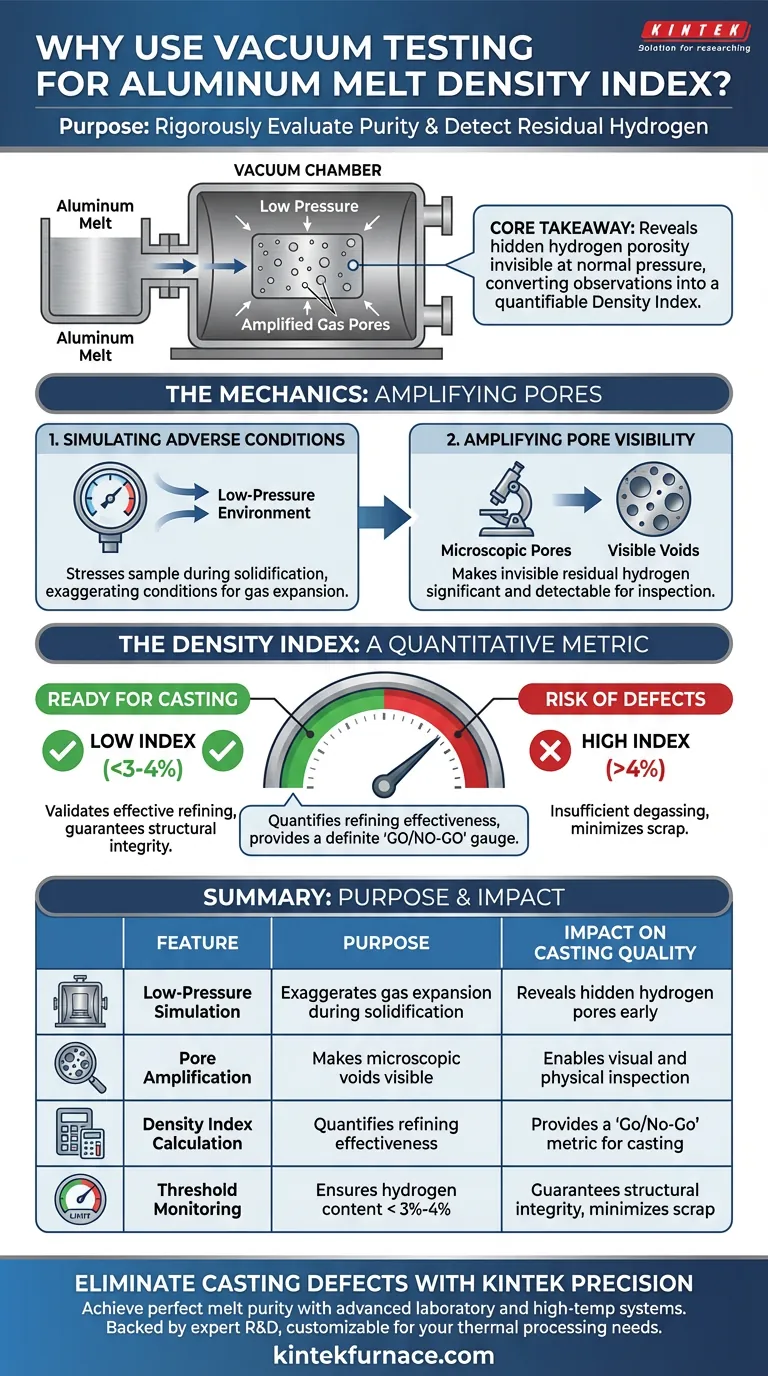
The primary purpose of using vacuum testing equipment is to rigorously evaluate the purity of aluminum melts by detecting the presence of residual hydrogen. By solidifying a sample under a simulated low-pressure environment, the equipment amplifies the formation of gas pores, allowing technicians to calculate a "density index" that quantitatively validates the effectiveness of the refining process.

Core Takeaway Vacuum testing acts as a critical quality control checkpoint, revealing hidden hydrogen porosity that might otherwise go undetected until casting is complete. It transforms subjective observations into a quantifiable density index, ensuring the melt meets specific purity thresholds—typically below 3% to 4%—to guarantee the structural integrity of the final component.

The Mechanics of Melt Evaluation

Simulating Adverse Conditions

Vacuum testing does not merely observe the melt; it actively stresses the sample. The equipment creates a low-pressure environment during the solidification phase of the aluminum sample.

This simulation is designed to exaggerate conditions that favor gas expansion. It forces dissolved gas to precipitate out of the solution earlier and more aggressively than it would under standard atmospheric pressure.

Amplifying Pore Visibility

The core function of this low-pressure simulation is to amplify the appearance of pores. Small amounts of residual hydrogen that might remain invisible or microscopic at normal pressure become significant, visible voids under vacuum.

This amplification makes it possible to visually and physically inspect the sample for internal defects. It converts a potential, invisible risk into an observable physical characteristic.

The Role of the Density Index

Quantifying Refining Effectiveness

The "density index" is the calculated metric derived from this test. It serves as a direct report card on the effectiveness of your refining process.

Rather than guessing if the melt is clean, the density index provides a hard number. If the index is high, the refining or degassing process was insufficient; if low, the melt is ready for casting.

Guarantees for Casting Quality

The ultimate goal of determining the density index is to guarantee casting quality. By establishing a quantitative baseline, you prevent defective metal from entering the mold.

This predictive step minimizes scrap rates and ensures the mechanical properties of the aluminum meet the required specifications.

Understanding the Limits

The Importance of Specific Thresholds

A common pitfall is treating the density index as an arbitrary number rather than a strict limit. The reference highlights that the hydrogen content must be below a specific limit, such as 3% to 4%.

Data without a threshold is useless. The test is only effective if the operator strictly adheres to these pre-defined pass/fail limits.

Simulation vs. Reality

It is important to remember that this test is a simulation of solidification. While it accurately predicts the potential for porosity, it assesses a sample, not the casting itself.

Therefore, the density index should be viewed as a gateway metric. It confirms the potential of the melt to produce a sound casting, provided the downstream casting process is also controlled.

Making the Right Choice for Your Goal

To utilize vacuum testing effectively, align the data with your specific production needs:

  • If your primary focus is Process Validation: Use the density index to immediately verify if your degassing equipment is functioning correctly or if your refining time needs adjustment.
  • If your primary focus is Product Certification: Enforce a strict cutoff (e.g., maximum 3% density index) to ensure every batch meets the mechanical safety standards required for the final application.

By using the density index as a definitive "go/no-go" gauge, you transform casting from a game of chance into a controlled engineering process.

Summary Table:

Feature Purpose Impact on Casting Quality
Low-Pressure Simulation Exaggerates gas expansion during solidification Reveals hidden hydrogen pores early
Pore Amplification Makes microscopic voids visible Enables visual and physical inspection
Density Index calculation Quantifies refining effectiveness Provides a "Go/No-Go" metric for casting
Threshold Monitoring Ensures hydrogen content < 3%-4% Guarantees structural integrity and minimizes scrap

Eliminate Casting Defects with KINTEK Precision

Don't leave your aluminum quality to chance. KINTEK’s advanced laboratory and high-temp systems empower you to achieve perfect melt purity through precise density index monitoring. Backed by expert R&D and manufacturing, we offer customizable Muffle, Tube, Rotary, Vacuum, and CVD systems designed to meet the rigorous demands of your thermal processing.

Ready to optimize your refining process? Contact us today to discover how our specialized equipment can enhance your lab's efficiency and guarantee the integrity of every component you cast.

Visual Guide
What is the purpose of using vacuum testing equipment? Achieve 100% Casting Quality via Density Index Visual Guide

References

  1. Ladislav Socha, Petr Nuska. Assessment of refining efficiency during the refining cycle in a foundry degassing unit in industrial conditions. DOI: 10.1038/s41598-024-51914-x

This article is also based on technical information from Kintek Furnace Knowledge Base .

Related Products

People Also Ask

Related Products

Vacuum Induction Melting Furnace and Arc Melting Furnace

Vacuum Induction Melting Furnace and Arc Melting Furnace

Explore KINTEK's Vacuum Induction Melting Furnace for high-purity metal processing up to 2000℃. Customizable solutions for aerospace, alloys, and more. Contact us today!

Vacuum Hot Press Furnace Machine for Lamination and Heating

Vacuum Hot Press Furnace Machine for Lamination and Heating

KINTEK Vacuum Lamination Press: Precision bonding for wafer, thin-film & LCP applications. 500°C max temp, 20-ton pressure, CE certified. Custom solutions available.

Stainless Steel Quick Release Vacuum Chain Three Section Clamp

Stainless Steel Quick Release Vacuum Chain Three Section Clamp

Stainless steel quick release vacuum clamps ensure leak-free connections for high vacuum systems. Durable, corrosion-resistant, and easy to install.

Ultra High Vacuum Stainless Steel KF ISO CF Flange Pipe Straight Pipe Tee Cross Fitting

Ultra High Vacuum Stainless Steel KF ISO CF Flange Pipe Straight Pipe Tee Cross Fitting

KF/ISO/CF ultra-high vacuum stainless steel flange pipe systems for precision applications. Customizable, durable, and leak-tight. Get expert solutions now!

Ultra Vacuum Electrode Feedthrough Connector Flange Power Lead for High Precision Applications

Ultra Vacuum Electrode Feedthrough Connector Flange Power Lead for High Precision Applications

Ultra-Vacuum Electrode Feedthroughs for reliable UHV connections. High-sealing, customizable flange options, ideal for semiconductor & space applications.

Vacuum Hot Press Furnace Machine Heated Vacuum Press Tube Furnace

Vacuum Hot Press Furnace Machine Heated Vacuum Press Tube Furnace

Discover KINTEK's advanced Vacuum Tube Hot Press Furnace for precise high-temperature sintering, hot pressing, and material bonding. Customizable solutions for labs.

304 316 Stainless Steel High Vacuum Ball Stop Valve for Vacuum Systems

304 316 Stainless Steel High Vacuum Ball Stop Valve for Vacuum Systems

KINTEK's 304/316 stainless steel vacuum ball valves and stop valves ensure high-performance sealing for industrial and scientific applications. Explore durable, corrosion-resistant solutions.

Ultra High Vacuum CF Observation Window Flange with High Borosilicate Glass Sight Glass

Ultra High Vacuum CF Observation Window Flange with High Borosilicate Glass Sight Glass

CF Ultra-High Vacuum Observation Window Flange with high borosilicate glass for precise UHV applications. Durable, clear, and customizable.

Small Vacuum Heat Treat and Tungsten Wire Sintering Furnace

Small Vacuum Heat Treat and Tungsten Wire Sintering Furnace

Compact vacuum tungsten wire sintering furnace for labs. Precise, mobile design with superior vacuum integrity. Ideal for advanced material research. Contact us!

2200 ℃ Tungsten Vacuum Heat Treat and Sintering Furnace

2200 ℃ Tungsten Vacuum Heat Treat and Sintering Furnace

2200°C Tungsten Vacuum Furnace for high-temperature materials processing. Precise control, superior vacuum, customizable solutions. Ideal for research & industrial applications.

Ultra High Vacuum CF Flange Stainless Steel Sapphire Glass Observation Sight Window

Ultra High Vacuum CF Flange Stainless Steel Sapphire Glass Observation Sight Window

CF sapphire viewing window for ultra-high vacuum systems. Durable, clear, and precise for semiconductor and aerospace applications. Explore specs now!

600T Vacuum Induction Hot Press Vacuum Heat Treat and Sintering Furnace

600T Vacuum Induction Hot Press Vacuum Heat Treat and Sintering Furnace

600T Vacuum Induction Hot Press Furnace for precise sintering. Advanced 600T pressure, 2200°C heating, vacuum/atmosphere control. Ideal for research & production.

Vacuum Heat Treat Sintering Furnace with Pressure for Vacuum Sintering

Vacuum Heat Treat Sintering Furnace with Pressure for Vacuum Sintering

KINTEK's Vacuum Pressure Sintering Furnace offers 2100℃ precision for ceramics, metals, and composites. Customizable, high-performance, and contamination-free. Get a quote now!

Ultra High Vacuum Observation Window KF Flange 304 Stainless Steel High Borosilicate Glass Sight Glass

Ultra High Vacuum Observation Window KF Flange 304 Stainless Steel High Borosilicate Glass Sight Glass

KF Ultra-High Vacuum Observation Window with borosilicate glass for clear viewing in demanding vacuum environments. Durable 304 stainless steel flange ensures reliable sealing.

Ultra High Vacuum Observation Window Stainless Steel Flange Sapphire Glass Sight Glass for KF

Ultra High Vacuum Observation Window Stainless Steel Flange Sapphire Glass Sight Glass for KF

KF flange observation window with sapphire glass for ultra-high vacuum. Durable 304 stainless steel, 350℃ max temperature. Ideal for semiconductor and aerospace.

2200 ℃ Graphite Vacuum Heat Treat Furnace

2200 ℃ Graphite Vacuum Heat Treat Furnace

2200℃ Graphite Vacuum Furnace for high-temperature sintering. Precise PID control, 6*10⁻³Pa vacuum, durable graphite heating. Ideal for research & production.

Vacuum Heat Treat Sintering Furnace Molybdenum Wire Vacuum Sintering Furnace

Vacuum Heat Treat Sintering Furnace Molybdenum Wire Vacuum Sintering Furnace

KINTEK's Vacuum Molybdenum Wire Sintering Furnace excels in high-temperature, high-vacuum processes for sintering, annealing, and material research. Achieve precise 1700°C heating with uniform results. Custom solutions available.

Vacuum Heat Treat Sintering and Brazing Furnace

Vacuum Heat Treat Sintering and Brazing Furnace

KINTEK Vacuum Brazing Furnaces deliver precision, clean joints with superior temperature control. Customizable for diverse metals, ideal for aerospace, medical, and thermal applications. Get a quote!

Magnesium Extraction and Purification Condensing Tube Furnace

Magnesium Extraction and Purification Condensing Tube Furnace

Magnesium purification tube furnace for high-purity metal production. Achieve ≤10Pa vacuum, dual-zone heating. Ideal for aerospace, electronics, and lab research.

Dental Porcelain Zirconia Sintering Ceramic Vacuum Press Furnace

Dental Porcelain Zirconia Sintering Ceramic Vacuum Press Furnace

Precision Vacuum Press Furnace for labs: ±1°C accuracy, 1200°C max, customizable solutions. Boost research efficiency today!


Leave Your Message
