
A high-temperature muffle furnace serves as the precise instrument for revealing the internal microstructure of ceramic materials. Specifically, after the sintering process is complete, this furnace is used to heat polished ceramic samples to a temperature slightly below their original sintering point. This controlled heating process facilitates atomic migration on the surface, causing grain boundaries to recede and become distinct enough for analysis.
The Core Takeaway Thermal etching is a necessary pretreatment step for visualizing ceramic grain structures. By utilizing the stable thermal field of a muffle furnace to induce thermal grooving at grain boundaries, you make the material's microstructure visible for Scanning Electron Microscopy (SEM) without the use of chemical etchants.
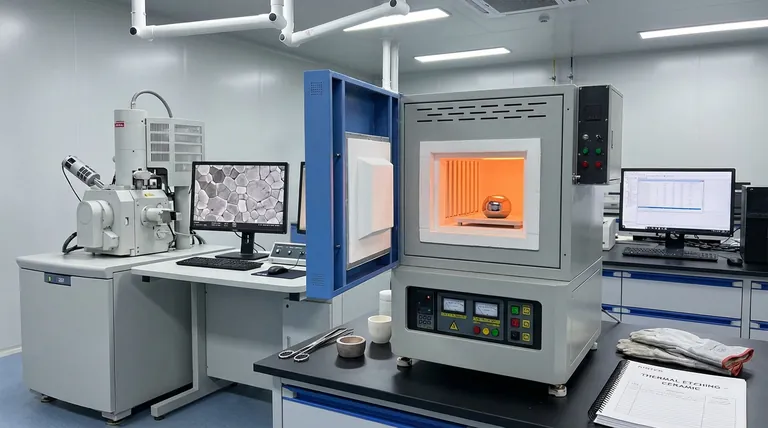
The Mechanism of Thermal Etching
Inducing Atomic Migration
The primary function of the furnace in this context is to create a high-energy environment that allows for controlled atomic migration.
When the polished ceramic sample is heated, atoms on the surface gain enough energy to move. This mobility is essential for altering the surface topography without melting the material.
Grain Boundary Recession
The goal of this migration is to change the energy state at the grain boundaries.
Because atoms at the boundaries possess higher energy than those within the grains, the heat causes these boundaries to thermally groove or "recede." This physical depression creates a topographic contrast between the grains and the boundaries.
The Role of the Muffle Furnace
Precision Temperature Control
The success of thermal etching hinges on hitting a very specific temperature window: slightly below the sintering temperature.
The muffle furnace provides the precise control necessary to reach this state. If the temperature is too low, the etching will not occur; if it is too high, you risk restarting the sintering process and altering the grain size.
A Stable Thermal Field
A high-temperature muffle furnace generates a uniform thermal field, ensuring that the etching process occurs evenly across the entire surface of the sample.
This stability prevents temperature gradients that could lead to uneven etching or thermal shock, ensuring that the visual data collected later is representative of the whole sample.
Enabling Microstructural Analysis
Pretreatment for Microscopy
Thermal etching is effectively a "developer" step for Scanning Electron Microscopy (SEM).
Without this step, a polished ceramic surface often appears featureless under a microscope. The furnace creates the necessary relief structure that allows the SEM to image the grains clearly.
Evaluating Process Impact
Once the boundaries are revealed, engineers can accurately measure grain size distribution.
This data is critical for evaluating how the original sintering process impacted the material's final microstructure. It allows for a direct correlation between the processing parameters and the physical structure of the ceramic.
Understanding the Trade-offs
Risk of Microstructural Coarsening
While the goal is to reveal the structure, there is a risk of altering the structure you are trying to measure.
Because thermal etching requires high temperatures, prolonged exposure or excessive heat can induce further grain growth. This would result in an SEM image that reflects the etched state rather than the original sintered state.
Dependency on Surface Preparation
The muffle furnace cannot correct for poor sample preparation.
The process relies entirely on the sample being perfectly polished beforehand. Thermal etching on a rough surface will simply blend the grain boundaries with existing scratches, rendering the analysis useless.
Making the Right Choice for Your Goal
To ensure the integrity of your material analysis, apply the following guidelines:
- If your primary focus is accurate grain size measurement: Ensure your etching temperature is high enough to induce grooving but low enough (and brief enough) to prevent active grain growth.
- If your primary focus is surface quality analysis: Verify that your sample is polished to a mirror finish before placing it in the muffle furnace, as thermal etching will highlight any residual surface defects.
Ultimately, the muffle furnace acts not just as a heater, but as a precision tool that translates invisible internal structures into visible surface topography.
Summary Table:
| Feature | Thermal Etching Requirement | Role of Muffle Furnace |
|---|---|---|
| Temperature Control | Slightly below sintering point | Ensures precise thermal energy without over-sintering |
| Thermal Stability | Uniform surface grooving | Prevents temperature gradients and uneven etching |
| Microstructure Reveal | Grain boundary recession | Creates topographic contrast for SEM imaging |
| Material Integrity | Minimal grain coarsening | Provides controlled heating cycles to maintain grain size |
Optimize Your Materials Research with KINTEK Precision
Unlock the full potential of your microstructural analysis with high-performance thermal solutions. Backed by expert R&D and manufacturing, KINTEK offers high-temperature Muffle, Tube, Rotary, Vacuum, and CVD systems, all fully customizable for your unique lab requirements.
Whether you are performing precise thermal etching or complex sintering processes, our furnaces provide the stability and control you need to achieve reliable results.
Ready to elevate your ceramic research? Contact us today to find your custom furnace solution.
References
- Siliang Lu, Zhenqiang Chen. Optimal Doping Concentrations of Nd3+ Ions in CYGA Laser Crystals. DOI: 10.3390/cryst14020168
This article is also based on technical information from Kintek Furnace Knowledge Base .
Related Products
- 1700℃ High Temperature Muffle Oven Furnace for Laboratory
- 1800℃ High Temperature Muffle Oven Furnace for Laboratory
- 1200℃ Muffle Oven Furnace for Laboratory
- 1400℃ Muffle Oven Furnace for Laboratory
- High Temperature Muffle Oven Furnace for Laboratory Debinding and Pre Sintering
People Also Ask
- What is the primary function of a high-temperature laboratory muffle furnace in chemical synthesis? Achieve Precision.
- How does a high-temperature laboratory muffle furnace affect material properties? Transform Anodic Oxide Films Fast
- What role does a muffle furnace play in BCZY712 electrolyte powder production? Achieve Perfect Phase Purity
- How does a muffle furnace impact Ni/MgAl2O4 catalysts? Optimize Stability and Catalytic Performance
- How does the two-stage sintering process contribute to the synthesis of MeCuFeO3 perovskite? Optimize crystal purity.



















