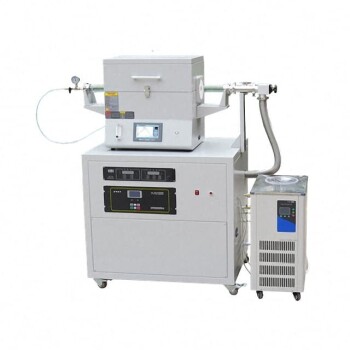
The primary purpose of using vacuum-sealed quartz tubes and high-temperature melting furnaces is to ensure the chemical purity and precise stoichiometric ratio of the Bismuth Telluride (BiTe) alloy. These tools create an isolated, oxygen-free environment that prevents the oxidation of raw materials and the evaporation of volatile elements like Tellurium. This controlled environment, combined with stable heat, is essential for producing high-performance thermoelectric materials.
Vacuum-sealed quartz tubes act as a high-purity containment vessel that isolates volatile materials from oxygen, while melting furnaces provide the stable thermal field required for complete chemical homogenization. Together, they guarantee that the final alloy maintains the exact chemical composition necessary for optimal thermoelectric efficiency.
The Role of Vacuum-Sealed Quartz Tubes
Prevention of Material Oxidation
At the elevated temperatures required for synthesis, elements like Bismuth (Bi), Antimony (Sb), and Tellurium (Te) are highly reactive with oxygen. Using a vacuum-sealed quartz tube creates an anaerobic environment that prevents the formation of oxide layers, which would otherwise degrade the material's electrical and thermal properties.
Retention of Volatile Elements
Tellurium is highly volatile and prone to escaping as a gas during the melting process. The sealed nature of the quartz tube maintains a constant vapor pressure, forcing volatile elements to remain within the melt and ensuring the alloy reaches its precise stoichiometric ratio.
High-Purity Containment
Fused quartz is selected for its high thermal resistance and chemical inertness. It serves as a sterile micro-environment that protects the raw materials from external contamination and prevents reactions with the furnace atmosphere, which is critical for maintaining high-purity levels.
The Function of High-Temperature Melting Furnaces
Providing a Stable Thermal Field
A melting furnace is designed to provide a uniform and stable thermal field throughout the heating cycle. This consistency is vital to prevent localized cooling or overheating, which can lead to structural defects or inconsistent phases within the alloy.
Ensuring Homogeneous Mixing
For a thermoelectric alloy to be effective, its components must be thoroughly mixed at the atomic level. High-temperature furnaces maintain the materials in a molten state long enough for complete diffusion, ensuring the resulting ingot is chemically homogeneous from top to bottom.
Understanding the Trade-offs and Limitations
Mechanical Fragility and Pressure Risks
While quartz is excellent for heat resistance, it is mechanically brittle and susceptible to thermal shock. Furthermore, if the internal vapor pressure of volatile elements exceeds the tube's strength, there is a significant risk of explosive decompression during the heating or cooling phases.
Thermal Lag and Gradient Issues
Even with a stable furnace, the quartz tube creates a thermal barrier that can result in a temperature difference between the furnace sensor and the actual melt. This requires precise calibration to ensure the materials reach the necessary liquidus temperature without overshooting into ranges where the quartz might soften.
How to Optimize Your Synthesis Process
Implementation Advice for Different Goals
- If your primary focus is Maximum Purity: Ensure the quartz tubes are cleaned with high-purity solvents and the vacuum level reaches at least 10^-5 Pa before sealing.
- If your primary focus is Compositional Accuracy: Minimize the "dead space" or head-volume inside the sealed tube to reduce the amount of material that can exist in the vapor phase.
- If your primary focus is Large-Scale Production: Use furnaces with multi-zone heating controls to maintain a uniform temperature profile across multiple tubes simultaneously.
Using these specialized tools correctly allows researchers and manufacturers to bypass atmospheric interference and achieve the high-quality material standards required for modern thermoelectric applications.
Summary Table:
| Tool/Process | Primary Function | Key Benefit for BiTe Alloys |
|---|---|---|
| Vacuum-Sealed Quartz Tube | Prevents oxidation & element evaporation | Ensures precise stoichiometric ratios & purity |
| High-Temp Melting Furnace | Provides stable & uniform thermal field | Achieves complete chemical homogenization |
| Anaerobic Environment | Eliminates oxygen reaction with Bi, Sb, Te | Preserves electrical & thermal properties |
| High-Purity Fused Quartz | Acts as a chemically inert containment | Prevents contamination from the atmosphere |
Elevate Your Material Synthesis with KINTEK Precision
Achieving the perfect stoichiometric ratio for Bismuth Telluride (BiTe) requires more than just heat—it requires a controlled, high-purity environment. KINTEK specializes in high-performance laboratory equipment designed to meet the rigorous demands of thermoelectric material research.
Our comprehensive range of high-temperature furnaces includes:
- Vacuum & Atmosphere Furnaces for oxygen-free synthesis.
- Tube & Muffle Furnaces for stable thermal fields.
- CVD, Rotary, and Induction Melting Furnaces for specialized material processing.
All our equipment is fully customizable to fit your unique laboratory needs, ensuring you achieve the highest purity and homogeneity for your alloys.
Ready to optimize your synthesis process? Contact KINTEK today to consult with our experts and find the ideal high-temperature solution for your lab!
References
- Yuxin Sun, Jiehe Sui. Performance boost for bismuth telluride thermoelectric generator via barrier layer based on low Young’s modulus and particle sliding. DOI: 10.1038/s41467-023-43879-8
This article is also based on technical information from Kintek Furnace Knowledge Base .
Related Products
- 1200℃ Split Tube Furnace Laboratory Quartz Tube Furnace with Quartz Tube
- High Pressure Laboratory Vacuum Tube Furnace
- Vertical Laboratory Quartz Tube Furnace Tubular Furnace
- Vacuum Induction Melting Furnace
- 1700℃ High Temperature Laboratory Tube Furnace with Alumina Tube
People Also Ask
- What is a split tube furnace? Unlock Easy Access for Complex Lab Experiments
- What are the components of a basic tube furnace design capable of withstanding 1200°C? Essential Parts for High-Temp Labs
- What are the primary benefits of using a split tube furnace? Enhance Lab Efficiency with Unmatched Flexibility
- Why is a split tube furnace utilized as the core reaction equipment in coal chemical looping? Simulate Thermal Shock
- What are the key factors affecting temperature control in split tube furnaces? Ensure Precision and Uniformity