
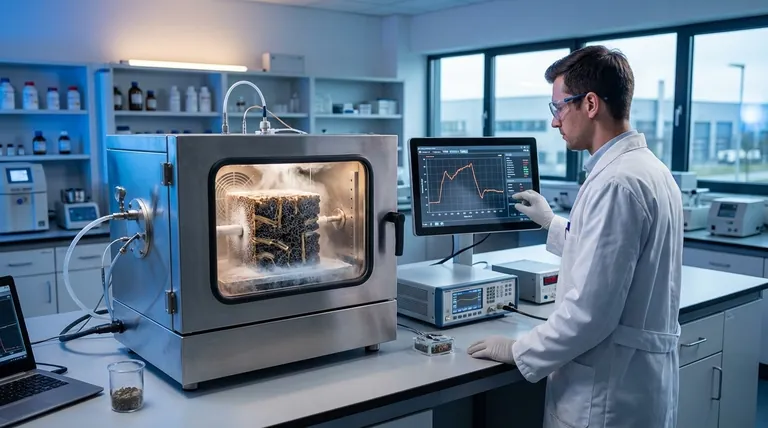
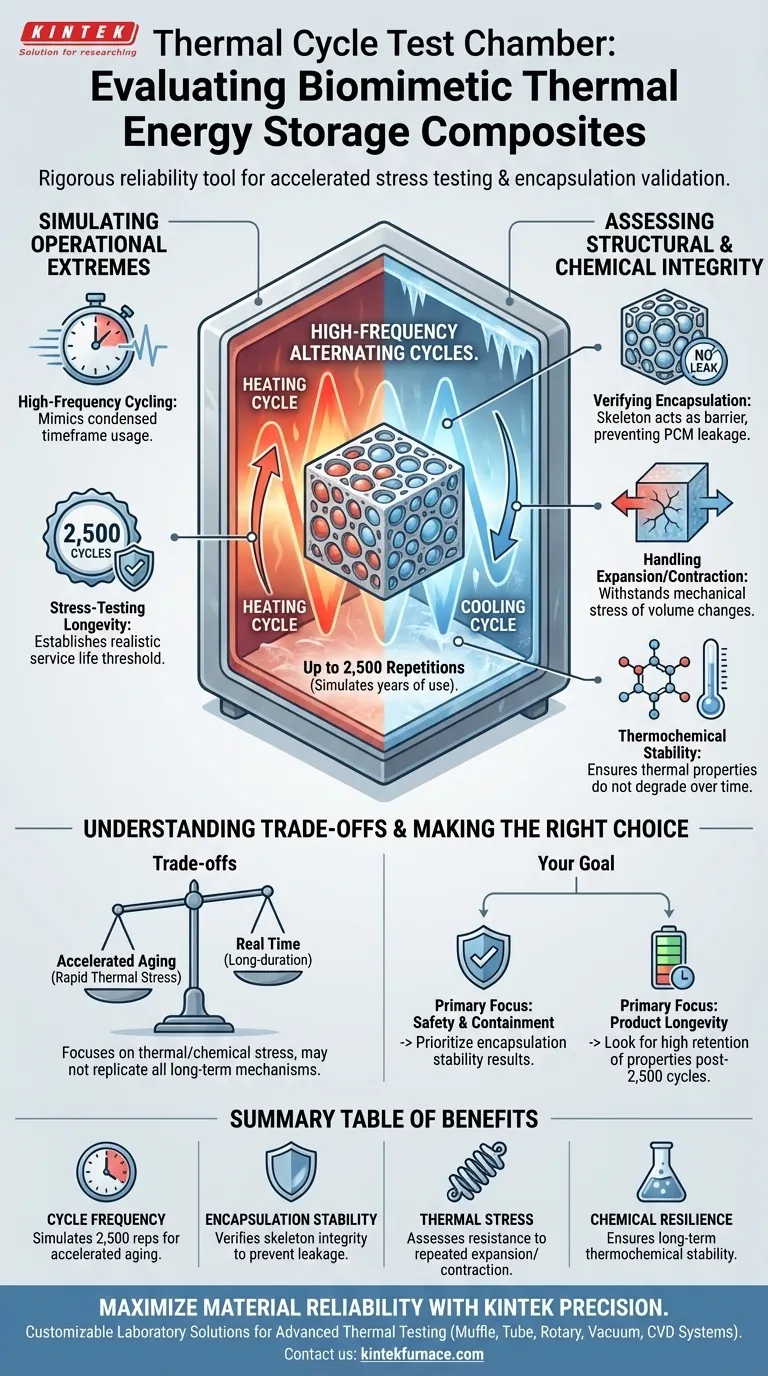
A thermal cycle test chamber functions as a rigourous reliability tool designed to evaluate the durability and performance of biomimetic thermal energy storage composites under accelerated stress. By subjecting these materials to high-frequency alternating heating and cooling cycles—often reaching up to 2,500 repetitions—the chamber simulates extreme working conditions to verify the material's physical and chemical integrity.
The core purpose of this testing is to validate the encapsulation stability of the biomimetic porous skeleton, ensuring it can effectively prevent Phase Change Material (PCM) leakage during repeated thermal expansion and contraction.
Simulating Operational Extremes
High-Frequency Cycling
The test chamber does not merely warm the material; it enforces rapid, alternating cycles of heating and cooling. This high-frequency oscillation is designed to mimic years of usage in a condensed timeframe.
Stress-Testing Longevity
Standard tests often run up to 2,500 cycles. This high volume of repetition is critical for establishing a realistic service life for the material.
If a composite can survive this threshold, it demonstrates the robustness required for real-world energy storage applications.
Assessing Structural and Chemical Integrity
Verifying Encapsulation Capability
The primary mechanical challenge for these composites is keeping the Phase Change Material (PCM) contained.
The test directly reflects the ability of the biomimetic porous skeleton to act as a barrier. It confirms whether the structure can prevent PCM leakage when the material becomes liquid during heat absorption.
Handling Expansion and Contraction
As PCMs cycle between solid and liquid states, they undergo significant volume changes.
The thermal cycle test assesses if the composite skeleton can withstand the mechanical stress of this repeated expansion and contraction without cracking or deforming.
Thermochemical Stability
Beyond physical structure, the test evaluates the chemical resilience of the material.
It ensures that the material's thermal properties do not degrade over time, confirming that the composite remains chemically stable throughout its intended service life.
Understanding the Trade-offs
Accelerated Aging vs. Real Time
While 2,500 cycles provide a strong indicator of lifespan, it is an accelerated simulation.
Rapid cycling stresses the material thermally but may not perfectly replicate low-frequency, long-duration degradation mechanisms found in decades-long applications.
Focus on Thermal Stress
This specific test isolates thermal expansion and chemical stability.
It is highly effective for testing leakage and breakdown, but it does not necessarily account for other external mechanical forces or environmental corrosion unless combined with other testing protocols.
Making the Right Choice for Your Goal
To effectively utilize data from a thermal cycle test, align the results with your specific engineering requirements.
- If your primary focus is Safety and Containment: Prioritize the encapsulation stability results to ensure the porous skeleton prevents all PCM leakage under stress.
- If your primary focus is Product Longevity: Look for high retention of thermochemical properties after the full 2,500-cycle threshold to guarantee a long service life.
By validating the biomimetic structure through rigorous thermal cycling, you ensure the composite will deliver consistent, leak-free performance in demanding energy storage applications.
Summary Table:
| Feature | Testing Benefit |
|---|---|
| Cycle Frequency | Simulates up to 2,500 repetitions for accelerated aging |
| Encapsulation Stability | Verifies porous skeleton integrity to prevent PCM leakage |
| Thermal Stress | Assesses resistance to repeated expansion and contraction |
| Chemical Resilience | Ensures long-term thermochemical stability without degradation |
Maximize Material Reliability with KINTEK Precision
Ensure your biomimetic composites meet the highest standards of durability and thermal efficiency. Backed by expert R&D and manufacturing, KINTEK offers a comprehensive range of customizable laboratory solutions—including Muffle, Tube, Rotary, Vacuum, and CVD systems—tailored to the rigorous demands of advanced thermal testing.
Ready to elevate your research and prevent material failure? Contact KINTEK today to discuss how our high-temperature furnace systems can be customized to your unique energy storage applications.
Visual Guide
References
- Min Yu, Dou Zhang. Review of Bioinspired Composites for Thermal Energy Storage: Preparation, Microstructures and Properties. DOI: 10.3390/jcs9010041
This article is also based on technical information from Kintek Furnace Knowledge Base .
Related Products
People Also Ask
- What role does a Tube Furnace play in the CVD growth of carbon nanotubes? Achieve High-Purity CNT Synthesis
- How does a CVD tube furnace achieve high purity in gate media preparation? Master Precision Control for Flawless Films
- What are the operational and maintenance requirements for a CVD tube furnace? Ensure Precision for Thin Film Deposition
- What are the advantages of using a CVD tube furnace for preparing gate dielectrics? Achieve High-Quality Thin Films for Transistors
- What are the benefits of developing new precursor materials for CVD tube furnaces? Unlock Advanced Thin-Film Synthesis
