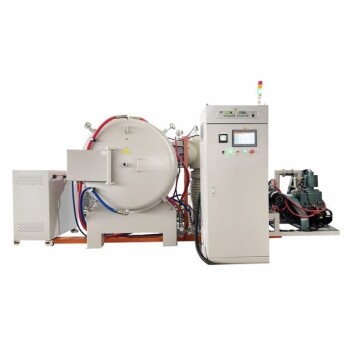
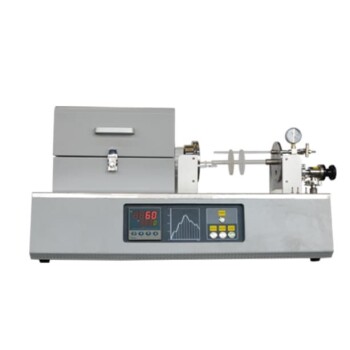
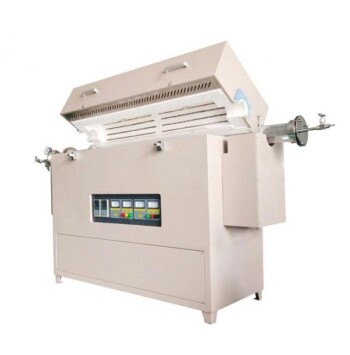
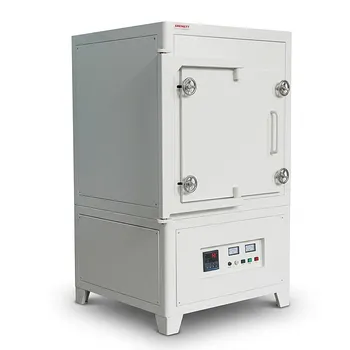
The laboratory high-temperature muffle furnace acts as the primary catalyst for the structural and functional realization of CaSc₂O₄:Er, Nd nanocrystals. It provides the stable thermal energy required to transform amorphous precursor powders into a highly ordered crystalline phase, typically at temperatures around 700 °C. This process is the definitive step for activating rare earth ions and achieving the material's specific upconversion luminescence properties.
The muffle furnace facilitates a critical phase transition from a disordered state to a specific crystalline space group while simultaneously activating doped ions. It is the essential tool for converting chemically synthesized precursors into functional, high-purity optical materials.
Driving Phase Transition and Crystallization
Structural Reorganization to the Pnam Space Group
The furnace provides the high-temperature environment necessary for atoms to rearrange into their most stable configuration. In the case of CaSc₂O₄:Er, Nd, this triggers a transition from amorphous components to the $D_{2h}^{16} Pnam$ space group.
Elimination of Internal Crystal Defects
High thermal energy allows for the "healing" of the lattice by reducing vacancies and dislocations. This reduction in internal defects is crucial for ensuring that energy within the crystal is used for light emission rather than being lost to heat.
Long-Range Atomic Ordering
The furnace maintains a precise temperature gradient that facilitates the long-range ordering of atoms. This ordering ensures that the nanocrystals achieve the structural integrity required for stable performance in demanding optical applications.
Activating Rare Earth Luminescence
Proper Positioning of Er³⁺ and Nd³⁺ Ions
The heat treatment in the muffle furnace ensures that the dopant ions, Erbium (Er³⁺) and Neodymium (Nd³⁺), are correctly integrated into the host lattice sites. If these ions do not reside in the correct positions within the $CaSc_2O_4$ structure, the material will fail to exhibit luminescence.
Facilitating Upconversion Properties
Upconversion—the process of converting low-energy light into high-energy light—requires a highly efficient crystal environment. The furnace creates this environment by optimizing the distance and interaction between the doped rare earth ions.
Removal of Quenching Impurities
High-temperature treatment helps decompose and remove residual organic components or water molecules from the synthesis process. These impurities often "quench" or dampen luminescence, so their removal is vital for high-purity output.
Understanding the Trade-offs
Temperature vs. Particle Size
While higher temperatures improve crystallinity and luminescence, they also drive grain growth. If the temperature exceeds the optimal 700 °C threshold, the nanocrystals may aggregate and grow into larger particles, potentially losing their "nano" characteristics.
Annealing Time and Phase Purity
Short annealing times may lead to incomplete phase transitions, resulting in a mixture of amorphous and crystalline material. Conversely, excessive time in the furnace can lead to lattice strain or unwanted chemical reactions with the atmosphere.
Thermal Uniformity Risks
If the muffle furnace does not provide a uniform thermal field, different parts of the sample will reach different stages of crystallization. This leads to inconsistent batch quality and unpredictable optical performance across the synthesized material.
How to Apply This to Your Project
When utilizing a high-temperature muffle furnace for nanocrystal synthesis, your parameters should align with your specific performance goals.
- If your primary focus is Maximum Luminescence Intensity: Prioritize a stable 700 °C annealing temperature to ensure full activation of Er³⁺ and Nd³⁺ ions and the elimination of quenching defects.
- If your primary focus is Controlling Particle Size: Utilize the lower end of the effective temperature range or shorter dwell times to prevent excessive grain growth and maintain the nanocrystalline structure.
- If your primary focus is Phase Purity: Ensure the furnace is calibrated for high temperature accuracy to strictly achieve the $D_{2h}^{16} Pnam$ space group without forming secondary impurity phases.
The muffle furnace is not merely a heater but a precision instrument that dictates the final atomic architecture and optical utility of your nanocrystals.
Summary Table:
| Function | Key Process | Impact on Nanocrystals |
|---|---|---|
| Phase Transition | Structural reorganization to Pnam | Achieves stable crystalline architecture. |
| Ion Activation | Integrating $Er^{3+}$ and $Nd^{3+}$ ions | Enables upconversion luminescence properties. |
| Lattice Healing | Elimination of internal defects | Minimizes energy loss and maximizes emission. |
| Purification | Removal of quenching impurities | Ensures high-purity, consistent optical output. |
| Growth Control | Precision temperature management | Balances crystallinity with desired nano-size. |
Elevate Your Materials Synthesis with KINTEK Precision
Achieving the perfect crystalline phase for CaSc₂O₄:Er, Nd nanocrystals requires uncompromising thermal accuracy. KINTEK specializes in high-performance laboratory equipment, offering a comprehensive range of high-temperature furnaces—including muffle, tube, rotary, vacuum, CVD, and atmosphere models—all fully customizable to meet your unique research specifications.
Whether you are a researcher aiming for peak luminescence or a laboratory manager seeking consistent batch quality, our furnaces provide the uniform thermal fields necessary for advanced optical materials.
Ready to optimize your synthesis process? Contact our experts today to find the ideal furnace solution for your lab!
References
- Wenhao CUI, Li CHEN. Upconversion Luminescence of CaSc<sub>2</sub>O<sub>4</sub>∶Er, Nd Nanocrystals Under 808 nm/980 nm Near Infrared Excitation. DOI: 10.37188/cjl.20220336
This article is also based on technical information from Kintek Furnace Knowledge Base .
Related Products
- 1800℃ High Temperature Muffle Oven Furnace for Laboratory
- 1700℃ High Temperature Muffle Oven Furnace for Laboratory
- 1400℃ Muffle Oven Furnace for Laboratory
- 1200℃ Muffle Oven Furnace for Laboratory
- Laboratory Muffle Oven Furnace with Bottom Lifting
People Also Ask
- What is the primary function of a high-temperature laboratory muffle furnace in chemical synthesis? Achieve Precision.
- How does a high-temperature laboratory muffle furnace affect material properties? Transform Anodic Oxide Films Fast
- Why is a laboratory high-temperature muffle furnace used for BaTiO3? Achieve Optimal Tetragonal Crystalline Phases
- What functions does a laboratory muffle furnace perform for AISI 1025 steel post-processing? Precision Thermal Control
- What is the critical role of a laboratory high-temperature muffle furnace in TiO2/LDH? Unlock Superior Crystallization