
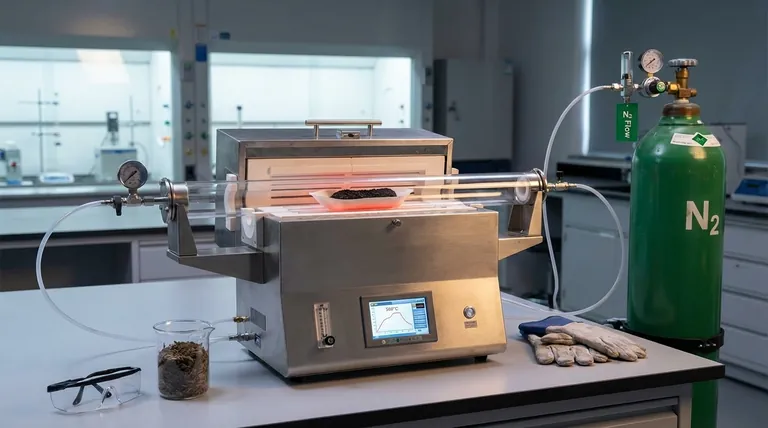
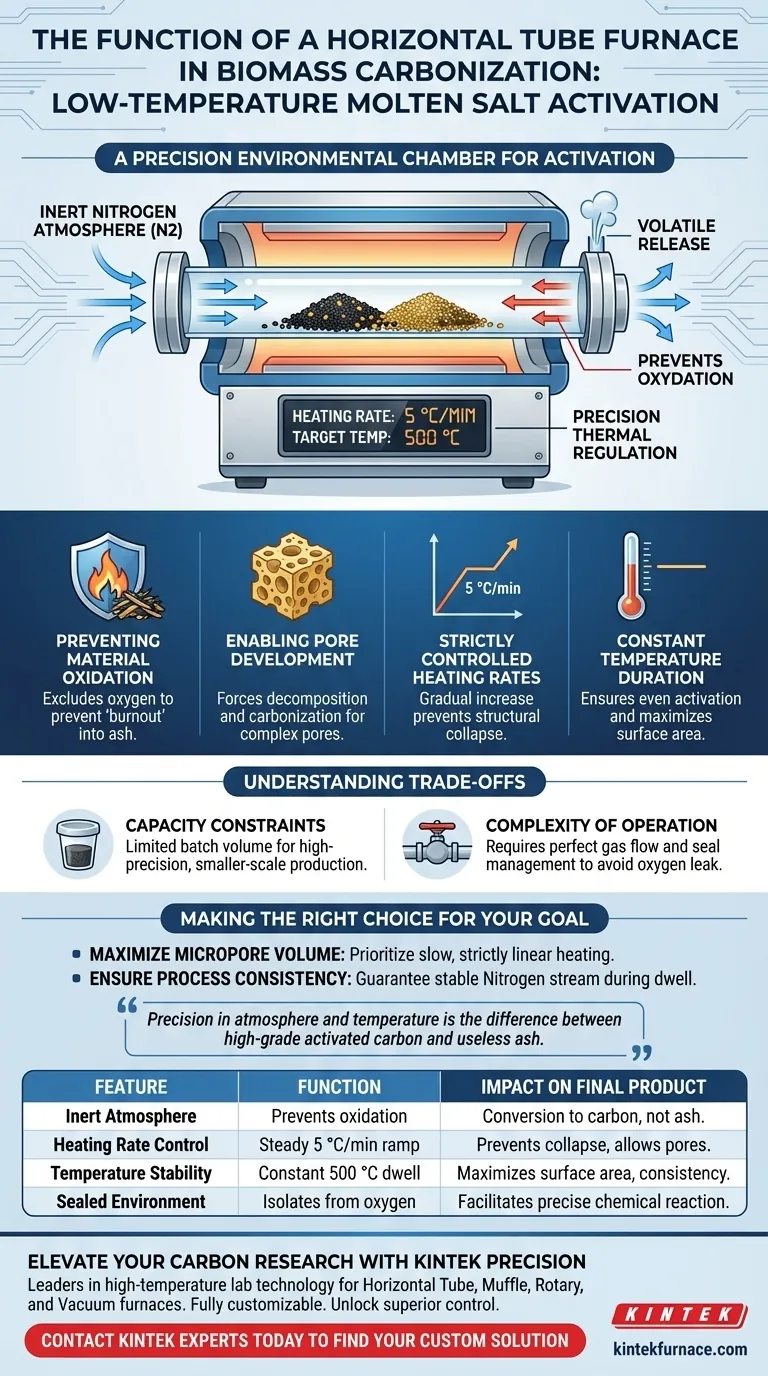
A horizontal tube furnace functions as a precision environmental chamber designed to isolate biomass from oxygen while applying specific thermal profiles. Its primary role in low-temperature molten salt activation is to maintain a stable inert nitrogen atmosphere and regulate heating rates (typically 5 °C per minute), ensuring the biomass converts to porous carbon rather than burning into ash.
Core Takeaway The horizontal tube furnace is not merely a heater; it is a strictly controlled atmosphere system. Its value lies in preventing the oxidation of biochar at elevated temperatures (e.g., 500 °C), forcing the material to develop internal pore structures rather than decomposing completely.
The Critical Role of Atmosphere Control
Preventing Material Oxidation
The most vital function of the furnace is the maintenance of an inert atmosphere, typically utilizing Nitrogen (N2).
At the temperatures required for activation, biomass precursors like chitin are highly reactive to oxygen. Without the sealed environment of the tube furnace, the material would oxidize and suffer "burnout," effectively turning into ash rather than activated carbon.
Enabling Pore Development
By excluding oxygen, the furnace forces the biomass to undergo thermal decomposition and carbonization.
This controlled environment ensures that the chemical reactions occurring between the biomass and the molten salt result in the development of a complex pore structure, rather than surface combustion.
Precision Thermal Regulation
Strictly Controlled Heating Rates
The tube furnace allows for the programming of exact heating ramps, such as a steady 5 °C per minute.
This gradual increase is essential for the activation process. A heating rate that is too fast can cause the structural collapse of the precursor, while a controlled rate allows for the orderly evolution of volatiles and the formation of stable carbon frameworks.
Constant Temperature Duration
Once the target temperature (often around 500 °C for low-temperature processes) is reached, the furnace maintains this heat with high stability.
This constant temperature duration ensures that the activation reaction propagates evenly throughout the material, maximizing the surface area and quality of the final product.
Understanding the Trade-offs
Capacity Constraints
While horizontal tube furnaces offer superior control, they generally have limited sample capacity compared to muffle furnaces or industrial kilns.
The defined geometry of the tube limits the volume of biomass and molten salt mixture you can process in a single batch, making it primarily a tool for high-precision, smaller-scale production or research.
Complexity of Operation
Unlike a standard oven, a tube furnace requires the management of gas flows and seals.
Ensuring the system is perfectly airtight is critical; even a minor leak in the tube flanges can introduce oxygen, compromising the inert atmosphere and ruining the pore structure of the entire batch.
Making the Right Choice for Your Goal
To maximize the utility of a horizontal tube furnace in your activation process, align your settings with your specific objectives:
- If your primary focus is maximizing micropore volume: Prioritize a slow, strictly linear heating rate (e.g., 5 °C/min) to prevent structural collapse during volatile release.
- If your primary focus is process consistency: Ensure your gas flow system provides a continuous, stable stream of Nitrogen to eliminate any partial pressure of oxygen during the dwell time.
Precision in atmosphere and temperature is the difference between high-grade activated carbon and useless ash.
Summary Table:
| Feature | Function in Carbonization | Impact on Final Product |
|---|---|---|
| Inert Atmosphere | Prevents biomass oxidation and burnout | Ensures conversion to carbon rather than ash |
| Heating Rate Control | Steady 5 °C/min ramp-up | Prevents structural collapse; allows pore formation |
| Temperature Stability | Maintains constant 500 °C dwell | Maximizes surface area and activation consistency |
| Sealed Environment | Isolate materials from oxygen | Facilitates precise chemical reaction with salts |
Elevate Your Carbon Research with KINTEK Precision
Unlock superior control over your material activation with KINTEK. As leaders in high-temperature lab technology, we provide expert R&D and manufacturing for Horizontal Tube, Muffle, Rotary, and Vacuum furnaces, all fully customizable to your specific research parameters. Whether you are maximizing micropore volume or ensuring process consistency, our systems deliver the stable inert atmospheres and precise thermal profiles your biomass precursors require.
Ready to transform your carbonization process? Contact KINTEK experts today to find your custom solution
Visual Guide
References
- Pu Yang, Feng Jiang. Phase Diagram‐Guided Molten Salt Engineering of Biocarbon Pores at Low Temperatures. DOI: 10.1002/smll.202501162
This article is also based on technical information from Kintek Furnace Knowledge Base .
Related Products
- Vertical Laboratory Quartz Tube Furnace Tubular Furnace
- 1700℃ High Temperature Laboratory Tube Furnace with Alumina Tube
- Vacuum Sealed Continuous Working Rotary Tube Furnace Rotating Tube Furnace
- Split Multi Heating Zone Rotary Tube Furnace Rotating Tube Furnace
- Laboratory Vacuum Tilt Rotary Tube Furnace Rotating Tube Furnace
People Also Ask
- What are the key differences between single-zone and multi-zone vertical tube furnaces? Choose the Right Furnace for Your Lab
- What is a vertical tube furnace and how does it function? Optimize Material Processing with Precision
- How are wafers loaded and unloaded in a vertical tube furnace? Achieve Precision and Purity in Wafer Processing
- What physical conditions does a vertical tube furnace provide for desulfurization experiments? Precision Heat Control
- How do heat treatment processes influence the configuration of a vertical tube furnace? Optimize for Quenching, Annealing, and More



















