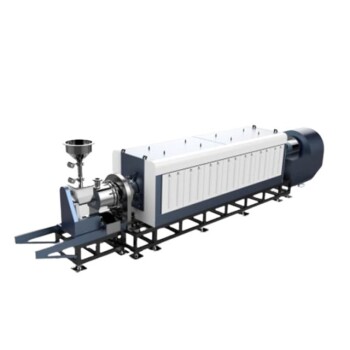
The high-temperature muffle furnace is the primary engine of thermal conversion in woody biomass pyrolysis. It provides the precisely controlled, oxygen-limited environment necessary to trigger thermal degradation without combustion. By managing heat application, the furnace facilitates the removal of volatile components and transforms raw organic matter into stable, high-porosity carbon materials.
The muffle furnace acts as a specialized reactor that dictates the physical and chemical properties of the resulting biochar. Through rigorous control of heating rates and residence times, it ensures the complete carbonization of biomass while optimizing the internal pore structure for industrial or environmental applications.
Precise Thermal Management
Controlling the Heating Rate
The muffle furnace allows researchers to set specific heating rates, such as 10 °C per minute, to ensure uniform thermal distribution. This gradual increase prevents the sudden release of gases that could damage the delicate internal structure of the biomass.
Consistent heating is critical for achieving a predictable and repeatable carbonization process across different batches.
Maintaining Peak Pyrolysis Temperatures
The furnace maintains a constant final temperature, typically ranging from 400 °C to 800 °C, depending on the desired end-product. This stable thermal environment ensures that the biomass reaches the necessary energy threshold for complete chemical transformation.
At these temperatures, the furnace provides the "soak time" required for the material to achieve structural equilibrium.
Chemical and Structural Transformation
Facilitating Volatile Removal
A primary function of the furnace is to drive the removal of volatile components from the raw woody biomass. By providing intense, localized heat, the furnace breaks down complex organic molecules into gases and vapors, which are then expelled.
This process leaves behind a concentrated carbon skeleton, significantly increasing the fixed carbon content of the material.
Development of Porous Architecture
The precise control offered by a muffle furnace is essential for creating high-porosity materials, with some biomass reaching porosity levels of 81.08%. As volatiles escape, they leave behind a network of micro and macro-pores.
This developed pore structure and increased surface roughness are what make the resulting biochar effective for adsorption and chemical enhancement.
Environmental Control and Reaction Dynamics
Establishing Oxygen-Limited Conditions
Pyrolysis requires an environment that is either oxygen-deficient or completely oxygen-free to prevent the biomass from catching fire and turning to ash. The muffle furnace, often used in conjunction with sealed crucibles or nitrogen gas flow, provides this isolation.
This controlled atmosphere ensures that the thermal energy leads to carbonization rather than combustion.
Inducing Molecular Degradation
The furnace provides the thermal energy required for specific chemical reactions, including dehydration, decarboxylation, and decarbonylation. These reactions break down the lignocellulosic structures inherent in wood.
The result is a transition from a low-energy-density raw material to a high-energy-density, stable carbon bio-enhancer.
Understanding the Trade-offs
The choice of temperature and heating rate within the furnace involves significant technical trade-offs. Higher temperatures (above 700 °C) typically result in biochar with a higher surface area and more complex pore structures, which is ideal for contaminant adsorption.
However, these high temperatures often lead to a lower total yield, as more material is converted into synthetic gas rather than solid biochar. Conversely, lower temperatures may preserve more mass but result in a less "active" carbon surface with fewer functional pores.
How to Apply This to Your Project
Recommendations for Process Optimization
- If your primary focus is maximizing adsorption capacity: Utilize higher furnace temperatures (near 700°C–800°C) to facilitate the development of a more complex and open microporous structure.
- If your primary focus is high biochar yield: Maintain lower pyrolysis temperatures (around 400°C–500°C) to minimize the loss of mass to the gas phase.
- If your primary focus is structural integrity: Employ a slower heating rate (e.g., 3°C to 10°C per minute) to allow volatiles to escape without fracturing the carbon skeleton.
- If your primary focus is electrical conductivity: Target higher temperatures to promote the formation of graphitized structures within the carbon matrix.
By mastering the thermal environment of the muffle furnace, you can precisely engineer the physical characteristics of biomass-derived carbon to meet specific technical requirements.
Summary Table:
| Furnace Function | Key Operational Detail | Impact on End-Product |
|---|---|---|
| Thermal Conversion | 400°C to 800°C range | Facilitates complete carbonization and structural stability |
| Heating Rate Control | Precise increments (e.g., 10°C/min) | Ensures uniform thermal distribution and prevents structural damage |
| Atmosphere Management | Oxygen-limited/Oxygen-free | Prevents combustion/ashing; induces molecular degradation |
| Volatile Expulsion | High-intensity localized heat | Increases fixed carbon content and develops high porosity (up to 81%) |
| Pore Engineering | Variable residence times | Optimizes internal surface area for adsorption applications |
Precision Thermal Solutions for Advanced Biomass Research
Achieving superior biochar properties requires more than just heat—it demands absolute control. KINTEK specializes in high-performance laboratory equipment, providing researchers and industrial professionals with a comprehensive range of high-temperature furnaces, including muffle, tube, rotary, vacuum, and atmosphere-controlled models.
Whether you are focusing on maximizing biochar yield or engineering complex porous architectures for contaminant adsorption, KINTEK’s furnaces are fully customizable to meet your unique pyrolysis requirements. Our systems ensure the thermal stability and oxygen-limited precision necessary for repeatable, high-quality results.
Ready to optimize your carbonization process? Contact KINTEK today to find the perfect furnace solution!
References
- Fabíola Martins Delatorre, Ananias Francisco Dias Júnior. Photoluminous Response of Biocomposites Produced with Charcoal. DOI: 10.3390/polym15183788
This article is also based on technical information from Kintek Furnace Knowledge Base .
Related Products
- 1700℃ High Temperature Muffle Oven Furnace for Laboratory
- 1800℃ High Temperature Muffle Oven Furnace for Laboratory
- 1200℃ Muffle Oven Furnace for Laboratory
- 1400℃ Muffle Oven Furnace for Laboratory
- High Temperature Muffle Oven Furnace for Laboratory Debinding and Pre Sintering
People Also Ask
- What is the primary function of a high-temperature laboratory muffle furnace in chemical synthesis? Achieve Precision.
- How does a high-temperature laboratory muffle furnace affect material properties? Transform Anodic Oxide Films Fast
- What role does a muffle furnace play in BCZY712 electrolyte powder production? Achieve Perfect Phase Purity
- Why must a high-temperature muffle furnace be used to evaluate the mineral density of tigernut composite flour?
- What role does a muffle furnace play in sintering photocathodes? Enhance Electrode Conductivity & Catalytic Activity