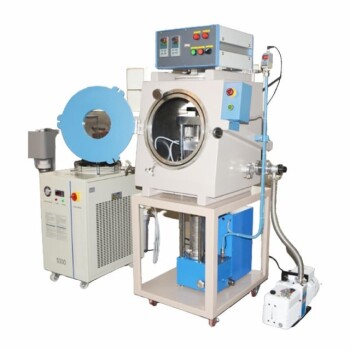
Processing must be conducted at elevated temperatures in a high-vacuum environment, typically while the matrix alloy exists in a semi-solid or just-incipient liquid phase. For aluminum matrices this often means operating between 500°C and 550°C; for reactive systems like titanium aluminide, temperatures range from 800°C to 1200°C. A vacuum level that effectively suppresses oxidation—combined with uniform heating that pushes the matrix past its recrystallization point—dramatically reduces the mechanical shear stresses on the fibers. The result is minimal fiber fracture, preserved aspect ratios, and consistent alignment during compaction.
The core insight is that fiber damage is not primarily a material problem but a mechanics problem. By transforming the matrix into a low-viscosity, semi-solid state under vacuum, deformation resistance collapses, allowing the metal to flow around the fibers rather than crush them. Oxidation control, wetting promotion, and gas desorption are critical enablers of this damage-free flow.
The True Cause of Fiber Damage During Compaction
Why Cold Pressing Destroys Reinforcement
When you compact a powder mixture containing short ceramic fibers at room temperature, the matrix particles act like rigid, abrasive grits. High unit pressures transmit directly through the powder skeleton to the fibers, causing brittle fracture and severe length reduction.
The fiber simply cannot accommodate the imposed strain. Since the matrix cannot plastically flow around the reinforcement, compaction densification comes at the cost of fiber integrity. This is why cold pressing alone cannot produce high-performance MMCs with the required low porosity and undamaged fiber networks.
The Plastic Flow Gate: Why Temperature Matters
The underlying problem is deformation resistance in the matrix. At low temperatures, the yield strength is high and plastic deformation is limited. As the temperature rises and passes the recrystallization threshold, the matrix softens dramatically.
Hot deformation processes—specifically hot pressing—exploit this softening to reduce the mechanical load on fibers. When the matrix can flow under minimal stress, it fills voids and surrounds fibers without applying the critical bending or shear forces that cause breakage.
The Critical Temperature Window
Transitioning to a Semi-Solid State
Optimal fiber preservation occurs when the matrix alloy partially enters a semi-solid or liquid phase during compaction. This state provides a drastic drop in viscosity, enabling the metal to behave like a viscous fluid that infiltrates the fiber preform.
The primary reference highlights that aluminum, magnesium, or titanium matrices perform best when they partially melt. This liquid–solid coexistence creates a lubricated environment where consolidation pressure is borne by the fluid, not by point contacts against fragile fibers.
Quantifying the Improvement
Data from aluminum matrix composites show what a difference the right temperature makes. Raising the processing temperature from 400°C to 500°C significantly increases matrix flowability and reduces deformation resistance.
At 500°C, the aluminum alloy can wrap around reinforcing fibers with extremely low shear stress. The result is not only less fiber breakage but also consistent fiber alignment along the material flow direction. By contrast, processing at a stiff 400°C leads to random fiber orientation, localized tangling, and greater fragmentation.
High-Temperature Windows for Reactive Systems
For more refractory matrix chemistries, the required temperature jumps. Titanium aluminide (TiAl) composites, for instance, demand 800–1200°C during vacuum hot pressing. At these temperatures, the matrix becomes sufficiently plastic to consolidate around SiC fibers without rupturing them.
This high-temperature window also drives necessary interface reactions—such as carbon and vanadium diffusion—while the semi-solid flow ensures these reactions happen in a controlled, uniform manner rather than in isolated, high-pressure stress points.
The Vacuum Imperative
Preventing Oxidation of Reactive Matrices
Many high-performance MMC matrices—aluminum, magnesium, titanium—are chemically aggressive at elevated temperatures. Titanium alloys in particular become highly reactive and suffer severe embrittlement if exposed to oxygen during processing.
A high-vacuum environment completely isolates the material from atmospheric contamination. This is non-negotiable when processing TiAl–SiC composites in the 800–1200°C range, where any oxygen ingress would degrade both the matrix and the fibers, rendering the property advantages of the composite useless.
Wetting and Interface Integrity
Oxidation is not just an embrittlement risk; it also destroys the wetting between matrix and fiber. Clean, oxide-free surfaces are essential for the liquid or semi-solid metal to spread across the ceramic reinforcement and develop a strong bond.
The vacuum furnace actively reduces surface oxides on aluminum powder and prevents new oxide films from forming. This ensures that the semi-solid matrix can chemically and mechanically bond to the fibers without interfacial voids or weak, contaminated layers.
Gas Desorption and Porosity Elimination
Aluminum powder surfaces readily adsorb water vapor and form hydrated oxide layers. During heating, these species can desorb and become trapped as internal pores if not removed.
High vacuum at approximately 550°C effectively promotes the desorption and extraction of chemically adsorbed water and other volatiles. Eliminating these gases before full densification ensures the final compact reaches maximum density and uniform mechanical properties, with no pressure pockets that could inadvertently fracture fibers during cooling.
Achieving Near-Net-Shape Compaction with Minimal Degradation
The Synergy of Heat and Vacuum
When high temperature and high vacuum are combined, the processing window opens for true near-net-shape compaction. The semi-solid matrix flows to replicate the die cavity with minimal applied pressure, while the vacuum prevents the defects that would ordinarily require subsequent machining.
Because the compaction pressure is low and primarily hydrostatic (transmitted through the fluid phase), the fibers experience very little mechanical load. They maintain their original aspect ratio and become naturally aligned along the flow direction, yielding a composite with predictable, and often enhanced, anisotropic properties.
Consistent Alignment and Enhanced Performance
Short fibers in a flowing semi-solid matrix tend to orient themselves with the velocity field. This yield a microstructure with aligned reinforcement, which drastically improves modulus and strength in the alignment direction.
The combination of damage-free fibers, clean interfaces, and deliberate orientation—all enabled by high-temperature vacuum processing—translates directly into superior static load capacity and dynamic fatigue performance of the final component.
Understanding the Trade-offs
The Risk of Excessive Melting
While a semi-solid state is ideal, a fully liquid matrix can introduce its own problems. Excessive fluidity may lead to fiber sedimentation, floating, or segregation, creating gradient microstructures that compromise performance. The temperature must be precisely controlled to achieve the right fraction of liquid—enough to lubricate flow, but not so much that fiber distribution or interfacial reaction kinetics become uncontrollable.
Interfacial Reactions at Elevate Temperatures
High temperatures accelerate diffusion and chemical reactions at the fiber–matrix interface. For example, in TiAl–SiC systems, reactions involving vanadium and carbon do occur between 800°C and 1200°C. The vacuum environment ensures these reactions are controlled and uniform, but the time-at-temperature must be managed to prevent excessive interfacial reaction layer growth, which could embrittle the composite.
Equipment Complexity and Cost
High-temperature vacuum hot presses represent a significant capital investment and require careful maintenance. The requirement for uniform heating, precise temperature control, and high vacuum integrity adds operational complexity compared to cold pressing or simple sintering. For some applications, the cost-benefit must be evaluated against the performance gains.
Trade-offs in Process Design
The processing parameters—temperature ramp rate, peak temperature, holding time, and pressure profile—must be balanced. Too low a temperature and fibers break; too high and the interface degrades. Similarly, too short a hold time may leave porosity; too long and grain growth or phase transformations alter the matrix’s final properties. Effective vacuum hot pressing is about navigating this multidimensional window.
Making the Right Choice for Your Goal
The specific conditions you select must match your matrix chemistry and final performance requirements. Use these goal-oriented guidelines to dial in your process.
- If your primary focus is preserving maximum fiber length and aspect ratio: Aim for a temperature where the matrix achieves a semi-solid state with just enough liquid phase to enable hydrostatic pressure transfer—typically 500–550°C for Al and 800°C+ for TiAl systems—and apply pressure only after this temperature is uniform throughout the preform.
- If your primary focus is achieving a clean, oxidation-free interface: Invest in a vacuum hot press capable of maintaining high vacuum (10⁻³ Pa or better) during the entire heat-up and cooling cycle; this is non-negotiable for reactive matrices like titanium or for powders prone to adsorbed moisture.
- If your primary focus is consistent fiber alignment and directional properties: Use unidirectional hot pressing where the semi-solid matrix flows in a controlled direction through the fiber preform, ensuring alignment is recorded in the final microstructure. Couple this with a temperature just high enough for flow, but not so high that fibers become mobile and lose orientation.
- If your primary focus is near-net-shape manufacturing: Combine precisely controlled liquid-phase fraction with a vacuum environment to eliminate gas porosity, allowing the matrix to fill the die completely without damaging the fibers, thus avoiding secondary machining that could introduce stress concentrations.
Design your compaction cycle around the fundamental principle of minimizing the mechanical work done on the fibers, using temperature to soften the matrix and vacuum to protect both materials, and you will consistently produce MMCs that fulfill their reinforcement potential.
Summary Table:
| Matrix Material | Temperature Window | Atmosphere / Vacuum | Core Deformation Mechanism | Primary Composite Benefit |
|---|---|---|---|---|
| Aluminum Matrices | 500°C – 550°C | High Vacuum ($10^{-3}$ Pa) | Semi-solid liquid-phase lubrication | Preserved aspect ratio & directional alignment |
| Titanium Aluminides (TiAl) | 800°C – 1200°C | Ultra-High Vacuum | Plastic flow with controlled diffusion | Zero atmospheric embrittlement & clean interfaces |
| Reactive / Magnesium Systems | Alloy semi-solid range | High Vacuum | Gas desorption & surface oxide removal | Superior interfacial wetting & zero volatile porosity |
Optimize Your Advanced Composite Processing with KINTEK
Ready to eliminate fiber degradation and achieve near-net-shape densification in your metal matrix composites? KINTEK specializes in high-performance laboratory equipment and customizable high-temperature furnaces—including specialized vacuum hot presses, vacuum furnaces, atmosphere furnaces, and tube furnaces engineered for delicate MMC sintering and compaction.
Whether you are processing lightweight aluminum alloys or refractory titanium aluminides, KINTEK systems deliver exact thermal uniformity, precise semi-solid flow control, and superior vacuum levels. Contact us today to tailor your custom thermal solution!
Related Products
- 2200 ℃ Graphite Vacuum Heat Treat Furnace
- 2200 ℃ Tungsten Vacuum Heat Treat and Sintering Furnace
- Molybdenum Vacuum Heat Treat Furnace
- Vacuum Heat Treat Sintering Furnace Molybdenum Wire Vacuum Sintering Furnace
- 9MPa Air Pressure Vacuum Heat Treat and Sintering Furnace
People Also Ask
- Why are vacuum heat treating furnaces essential for aerospace? Ensure Superior Material Integrity for High-Stakes Applications
- What is the primary application of vacuum heat treating furnaces in aerospace? Enhance Component Performance with Precision
- How does a vacuum heat treating furnace improve the condition of metal alloys? Achieve Superior Metal Performance
- How does vacuum heat treating work in terms of temperature and time control? Master Precise Material Transformations
- What is the process of vacuum heat treating? Achieve Superior Metallurgical Properties