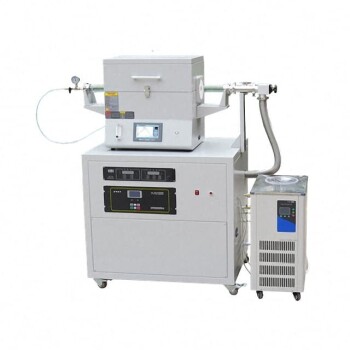
Your group III-nitride heterostructure quality hinges on achieving a stable, high-temperature environment near 1120°C and a precisely controlled low-pressure atmosphere around 15 mbar. These conditions, combined with a high group V-to-III precursor ratio (~2000) and rigorous gas purity, are the non-negotiable thermal and atmospheric parameters for depositing device-grade AlGaN/GaN layers via chemical vapor deposition.
To grow AlGaN/GaN heterostructures with a functional two-dimensional electron gas (2DEG) and nm-scale precision, you must deliver uniform substrate heating at ~1120°C under a stable reduced pressure of ~15 mbar while maintaining an ammonia-rich atmosphere with extreme oxygen and moisture exclusion. This window balances precursor decomposition, surface mobility, and parasitic reaction suppression to create abrupt, defect-free interfaces.
Decoding the Critical Temperature Requirement
The primary reference specifies a stable processing temperature around 1120°C. This is not an arbitrary number—it’s the thermodynamic sweet spot for group III-nitride epitaxy using metalorganic precursors.
Why 1120°C is Essential for GaN and AlGaN
At this temperature, ammonia (NH₃) crack efficiently to supply reactive nitrogen species. GaN and AlGaN films require this high thermal energy to achieve sufficient surface adatom mobility, allowing atoms to find their correct lattice sites and form a high-quality crystal.
Insufficient temperature dramatically reduces growth rate and yields a carbon-contaminated, defect-ridden film because un-cracked precursor ligands incorporate. On the other hand, excessively high temperatures can cause gallium desorption from the surface, depleting the layer and roughening the interface. The 1120°C target is the practical compromise that maximizes crystal quality while keeping group III elements on the surface.
The Role of Multi-Zone Thermal Uniformity
A single setpoint is useless without uniformity across the entire growth area. High-quality heterostructures require multi-zone furnace control to eliminate thermal gradients. Even a few degrees of variation can cause layer thickness non-uniformity and compositional drift in AlGaN barriers, directly degrading the electrical mobility of the resulting 2DEG.
The supplementary reference explicitly links precise multi-zone control to achieving a uniform 30 nm AlGaN barrier layer with 30% aluminum content. Without actively managed thermal profiles, the aluminum incorporation rate—highly temperature-sensitive—would vary across a wafer, creating performance hotspots and dead zones.
Mastering Low-Pressure Atmosphere Control
Alongside temperature, the vacuum and gas environment is the second pillar of successful heterostructure growth. The primary reference targets ~15 mbar, a reduced pressure regime that fundamentally alters reaction kinetics.
Suppressing Parasitic Gas-Phase Reactions
At atmospheric pressure, metalorganic precursors react violently with ammonia in the gas phase, forming solid adduct particles that rain onto the surface as defects. Operating at 15 mbar drastically increases the mean free path of molecules and reduces collision frequency, suppressing these parasitic reactions. This shifts the deposition mechanism toward surface-dominated pyrolysis, which is critical for growing clean, smooth epitaxial films layer by layer.
Enabling Precise Gas Flow Dynamics
Low pressure enhances the flow velocity for a given mass flow rate, enabling sharper transition between layers and faster purging of reactants. This is essential when you switch from GaN buffer growth to AlGaN barrier deposition. Any precursor carryover creates an unwanted interfacial grading layer that blurs the potential well of the 2DEG.
To maintain this delicate pressure regime, the CVD system must feature high-vacuum integrity, a fast-responding throttle valve, and a dry pump backing system to avoid oil contamination. The atmosphere demands exclusion of oxygen and moisture to sub-ppm levels, as GaN is notoriously sensitive to background oxygen that forms deep-level traps.
The Chemical Matrix: Precursors and V-III Ratio
The thermal and pressure conditions exist to serve the chemical reaction. The primary reference cites triethylgallium (TEGa), trimethylaluminum (TMAl), and ammonia (NH₃) as the standard precursor suite.
The Non-Negotiable High Ammonia Overpressure
The supplementary reference highlights a V-III precursor ratio of ~2000. This enormous excess of ammonia is mandatory. At 1120°C, the vapor pressure of nitrogen over GaN is high; without a massive ammonia overpressure, the film would decompose as fast as it grows.
This ammonia deluge also acts as a reactant, a carrier of reactive nitrogen, and a sacrificial getter for carbon contamination, converting methyl and ethyl radicals into volatile methane and ethane. A failure to maintain this ratio results immediately in metallic gallium droplets on the surface.
Carrier Gas Selection
While not explicitly detailed in the primary references, the carrier gas—typically ultra-high-purity hydrogen or a hydrogen/nitrogen mixture—completes the atmospheric recipe. Hydrogen enhances ammonia decomposition and scavenges carbon, while nitrogen can moderate the aggressive etch rate of pure hydrogen on the growing GaN surface. The choice of mixture is a fine-tuning parameter to optimize surface morphology.
Understanding the Trade-offs
This high-stakes parameter set is not without its practical engineering challenges and fundamental compromises.
The Temperature-Uniformity vs. Reactor Complexity Trade-off
Achieving true 1120°C uniformity across a large area requires inductively heated susceptors and complex multi-zone resistive furnaces. This drives up system cost and complexity. A simpler hot-wall design might reach the setpoint but with an unacceptable 5–10°C gradient, rendering the barrier layer aluminum composition inconsistent from center to edge.
Low Pressure vs. Precursor Utilization
Operating at 15 mbar enhances film purity but means a large fraction of expensive metalorganic precursors are simply swept through the chamber unused. High V-III ratios exacerbate this inefficiency. You must budget for higher chemical consumption per micron of film compared to growth at a higher pressure, trading growth economy for defect density.
The High-Temperature Surface Roughening Window
The process window at 1120°C is narrow. Slight drift in temperature or pressure can push you into a regime where surface faceting or step-bunching roughens the film. This demands stable, active closed-loop control on both heating elements and pressure valves, leaving no room for manual, open-loop operation.
Making the Right Choice for Your Goal
Now that the underlying principles are clear, you can map your specific project requirements to the correct parameter set and system design.
- If your primary focus is on achieving the highest 2DEG mobility for RF or power transistors: Prioritize a cold-wall reactor with multi-zone heating to achieve flawless 1120°C ± 1°C uniformity and a 15 mbar pressure control capable of maintaining a V-III ratio of 2000 with instant precursor switching.
- If your primary focus is on prototyping MEMS resonators with nanometer-tolerance AlGaN barriers: Insist on a system with high-resolution gas panel mass flow controllers and low-dead-volume plumbing to enable sub-5-second layer transitions, preventing interfacial grading that damps resonance quality factor.
- If your primary focus is on flexible research across multiple III-nitride compositions: Select a furnace that can reliably step from 1120°C for GaN down to lower buffer layer nucleation temperatures without overshoot, while offering user-tunable pressure control between 10–50 mbar to explore process windows.
Ultimately, the secret to repeatable AlGaN/GaN heterostructures is not a single magic number, but a tightly integrated system that can religiously hold 1120°C and 15 mbar while flooding the chamber with ultra-pure ammonia—and it is this holistic control that separates a scientific toy from a reliable device-grade thin-film reactor.
Summary Table:
| Process Parameter | Critical Target Value | Primary Functional Role & Impact |
|---|---|---|
| Growth Temperature | ~1120°C (Multi-zone control) | Enables NH₃ cracking, adatom mobility, & uniform Al incorporation |
| System Pressure | ~15 mbar (Reduced pressure) | Suppresses parasitic gas-phase reactions & ensures abrupt interfaces |
| Precursor V/III Ratio | ~2000 (Ammonia overpressure) | Prevents Ga film decomposition & scavenges carbon contaminants |
| Precursor Suite | TEGa, TMAl, Ultra-pure NH₃ | Delivers elemental species for device-grade AlGaN/GaN layers |
| Atmosphere Purity | Sub-ppm O₂/H₂O (H₂/N₂ carrier) | Eliminates deep-level defect traps & stabilizes film morphology |
Elevate Your III-Nitride Thin-Film Epitaxy with KINTEK
Achieving high-mobility AlGaN/GaN heterostructures demands absolute multi-zone thermal uniformity and reliable atmosphere control. At KINTEK, we specialize in high-performance laboratory equipment, offering fully customizable high-temperature furnaces—including CVD, atmosphere, muffle, and vacuum systems—engineered specifically to meet your rigorous semiconductor research and production requirements.
Whether you need precise low-pressure control, low-dead-volume plumbing, or custom high-temp heating zones, our team is ready to deliver tailored solutions for your facility. Contact KINTEK today to discuss your customized furnace requirements and partner with experts who understand thin-film deposition!
Related Products
- Custom Made Versatile CVD Tube Furnace Chemical Vapor Deposition CVD Equipment Machine
- Split Chamber CVD Tube Furnace with Vacuum Station CVD Machine
- Multi Heating Zones CVD Tube Furnace Machine for Chemical Vapor Deposition Equipment
- Slide PECVD Tube Furnace with Liquid Gasifier PECVD Machine
- Controlled Inert Nitrogen Hydrogen Atmosphere Furnace
People Also Ask
- Why are CVD tube furnace sintering systems indispensable for 2D material research and production? Unlock Atomic-Scale Precision
- What is a CVD tube furnace and what is its primary function? Discover Precision Thin-Film Deposition
- Which industries and research fields benefit from CVD tube furnace sintering systems for 2D materials? Unlock Next-Gen Tech Innovations
- How does CVD tube furnace sintering enhance graphene growth? Achieve Superior Crystallinity and High Electron Mobility
- What are the benefits of developing new precursor materials for CVD tube furnaces? Unlock Advanced Thin-Film Synthesis