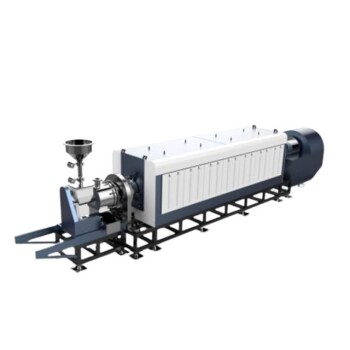
A high-temperature muffle furnace provides the specific thermal and oxidative conditions required to isolate inorganic minerals from biomass. It creates a stable environment—typically maintained at 550°C—where organic matter is completely combusted and volatilized. This process leaves behind only the non-volatile residue, known as ash, which is essential for assessing material purity and fuel quality.
The muffle furnace acts as a precision tool to ensure the complete removal of carbonaceous matter through controlled oxidation. By providing a uniform, high-temperature environment, it allows for the accurate quantification of inorganic minerals, which directly impacts biomass energy valuation and industrial processing.
The Critical Environment for Ash Analysis
Constant High-Temperature Stability
The furnace maintains a steady thermal state, often ranging from 550°C to 900°C depending on the specific biomass standard. This sustained heat is necessary to break down complex organic structures that would otherwise remain stable at lower temperatures.
Consistent temperature control ensures that the decomposition is uniform across the entire sample. Without this stability, the resulting ash measurement would be inconsistent and unreliable for quality control.
The Role of an Oxidizing Atmosphere
A muffle furnace provides an oxidizing environment under atmospheric pressure, allowing oxygen to react with the carbonaceous material. This reaction facilitates the total conversion of organic substances into gaseous byproducts like carbon dioxide and water vapor.
By facilitating thorough combustion, the furnace ensures that no "char" or unburnt carbon remains in the crucible. This leaves only the inorganic solid residue, which is the true mineral content of the sample.
Evaluating Biomass Quality and Performance
Quantification of Inorganic Residue
Determining ash content is a critical step in evaluating the purity and composition of materials like fruit peels or wood chips. Researchers use this data to assess whether biomass is suitable as a fermentation feedstock or a biofuel.
The remaining inorganic minerals help researchers understand the chemical makeup of the material. For example, in biochar applications, ash analysis can validate whether new crystalline phases have formed during heavy metal remediation.
Predicting Slagging and Heating Value
Ash content directly influences the heating value of biomass fuels; generally, higher ash content leads to lower energy efficiency. The data gathered from the furnace allows engineers to predict the fuel's performance in industrial boilers.
Furthermore, high mineral concentrations can lead to slagging, where ash melts and creates deposits on combustion equipment. Precise furnace testing helps operators manage these risks by identifying high-residue batches before they are processed.
Understanding the Trade-offs and Limitations
Temperature Sensitivity and Mineral Loss
While higher temperatures ensure the complete removal of carbon, they can also cause the volatilization of certain minerals. Elements like potassium or chlorine may escape if the furnace is set too high, leading to an underestimation of the total inorganic content.
Conversely, if the temperature is too low, the oxidation may be incomplete. Striking the right balance is essential for maintaining the chemical integrity of the ash sample.
Uniformity vs. Throughput
Achieving perfect temperature uniformity often requires smaller sample sizes and slower heating cycles. While this increases the accuracy of the analysis, it limits the speed at which a laboratory can process multiple batches.
Using a furnace with poor heat circulation can create "cold spots," resulting in uneven calcination. Choosing a furnace with high-quality insulation and precise heat distribution is vital for high-stakes industrial testing.
How to Apply These Conditions to Your Project
When utilizing a muffle furnace for biomass analysis, your specific goals should dictate your operational parameters.
- If your primary focus is Biofuel Quality Assessment: Set the furnace to the standard 550°C or 600°C to measure the impact of ash on heating value and slagging risks.
- If your primary focus is Biochar or Activated Carbon Research: Use higher temperatures (700°C+) to ensure complete calcination and to study the formation of new mineral phases or crystalline structures.
- If your primary focus is Material Purity in Feedstocks: Prioritize temperature uniformity and stable heat circulation to ensure that all organic contaminants are fully removed from the inorganic residue.
Selecting the correct temperature and ensuring a steady supply of oxygen are the most critical factors in achieving a definitive and reproducible ash content measurement.
Summary Table:
| Critical Condition | Role in Biomass Analysis | Impact on Final Results |
|---|---|---|
| High-Temp Stability | Breaks down complex organic structures | Ensures uniform and reliable decomposition |
| Oxidizing Atmosphere | Converts carbonaceous matter into gas | Isolates pure inorganic mineral residue |
| Uniform Heat Distribution | Prevents "cold spots" during calcination | Guarantees reproducible ash quantification |
| Precision Control | Balances heat to prevent mineral loss | Maintains chemical integrity of the sample |
Elevate Your Research with KINTEK Precision Furnaces
Achieve flawless ash analysis and material testing with KINTEK’s industry-leading laboratory equipment. We specialize in a comprehensive range of high-temperature solutions, including muffle, tube, rotary, vacuum, CVD, atmosphere, dental, and induction melting furnaces.
Whether you are evaluating biomass fuel quality, researching biochar, or verifying material purity, our equipment is fully customizable to meet your unique thermal and oxidative requirements. Don't compromise on accuracy—ensure temperature uniformity and stable performance in every batch.
Contact KINTEK today to find your ideal furnace solution!
References
- Asab Alemneh Tadesse, Temesgen Atnafu Yemata. Production and Optimization of Bioethanol from Mixed Banana and Papaya Peels Using <i>Saccharomyces Cerevisiae</i>. DOI: 10.11648/j.ajcbe.20240802.12
This article is also based on technical information from Kintek Furnace Knowledge Base .
Related Products
- 1700℃ High Temperature Muffle Oven Furnace for Laboratory
- 1800℃ High Temperature Muffle Oven Furnace for Laboratory
- 1200℃ Muffle Oven Furnace for Laboratory
- 1400℃ Muffle Oven Furnace for Laboratory
- High Temperature Muffle Oven Furnace for Laboratory Debinding and Pre Sintering
People Also Ask
- What is the primary function of a high-temperature laboratory muffle furnace in chemical synthesis? Achieve Precision.
- How does a high-temperature laboratory muffle furnace affect material properties? Transform Anodic Oxide Films Fast
- What role does a muffle furnace play in BCZY712 electrolyte powder production? Achieve Perfect Phase Purity
- What role does a muffle furnace play in sintering photocathodes? Enhance Electrode Conductivity & Catalytic Activity
- What is the role of a high-temperature muffle furnace in guava leaf carbonization? Master Precise Pyrolysis Control