Restoring Cu20LNO catalysts requires a specific thermal and atmospheric environment to reverse the structural decomposition that occurs during use.
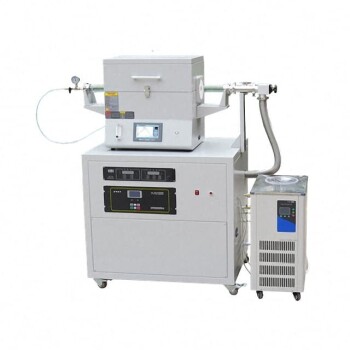
A tube furnace provides a precisely controlled oxidative environment that subjects the catalyst to temperatures between 600 °C and 800 °C in static air for a duration of 3 hours. This specific combination of high heat and oxygen availability facilitates the recombination of decomposed metallic nickel (Ni⁰) and binary oxides back into their original perovskite phase, fully restoring catalytic activity.
Core Takeaway: The tube furnace enables in situ regeneration by providing a stable oxidative thermal field that drives the chemical recombination of metal oxides into a functional perovskite structure.
The Precise Thermal Environment
Temperature Range and Stability
The regeneration of Cu20LNO necessitates a high-energy environment, specifically between 600 °C and 800 °C. The tube furnace ensures this temperature remains constant and uniform across the catalyst bed, which is vital for complete phase transformation.
Controlled Heating Rates
Precision heating prevents thermal shock to the catalyst carrier and ensures that the thermal energy is applied gradually. This allows for the steady migration of ions required to rebuild the crystalline lattice without causing structural fractures.
Sustained Residence Time
The furnace maintains these conditions for a 3-hour duration, providing the necessary time for the slow process of solid-state recombination. Short-duration heating would likely result in an incomplete transition, leaving inactive metallic nickel residues.
Atmospheric Control and Chemical Transformation
The Role of Static Air
Unlike many synthesis processes that require flowing gas, Cu20LNO regeneration utilizes static air within the furnace tube. This provides the oxidative environment necessary to transition metallic nickel (Ni⁰) back into an oxidized state within the perovskite lattice.
Reversing Phase Decomposition
During the catalyst's operation, it often decomposes into metallic components and binary oxides. The tube furnace’s environment forces these separate phases to recombine, restoring the complex chemical identity of the original catalyst.
Sealing and Purity
The sealed nature of the tube furnace prevents contamination from the external environment. This ensures that the oxidation states of the copper and nickel are regulated purely by the temperature and the internal air supply.
Understanding the Trade-offs
Sintering vs. Regeneration
While high temperatures (above 600 °C) are required for phase restoration, excessive heat can lead to sintering. Sintering reduces the surface area of the catalyst, which can permanently lower its efficiency despite successful phase recombination.
Energy Consumption and Throughput
Tube furnaces are highly effective for precise, small-to-medium scale regeneration but can be energy-intensive. The 3-hour dwell time at high temperatures represents a significant energy cost that must be weighed against the cost of fresh catalyst.
Atmospheric Limitations
Regenerating in static air is effective for Cu20LNO, but if carbon fouling (coking) is also present, a static environment may not be as efficient as a flowing oxygen or nitrogen environment at lower temperatures. Relying solely on high-temperature oxidation might trap some combustion by-products if the tube is not purged.
How to Apply This to Your Process
To achieve the best results when using a tube furnace for Cu20LNO regeneration, consider your specific operational priorities:
- If your primary focus is Maximum Activity Recovery: Aim for the higher end of the temperature scale (near 800 °C) to ensure the most complete transition back to the perovskite phase.
- If your primary focus is Catalyst Longevity: Utilize the lower end of the temperature range (600 °C) to minimize the risk of metal particle sintering and loss of surface area.
- If your primary focus is Process Efficiency: Ensure the catalyst is evenly distributed within the "hot zone" of the furnace tube to guarantee uniform phase restoration across the entire batch.
By precisely tuning the oxidative thermal field of the tube furnace, you can effectively cycle Cu20LNO catalysts through multiple rounds of use and regeneration.
Summary Table:
| Parameter | Optimal Condition | Impact on Cu20LNO Catalyst |
|---|---|---|
| Temperature Range | 600 °C – 800 °C | Drives recombination of oxides back to perovskite phase |
| Atmosphere | Static Air | Provides oxygen to oxidize metallic nickel (Ni⁰) |
| Dwell Time | 3 Hours | Ensures complete lattice rebuilding and ion migration |
| Heating Stability | High Precision | Prevents thermal shock and ensures uniform phase recovery |
| Sealing | Airtight/Pure | Prevents contamination and maintains specific oxidation states |
Optimize Your Catalyst Research with KINTEK Precision
Achieving the perfect perovskite phase requires more than just heat—it requires total control. KINTEK specializes in advanced laboratory equipment and consumables, offering a comprehensive range of high-temperature furnaces including muffle, tube, rotary, vacuum, CVD, and atmosphere furnaces.
Whether you are performing in situ regeneration of Cu20LNO catalysts or developing new materials, our customizable heating solutions provide the thermal uniformity and atmospheric purity your research demands.
Why choose KINTEK?
- Precision Control: Fine-tune temperature and gas environments for repeatable results.
- Customizable Designs: Tailored furnace configurations for your unique laboratory needs.
- Expert Support: Specialized equipment designed for high-performance material science.
Ready to enhance your lab's efficiency? Contact KINTEK today to find the ideal furnace for your high-temperature applications!
References
- Akbar Hossain, Arup Gayen. Cu-doped LaNiO<sub>3</sub> perovskite catalyst for DRM: revisiting it as a molecular-level nanocomposite. DOI: 10.1039/d4cp02252a
This article is also based on technical information from Kintek Furnace Knowledge Base .
Related Products
- Multi Zone Laboratory Quartz Tube Furnace Tubular Furnace
- Laboratory Quartz Tube Furnace RTP Heating Tubular Furnace
- Vertical Laboratory Quartz Tube Furnace Tubular Furnace
- Magnesium Extraction and Purification Condensing Tube Furnace
- Electric Rotary Kiln Small Rotary Furnace for Activated Carbon Regeneration
People Also Ask
- What environmental protection applications utilize multi zone tube furnaces? Unlock Precision in Waste Treatment and Green Tech
- What role do multi zone tube furnaces play in new energy research? Unlock Precise Thermal Control for Innovation
- Why are multi zone tube furnaces particularly useful for nanomaterial research? Unlock Precise Thermal Control for Advanced Synthesis
- What temperature-related capabilities make multi zone tube furnaces valuable for research? Unlock Precision Thermal Control
- What are the main applications of multi zone tube furnaces in university laboratories? Unlock Precision in Material Science and Energy Research