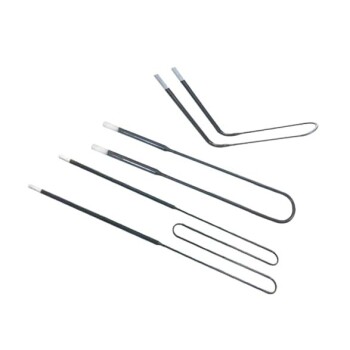
A high-temperature muffle furnace equipped with Silicon Molybdenum (MoSi2) heating elements provides the extreme thermal energy and precision control required to drive complex chemical reduction and material densification. By reaching temperatures often exceeding 1600°C with stable, high-precision ramp rates, these systems ensure predictable phase transitions and the successful removal of volatile compounds. This technology is essential for achieving high relative density and chemical purity in advanced metallurgical and ceramic applications.
The central advantage of MoSi2-equipped furnaces lies in their ability to provide a stable, contamination-free thermal environment at temperatures above 1500°C. This combination of extreme heat and precise atmospheric stability is the key to managing the delicate kinetics of reduction sintering and phase equilibrium.
Superior Thermal Energy and Kinetic Capabilities
Reaching Ultra-High Temperatures
MoSi2 heating elements are the industry standard for applications requiring temperatures of 1540°C or higher. They provide the sustained energy necessary for solid-state reactions, such as the reaction sintering of Al2O3-Y3Al5O12, which requires environments as hot as 1610°C to facilitate the formation of reinforcing phases.
Driving Reduction and Volatilization
The intense heat generated by these elements provides the kinetic energy required for the reduction of metal oxides and the volatilization of secondary compounds. In processes like the desodiation of vanadium tailings, high temperatures are critical for the volatilization of sodium compounds, ensuring the final product meets purity standards.
Achieving High Relative Density
Continuous high-temperature environments allow materials to reach their maximum theoretical density. For specific ceramic systems, MoSi2 elements provide the stable energy needed to achieve a relative density exceeding 98%, which is vital for mechanical performance.
Precision Control of Sintering Kinetics
Exact Ramp-Rate Management
Modern muffle furnaces offer exceptional control over heating curves, allowing for precise increases such as 7.5°C per minute. This level of accuracy is vital for investigating sequential phase transitions, ensuring that the metal and slag phases separate effectively without bypassing critical reaction windows.
Facilitating Multi-Stage Sintering
High-precision controllers enable specialized two-stage workflows, such as initial dewaxing or pre-burning followed by high-temperature bonding. This ensures that moisture and organic binders are removed slowly (e.g., at 400°C) before the material is subjected to the high temperatures (1050°C–1200°C) required for glass phase formation.
Maintaining Dimensional Stability
By strictly controlling heating and cooling curves, these furnaces minimize linear shrinkage in sensitive components like silica-based ceramic cores. This precision ensures that parts maintain their mechanical strength and dimensional accuracy, which is critical for downstream casting processes.
Chemical Purity and Long-Term Stability
Contamination-Free Environments
MoSi2 elements are exceptionally stable in oxidizing atmospheres and do not produce volatile substances that could leach into the workload. This ensures rigorous consistency in experimental conditions, particularly when studying the grain growth kinetics of sensitive lithium-rich cathode materials.
Sustained Thermal Fields for Diffusion
These furnaces can maintain a stable thermal field for extended durations, ranging from 80 hours to several weeks. This long-term stability is necessary for complex systems to reach phase equilibrium and for solid solutions to achieve uniform composition alignment.
Resistance to Oxidizing Atmospheres
Unlike other heating materials that may degrade rapidly in air, MoSi2 is specifically designed for stable operation in oxidizing environments. This makes it the preferred choice for sintering processes that must occur in an air atmosphere to maintain the desired oxidation state of the material.
Understanding Technical Trade-offs
Maintenance and Contamination Sensitivity
MoSi2 elements are highly effective but require diligent maintenance and clean operating conditions. They are particularly prone to contamination if materials are not properly dried before sintering or if the furnace environment is not kept free of corrosive vapors.
Temperature Threshold Selection
The choice between heating elements often comes down to the intended operating window. While MoSi2 is superior for temperatures above 1540°C, Silicon Carbide (SiC) elements are often recommended for processes that stay below 1450°C, as they can be more cost-effective and less sensitive to certain process details.
Fragility and Handling
MoSi2 elements become brittle after use and are susceptible to mechanical shock. This requires a stable installation environment and careful handling during any maintenance procedures to prevent element breakage.
Applying This Technology to Your Project
High-temperature MoSi2 muffle furnaces are specialized tools that should be selected based on your specific material requirements and thermal profile.
- If your primary focus is extreme densification: Prioritize a furnace configuration that can maintain temperatures above 1600°C for extended dwell times to ensure maximum relative density.
- If your primary focus is phase purity: Choose MoSi2 elements for their non-volatile characteristics to ensure no external contaminants interfere with the chemical evolution of your sample.
- If your primary focus is complex geometry or pores: Utilize the high-precision ramp-rate controls to implement a multi-stage sintering process that preserves structural integrity during dewaxing.
By matching the unique capabilities of MoSi2 heating elements to your specific sintering kinetics, you can achieve unprecedented levels of material performance and experimental repeatability.
Summary Table:
| Feature | Technical Advantage | Impact on Sintering |
|---|---|---|
| MoSi2 Heating Elements | Stable at 1600°C+ in oxidizing atmospheres | High-energy supply for densification and volatilization |
| Precise Ramp Control | High-precision controllers (e.g., 7.5°C/min) | Prevents thermal shock and ensures phase equilibrium |
| Clean Thermal Field | Non-volatile, contamination-free operation | Maintains high chemical purity in ceramics and metals |
| Atmosphere Stability | Durable in air and oxidizing environments | Reliable results for grain growth and oxidation state control |
| Long-Term Durability | Sustained performance for 80+ hour cycles | Allows complex systems to reach full phase equilibrium |
Elevate Your Material Research with KINTEK Precision
Unlock the full potential of your high-temperature processes with KINTEK. As specialists in laboratory equipment and consumables, we provide a comprehensive range of high-temperature furnaces, including muffle, tube, rotary, vacuum, CVD, atmosphere, dental, and induction melting furnaces.
Our MoSi2-equipped muffle furnaces are engineered for superior thermal stability and are fully customizable to meet your unique reduction sintering and material densification needs. Whether you require extreme 1600°C+ temperatures or precise multi-stage ramp control, our solutions guarantee reliability and purity for your most demanding projects.
Ready to optimize your lab's performance? Contact KINTEK today to consult with our experts on the perfect furnace configuration for your application!
References
- Chao Wang, Yu Zheng. Removal of Sodium from Vanadium Tailings by Calcification Roasting in Reducing Atmosphere. DOI: 10.3390/ma16030986
This article is also based on technical information from Kintek Furnace Knowledge Base .
Related Products
- High Temperature Muffle Oven Furnace for Laboratory Debinding and Pre Sintering
- 1400℃ Muffle Oven Furnace for Laboratory
- 1700℃ High Temperature Muffle Oven Furnace for Laboratory
- 1800℃ High Temperature Muffle Oven Furnace for Laboratory
- 1200℃ Muffle Oven Furnace for Laboratory
People Also Ask
- What thermal phenomena occur during polymer binder burnout in ceramic green bodies? Lab Furnace Guide
- What role does a high-temperature muffle furnace play in STFO synthesis? Achieve Pure Perovskite Results
- Why is controlled heat treatment in a muffle furnace necessary for calcined clay? Achieve Optimal Pozzolanic Activity
- How does a high-temperature muffle furnace facilitate the formation of LaNbxAl1−xO3+δ perovskite structures? Key Roles
- What role does a high-temperature muffle furnace play in the multi-stage synthesis of Li0.5MnFe1.5O4? Key to Pure Spinel