
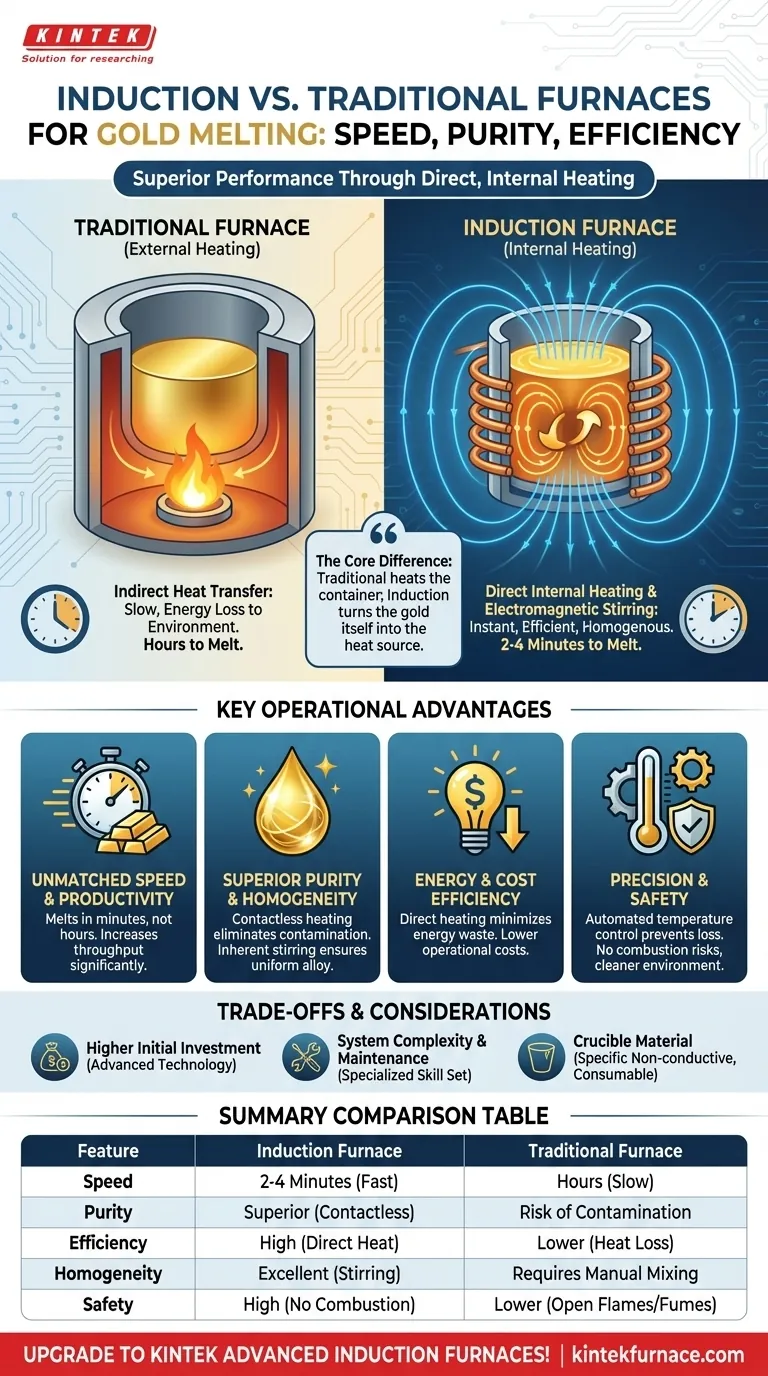
In short, an induction furnace offers superior speed, efficiency, and purity for gold melting compared to traditional methods. By using electromagnetic fields to heat the gold directly, it melts metal in minutes instead of hours, ensures a more homogenous mixture, and prevents contamination, all while reducing energy costs and improving safety.
The core difference is not just the heat source, but the heating method. Traditional furnaces heat a container from the outside, while induction furnaces turn the gold itself into the heat source, leading to unparalleled control and efficiency.
How Induction Fundamentally Changes the Melting Process
To understand the benefits, you must first understand the core principle. Traditional furnaces rely on external combustion or resistance heating elements to slowly transfer heat to a crucible, which then heats the gold. Induction is entirely different.
Direct, Internal Heating
An induction furnace uses a powerful alternating magnetic field. This field passes through a crucible and induces electrical eddy currents directly within the gold.
The gold's natural electrical resistance causes these currents to generate intense, rapid heat from the inside out. This eliminates the slow process of thermal transfer and minimizes energy wasted heating the surrounding air.
Inherent Electromagnetic Stirring
The same magnetic forces that generate heat also create a gentle, continuous stirring motion within the molten gold.
This natural stirring is a unique advantage of induction. It ensures that alloys are mixed perfectly, leading to a highly uniform and homogenous final product without any manual intervention.
Key Operational Advantages
This fundamental difference in heating method translates directly into tangible operational benefits that impact quality, cost, and productivity.
Unmatched Speed and Productivity
Because heat is generated instantly within the metal, melting times are dramatically reduced. A process that takes hours in a traditional furnace can often be completed in 2-4 minutes in an induction furnace.
This speed directly increases throughput and productivity, a critical factor for any commercial operation.
Superior Purity and Homogeneity
With induction, the heating element never touches the metal. This completely eliminates contamination from combustion byproducts (like in gas furnaces) or degrading heating elements.
Combined with the electromagnetic stirring effect, the result is gold of superior purity and consistency.
Precision Temperature Control
Induction systems allow for highly accurate and automated temperature control. This precision prevents overheating, which can lead to the vaporization and loss of valuable gold.
It also ensures repeatable, uniform results for every melt, improving quality control.
Significant Energy and Cost Efficiency
By generating heat only where it's needed—inside the gold—induction furnaces are incredibly energy efficient. Very little heat is lost to the environment.
This direct heating method significantly lowers energy consumption and operational costs compared to the constant heat dissipation of traditional fuel-based or resistance furnaces.
Understanding the Trade-offs and Considerations
While the advantages are significant, a complete picture requires acknowledging the trade-offs. Induction technology is a strategic investment, not a simple replacement.
Initial Investment Cost
The primary consideration is the higher upfront capital cost. Induction furnaces are more complex systems than simple gas or resistance melters, and the initial purchase price reflects this advanced technology.
System Complexity and Maintenance
These systems consist of a power supply, a cooling unit, and the coil assembly. While highly reliable, they require a different skill set for maintenance and repair compared to traditional furnaces. Proper installation and operator training are essential.
Crucible Material
The crucible used in an induction furnace must be made of a non-conductive, refractory material like graphite or ceramic. It also acts as a consumable component that requires periodic replacement, which should be factored into operating costs.
Safety and Environmental Impact
Beyond performance, induction technology offers a fundamentally safer and cleaner operational environment.
Eliminating Combustion Risks
Induction furnaces use electricity, not combustible fuels. This eliminates the risks associated with open flames, fuel storage, and carbon monoxide emissions that are inherent to gas-powered furnaces.
A Cleaner Working Environment
With no fumes, smoke, or excessive waste heat, the working conditions around an induction furnace are vastly improved. This creates a safer and more comfortable environment for operators.
Making the Right Choice for Your Operation
The decision to adopt induction technology depends entirely on your operational priorities and scale.
- If your primary focus is maximizing throughput and final product quality: The speed, purity, and homogeneity offered by induction are unmatched.
- If your primary focus is large-scale production and cost efficiency: The long-term energy savings and reduced metal loss of an induction furnace will justify the initial investment.
- If your primary focus is operational safety and environmental responsibility: The elimination of fossil fuels and harmful emissions makes induction the superior choice.
- If your primary focus is small-scale, infrequent melting with minimal upfront cost: A traditional gas or electric resistance furnace may remain a viable entry-level option.
Ultimately, choosing an induction furnace is an investment in control, consistency, and efficiency for your melting process.
Summary Table:
| Benefit | Description |
|---|---|
| Speed | Melts gold in 2-4 minutes vs. hours in traditional furnaces |
| Purity | Eliminates contamination with direct, contactless heating |
| Efficiency | Reduces energy costs by heating metal directly |
| Homogeneity | Ensures uniform mixing via electromagnetic stirring |
| Safety | No combustion risks, cleaner environment |
| Control | Precise temperature management prevents gold loss |
Upgrade your gold melting process with KINTEK's advanced induction furnaces! Leveraging exceptional R&D and in-house manufacturing, we provide diverse laboratories with high-performance solutions like Muffle, Tube, Rotary, Vacuum & Atmosphere Furnaces, and CVD/PECVD Systems. Our strong deep customization capability ensures we precisely meet your unique experimental needs for faster, purer, and more efficient results. Contact us today to discuss how we can enhance your operations!
Visual Guide
Related Products
- Vacuum Induction Melting Furnace
- 600T Vacuum Induction Hot Press Vacuum Heat Treat and Sintering Furnace
- Vacuum Heat Treat Sintering Furnace with Pressure for Vacuum Sintering
- High Temperature Muffle Oven Furnace for Laboratory Debinding and Pre Sintering
- Small Vacuum Heat Treat and Tungsten Wire Sintering Furnace
People Also Ask
- What are the core functions of the High Vacuum Induction Melting (VIM) furnace? Optimize DD5 Superalloy Purification
- What is the role of VIM and directional solidification in aero-engine blade substrates? Engineering Extreme Durability
- Why is a Vacuum Induction Melting furnace (VIM) used for Cu-Zn-Al-Sn alloys? Achieve Precision Composition Control
- What are the technical advantages of using a Vacuum Induction Melting furnace in the development of advanced packaging steel?
- What role does a Vacuum Induction Melting furnace play in the production of high-aluminum nickel-based superalloys?



















