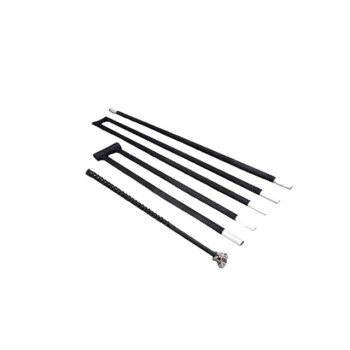
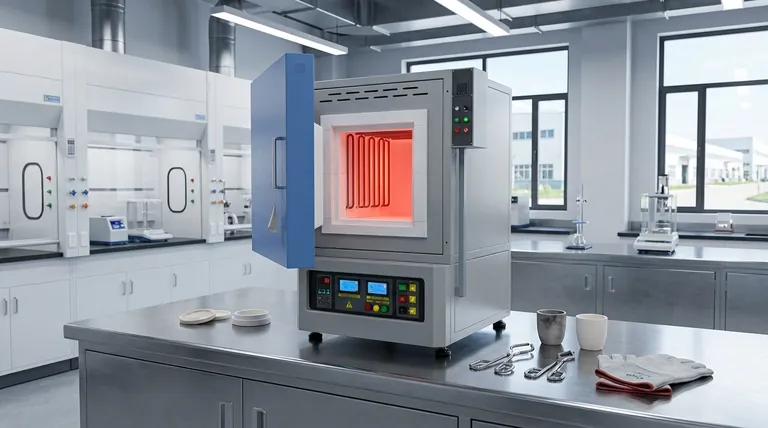
At their core, box type electric furnaces are versatile workhorses for heat treatment, designed to deliver precise thermal control in a robust, self-contained unit. Their key features revolve around a double-shell construction with high-performance insulation, modular heating elements for uniform temperature, and integrated control systems that ensure both operational simplicity and operator safety. These furnaces are widely used for processes like quenching, annealing, and solution treatment to fundamentally alter a metal's properties.
The true value of a box type electric furnace lies in the integration of its features. It is the combination of thermal uniformity, energy efficiency, and operational safety that enables the consistent, high-quality results required for critical metallurgical processes.
The Foundation: Structural Design and Efficiency
The physical construction of a box furnace is engineered for more than just containment; it is fundamental to its performance, efficiency, and lifespan.
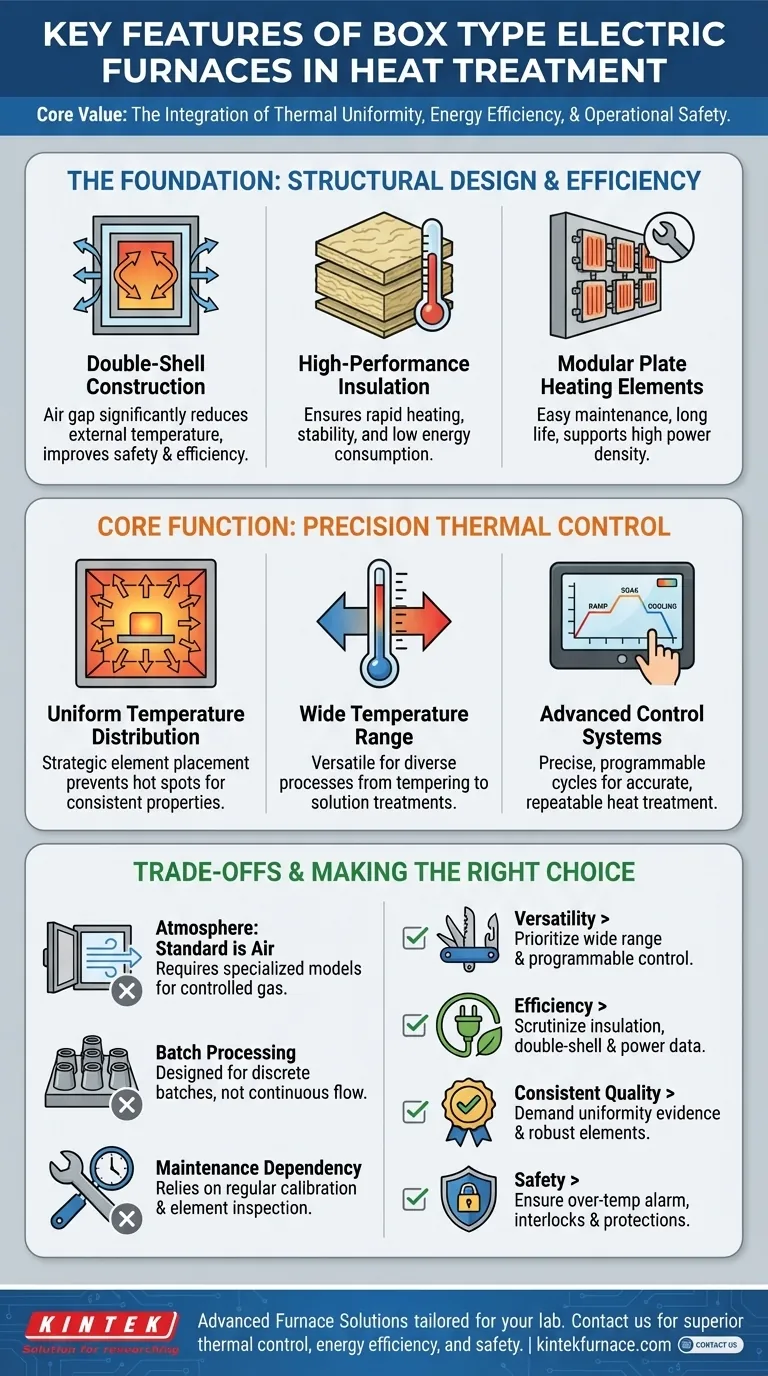
Double-Shell Construction
This design creates an air gap between the inner and outer furnace walls. This gap serves as an insulator, significantly reducing the external surface temperature, which improves both operator safety and overall energy efficiency by minimizing heat loss to the surrounding environment.
High-Performance Insulation
Modern box furnaces utilize advanced, multi-layer insulation. This material choice is critical for maximizing thermal performance, ensuring rapid heating times, maintaining temperature stability, and dramatically lowering energy consumption during long processes.
Modular Plate Heating Elements
Many designs feature modular heating elements mounted on the furnace walls. This approach offers superior longevity and makes maintenance straightforward, as individual elements can be replaced without a complete overhaul. This design also supports high power density without the typical watt loading limitations, ensuring robust and reliable heating.
Core Function: Precision Thermal Control
The primary goal of heat treatment is to execute a precise thermal recipe. The following features are central to achieving that goal.
Uniform Temperature Distribution
Arguably the most critical performance feature, temperature uniformity ensures that the entire workpiece, regardless of its position in the chamber, experiences the exact same thermal conditions. This is achieved through the strategic placement of heating elements and advanced control algorithms, preventing hot spots and ensuring consistent material properties.
Wide Temperature Range
A key advantage is their operational flexibility. A single furnace can often handle a wide spectrum of temperatures, making it suitable for a diverse range of materials and processes, from low-temperature tempering to high-temperature solution treatments.
Advanced Control Systems
The furnace's "brain" is a digital controller that allows operators to set and maintain precise temperatures. More advanced systems enable multi-step programming for complex ramp, soak, and cooling cycles, ensuring the heat treatment process is both accurate and perfectly repeatable.
Understanding the Trade-offs
While highly versatile, it is crucial to recognize the inherent limitations of a standard box type electric furnace.
Atmosphere is a Key Consideration
Standard box furnaces operate with an air atmosphere. For processes that require a controlled or inert atmosphere (such as nitrogen, argon, or a reducing gas) to prevent oxidation, a specialized furnace with a sealed retort and gas handling system is necessary.
Designed for Batch Processing
By their nature, box furnaces are designed for processing parts in discrete batches. For high-volume, continuous production lines, other furnace types like conveyor or roller hearth furnaces are more appropriate.
Reliability Hinges on Maintenance
The accuracy promised by advanced control systems depends entirely on regular calibration of thermocouples and controllers. Likewise, the longevity of heating elements relies on operating them within their design limits and inspecting them for wear.
Making the Right Choice for Your Goal
When evaluating a box type electric furnace, your specific application should guide your priorities.
- If your primary focus is process versatility: Prioritize a model with a wide operating temperature range and a highly programmable controller that can store multiple heat treatment recipes.
- If your primary focus is operational efficiency: Scrutinize the quality of the insulation, the double-shell design, and the power consumption data to minimize long-term running costs.
- If your primary focus is consistent quality: Demand evidence of the furnace's temperature uniformity (e.g., a formal temperature uniformity survey) and choose a design with robust, long-life heating elements.
- If your primary focus is operator safety: Ensure the furnace includes essential protections like an over-temperature alarm, door interlocks, and leakage protection as standard features.
Understanding these core features empowers you to select not just a furnace, but a reliable partner for your critical heat treatment operations.
Summary Table:
| Feature | Description |
|---|---|
| Double-Shell Construction | Reduces heat loss and improves safety with an insulating air gap. |
| High-Performance Insulation | Ensures rapid heating, temperature stability, and lower energy use. |
| Modular Plate Heating Elements | Offers easy maintenance and reliable, uniform heating. |
| Uniform Temperature Distribution | Prevents hot spots for consistent material properties. |
| Wide Temperature Range | Supports diverse processes from low to high temperatures. |
| Advanced Control Systems | Enables precise, programmable ramp, soak, and cooling cycles. |
| Atmosphere Limitation | Operates in air; requires specialized models for controlled atmospheres. |
| Batch Processing Design | Ideal for discrete batches, not continuous production. |
| Maintenance Dependency | Relies on regular calibration and element inspection for accuracy and longevity. |
Ready to enhance your heat treatment processes with a reliable box type electric furnace? KINTEK leverages exceptional R&D and in-house manufacturing to provide advanced high-temperature furnace solutions tailored for your lab. Our product line, including Muffle, Tube, Rotary Furnaces, Vacuum & Atmosphere Furnaces, and CVD/PECVD Systems, is complemented by strong deep customization capabilities to precisely meet your unique experimental requirements. Contact us today to discuss how our furnaces can deliver superior thermal control, energy efficiency, and safety for your critical metallurgical applications!
Visual Guide
Related Products
- Electric Rotary Kiln Continuous Working Small Rotary Furnace Kiln for Pyrolysis Plant Heating
- Electric Rotary Kiln Small Rotary Furnace for Activated Carbon Regeneration
- Electric Rotary Kiln Pyrolysis Furnace Plant Machine Small Rotary Kiln Calciner
- Electric Rotary Kiln Small Rotary Furnace Biomass Pyrolysis Plant Rotating Furnace
- Spark Plasma Sintering SPS Furnace
People Also Ask
- What are the advantages of electric rotary kilns compared to fuel-fired ones? Boost Precision and Efficiency in Your Process
- What materials can be processed in an electric rotary kiln? Versatile Solutions for Advanced Materials
- What advantages do electric rotary kilns offer over fuel-based kilns? Boost Efficiency and Purity in Your Process
- What are the primary applications of electric rotary kilns? Precision Thermal Processing for High-Value Materials
- How do electric rotary kilns achieve high thermal efficiency? Unlock Over 95% Thermal Efficiency