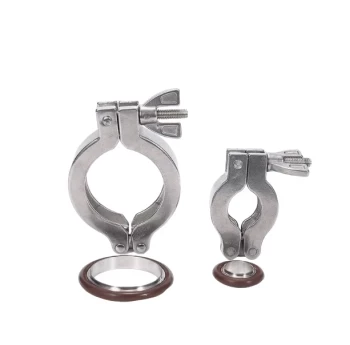
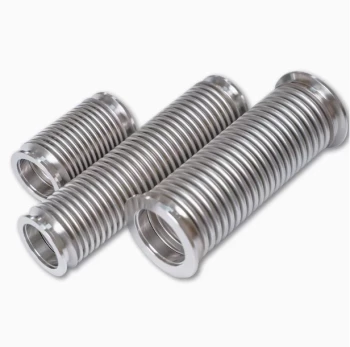
Vacuum devices and containers serve as the fundamental mechanical drivers in the Polymer Impregnation Method (PIM). Their primary function is to evacuate trapped air from within the microscopic pores of cement mortar. This evacuation creates a critical pressure void that allows liquid polymer to be forcibly drawn deep into the material, achieving saturation levels impossible through passive soaking.
By removing internal air and utilizing atmospheric pressure as a driving force, vacuum systems convert the impregnation process from a passive surface treatment into a deep structural reinforcement, significantly enhancing density and strength.
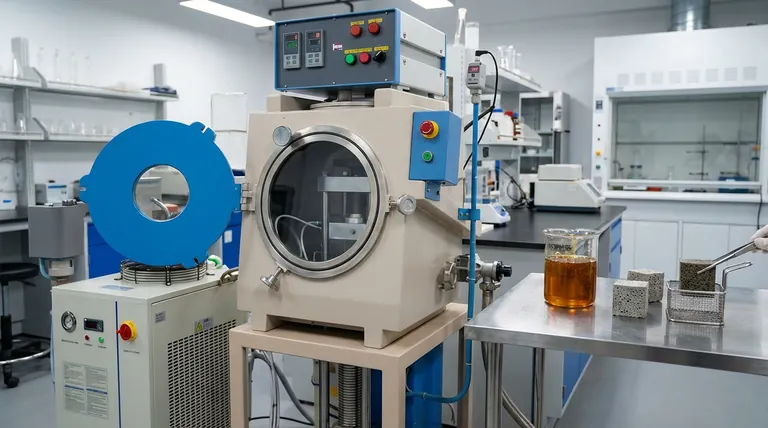
The Mechanics of Vacuum-Assisted Impregnation
Evacuating the Micro-Structure
Cement mortar is naturally porous, containing a network of capillaries and micro-pores filled with air.
The first function of the vacuum device is to remove this air. By subjecting the specimen to a vacuum within a sealed container, the system effectively "empties" the internal structure, preparing the void space to receive the polymer solution.
Creating a Pressure Differential
The efficacy of PIM relies on physics rather than just chemical absorption.
The vacuum container creates a state of low pressure inside the specimen relative to the exterior environment. This pressure differential is the potential energy that will eventually drive the impregnation process.
The Driving Force of Atmospheric Return
Once the air is removed and the specimen is submerged in the polymer solution, the system is returned to atmospheric pressure.
Because the interior of the specimen is under vacuum (low pressure) and the exterior is now at atmospheric (higher) pressure, the liquid is compelled into the pores. This pressure difference acts as a powerful driving force, pushing the polymer deep into the capillary network.
Performance Outcomes vs. Standard Methods
Achieving Greater Impregnation Depth
Standard soaking relies on capillary action, which is often blocked by air pockets trapped inside the material.
By removing this air beforehand, vacuum devices allow the polymer to penetrate much deeper into the mortar. This results in a comprehensive internal modification rather than a superficial coating.
Enhancing Material Density and Strength
The ultimate function of the vacuum system is to maximize polymer loading.
Because the polymer fills voids that were previously empty or air-filled, the final composite material exhibits significantly higher density. This densification directly translates to improved mechanical strength and durability compared to untreated or simply soaked mortar.
Understanding the Operational Context
Equipment Necessity vs. Process Simplicity
While vacuum impregnation delivers superior mechanical properties, it inherently requires specialized hardware.
The process demands airtight containers and reliable vacuum pumps to generate the necessary pressure differential. This adds a layer of operational complexity compared to standard soaking, which requires no active machinery.
The Implication of Pore Structure
The effectiveness of the vacuum device is linked to the connectivity of the material's pores.
The vacuum creates the driving force, but the polymer must still physically travel through the capillary network. Therefore, the outcome is a synergy between the vacuum pressure applied and the inherent porosity of the cement mortar.
Making the Right Choice for Your Goal
To determine if vacuum-assisted PIM is the correct approach for your application, consider the following technical requirements:
- If your primary focus is maximum structural reinforcement: You must use vacuum devices to ensure deep penetration and high polymer loading, as passive soaking cannot achieve the same density.
- If your primary focus is minimizing equipment complexity: You may opt for standard soaking, but you must accept that the polymer will likely be limited to surface layers and lower loading volumes.
- If your primary focus is material durability: The vacuum method is essential for eliminating internal air voids that could otherwise compromise the material's mechanical integrity.
The vacuum device is not merely an accessory; it is the engine that generates the pressure differential required to transform porous mortar into a high-density composite.
Summary Table:
| Feature | Vacuum-Assisted Impregnation (PIM) | Standard Passive Soaking |
|---|---|---|
| Primary Driver | Atmospheric pressure differential | Capillary action (surface only) |
| Air Removal | Active evacuation of micro-pores | None (air pockets remain trapped) |
| Impregnation Depth | Deep structural penetration | Superficial surface coating |
| Material Density | High (maximized polymer loading) | Low to Moderate |
| Complexity | Requires vacuum pumps & airtight vessels | Simple, no specialized machinery |
Maximize Your Material Performance with KINTEK
Ready to elevate your material science research? KINTEK provides high-precision vacuum systems designed for deep structural reinforcement in polymer impregnation. Backed by expert R&D and manufacturing, we offer specialized vacuum containers and high-temperature systems tailored for your unique lab requirements.
Take the next step in achieving superior material density and strength.
Contact our specialists today to customize your PIM setup!
References
- Shanaz Ahmed, Khalida Al-Azawi. Polymer-Impregnated Cement Mortar: Effects of PEG, PAM, and PVA on Mechanical Properties. DOI: 10.53293/jasn.2024.7089.1241
This article is also based on technical information from Kintek Furnace Knowledge Base .
Related Products
- Stainless Steel Quick Release Vacuum Chain Three Section Clamp
- High Performance Vacuum Bellows for Efficient Connection and Stable Vacuum in Systems
- Vacuum Dental Porcelain Sintering Furnace for Dental Laboratories
- Vacuum Heat Treat Sintering Furnace with Pressure for Vacuum Sintering
- Vacuum Sealed Continuous Working Rotary Tube Furnace Rotating Tube Furnace
People Also Ask
- What is the function of quartz vacuum encapsulation in RhSeCl CVT? Mastering Pure Crystal Growth
- What type of pump is used in water circulating vacuum pumps and how is it installed? Discover Robust Fluid-Based Vacuum Solutions
- What role do vacuum-sealed high-purity silica ampoules play in phase equilibrium experiments? Enhance Sample Integrity
- What is the operating principle of a vacuum freeze-dryer in the fabrication of carbon aerogels? Master Sublimation
- What role does a vacuum atmosphere play in Sn-Ag-Co TLP soldering? Optimize Bond Purity and Joint Strength