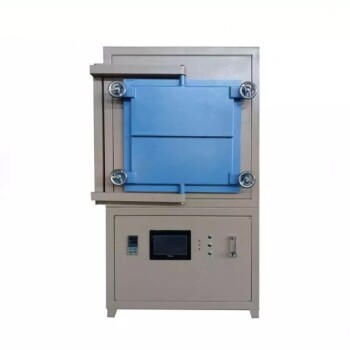
Utilizing a laboratory high-temperature muffle furnace for the long-term aging of 17-4 PH stainless steel ensures exceptional thermal stability and precise kinetic control. This environment is essential for processes lasting up to 100 hours, allowing for the consistent precipitation of Cu-rich nanoparticles and niobium (Nb) carbides. These microstructural changes are the primary drivers for increasing the hardness and mechanical strength of the material's martensitic matrix.
The laboratory muffle furnace provides the reliable thermal equilibrium necessary to facilitate complex precipitation hardening in 17-4 PH stainless steel. By maintaining a constant temperature—typically around 480 °C—the furnace enables the predictable growth of strengthening phases that define the material's final engineering properties.
Superior Thermal Stability for Extended Aging
Reliable Performance Over Long Durations
Long-term aging treatments often require holding a specific temperature for up to 100 hours. Laboratory muffle furnaces are engineered to provide excellent thermal stability over these extended periods without significant fluctuations. This consistency ensures that the kinetic energy provided to the alloy remains constant, preventing variations in the aging results.
Precise Kinetic Control for Precipitation
The aging process in 17-4 PH is highly sensitive to the stable kinetic conditions of the environment. A muffle furnace allows for a constant temperature (such as 480 °C) that is critical for the diffusion of alloying elements. This precise control facilitates the uniform formation of niobium (Nb) carbides and copper-rich phases throughout the martensitic matrix.
Microstructural Transformation and Strengthening
Induction of Cu-Rich Nanoparticles
The primary benefit of aging 17-4 PH is the precipitation of Cu-rich nanoparticles. These nano-sized phases create internal stresses within the crystal lattice that impede dislocation movement. The result is a significant increase in both the yield strength and the overall hardness of the stainless steel.
Homogenization and Secondary Phases
Beyond copper, the muffle furnace supports the formation of other intermetallic compounds and the homogenization of alloying elements. This process eliminates micro-segregation that may have occurred during previous casting or sintering stages. The resulting uniform microstructure is vital for components that require high fatigue life and resistance to stress corrosion.
Understanding the Trade-offs
Atmosphere and Surface Oxidation
Unlike vacuum brazing furnaces, standard muffle furnaces operate in an atmospheric environment. At high aging temperatures, this can lead to the formation of surface oxides or scale on the 17-4 PH samples. If a pristine surface finish is required for subsequent electrochemical testing, users may need to introduce an inert gas or accept the need for post-process cleaning.
Heating Rates and Uniformity
While muffle furnaces are excellent at maintaining a set temperature, their heating and cooling rates are often slower than specialized vacuum or induction systems. For large batches of samples, temperature uniformity across the entire chamber must be monitored to ensure every part experiences the same thermal history. Inconsistent placement within the furnace can lead to localized differences in precipitate size and distribution.
Making the Right Choice for Your Goal
How to Apply This to Your Project
To achieve the best results when aging 17-4 PH stainless steel in a laboratory muffle furnace, consider your primary objective:
- If your primary focus is Maximum Hardness: Maintain a steady aging temperature of 480 °C for the full duration recommended to maximize the density of Cu-rich precipitates.
- If your primary focus is Research and Simulation: Utilize the furnace's stability to simulate long-term service conditions, such as those found in power station boilers, to study microstructure evolution.
- If your primary focus is Structural Uniformity: Ensure a proper solution treatment at 1040 °C is performed and quenched before starting the aging cycle in the muffle furnace.
By leveraging the thermal precision of a laboratory muffle furnace, you can transform 17-4 PH stainless steel into a high-performance material with predictable and repeatable mechanical properties.
Summary Table:
| Feature | Impact on 17-4 PH Stainless Steel | Process Benefit |
|---|---|---|
| Thermal Stability | Maintains consistent kinetics for up to 100 hours | Prevents variations in precipitation hardening |
| Kinetic Control | Precise 480°C temperature management | Ensures uniform diffusion of Cu-rich nanoparticles |
| Microstructure | Homogenizes alloying elements & Nb carbides | Increases yield strength and fatigue resistance |
| Versatility | Supports both aging (480°C) and solution (1040°C) | Provides a complete thermal treatment solution |
Elevate Your Material Research with KINTEK Precision
Achieving the perfect microstructural transformation in 17-4 PH stainless steel requires uncompromising thermal accuracy. KINTEK specializes in laboratory equipment and consumables, offering a comprehensive range of high-temperature furnaces, including muffle, tube, rotary, vacuum, CVD, atmosphere, and dental furnaces.
Whether you need standard laboratory models or customizable solutions tailored to unique industrial aging requirements, KINTEK provides the reliability and precision your project demands. For our distributor partners, we offer robust support, certifications, and high-performance equipment that ensures long-term customer satisfaction.
Ready to optimize your heat treatment results? Contact KINTEK today to find the perfect furnace for your lab!
References
- Mattia Merlin, Chiara Soffritti. Influence of Heat Treatment Parameters on the Microstructure of 17-4 PH Single Tracks Fabricated by Direct Energy Deposition. DOI: 10.3390/app14020700
This article is also based on technical information from Kintek Furnace Knowledge Base .
Related Products
- 1800℃ High Temperature Muffle Oven Furnace for Laboratory
- 1700℃ High Temperature Muffle Oven Furnace for Laboratory
- 1400℃ Muffle Oven Furnace for Laboratory
- 1200℃ Muffle Oven Furnace for Laboratory
- Laboratory Muffle Oven Furnace with Bottom Lifting
People Also Ask
- How does a high-temperature laboratory muffle furnace affect material properties? Transform Anodic Oxide Films Fast
- What is the primary function of a high-temperature laboratory muffle furnace in chemical synthesis? Achieve Precision.
- What is the role of a laboratory high-temperature muffle furnace in iron analysis? Key to Precise Sample Mineralization
- What is the critical role of a laboratory high-temperature muffle furnace in TiO2/LDH? Unlock Superior Crystallization
- What functions does a laboratory muffle furnace perform for AISI 1025 steel post-processing? Precision Thermal Control