
At its core, a dental ceramic furnace provides three primary benefits: precise process control, consistent clinical results, and significant operational efficiency. By mastering the heating and cooling cycles essential for modern ceramics, these devices enable dental labs and practices to produce durable, aesthetic, and perfectly fitting restorations while saving both time and cost.
A dental furnace is more than a piece of heating equipment; it is the cornerstone of modern restorative dentistry. Its value lies not just in firing ceramic, but in transforming your workflow to deliver predictable excellence and gain control over both clinical outcomes and business profitability.
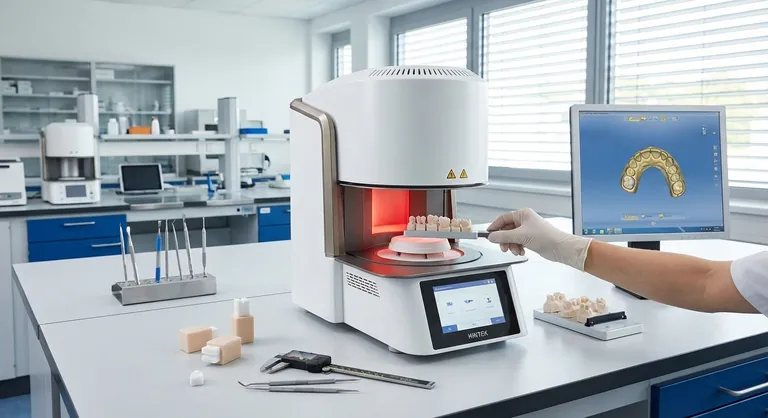
The Foundation of Clinical Excellence: Predictable, High-Quality Results
The ultimate goal of any restoration is a perfect fit and long-term function. A quality furnace is the critical tool for achieving this standard repeatably.
Unmatched Precision in Temperature Control
Modern dental ceramics, like zirconia and lithium disilicate, require incredibly specific heating and cooling protocols to achieve their desired strength and translucency.
A high-quality furnace provides exact temperature control, often to within a single degree. This precision ensures the material undergoes the correct physical and chemical changes, preventing micro-fractures or internal stresses.
The Impact of Consistency on Fit and Aesthetics
Inconsistent heating leads to unpredictable shrinkage and warping. This results in restorations that require significant chairside adjustments or must be completely remade.
By delivering stable and repeatable firing cycles, a furnace guarantees that each unit is a faithful reproduction of the digital design. This consistency is the key to achieving a perfect marginal fit and natural aesthetics every single time.
Enhanced Durability and Strength
The sintering process transforms a chalky, pre-milled restoration into an extremely hard ceramic capable of withstanding significant occlusal forces.
The furnace's ability to maintain a controlled atmosphere, sometimes with low oxygen levels, enhances material purity and ensures a complete, homogenous sinter. This process is what produces exceptionally durable restorations that are built to last.
Driving Operational and Financial Efficiency
Beyond the clinical advantages, a dental furnace delivers clear and measurable benefits to the business operations of a lab or dental practice.
Reducing Turnaround Times
Relying on an outside lab adds days to any restorative case. Bringing this capability in-house gives you complete control over the production schedule.
Modern sintering furnaces often feature shortened, automated cycles that can complete the process in a fraction of the traditional time, enabling same-day dentistry and improving patient satisfaction.
Minimizing Costly Remakes and Adjustments
A restoration that doesn't fit perfectly costs you in multiple ways: wasted material, lost lab time, and unproductive chair time.
Because a furnace’s precision leads to highly accurate results, the need for adjustments and remakes plummets. This directly reduces labor costs and material waste.
Expanding In-House Capabilities
A versatile furnace is an investment in future growth. It allows you to work with a wide range of materials and produce various types of restorations.
This adaptability means you can handle everything from single crowns and veneers to multi-unit bridges and implant abutments, expanding your service offerings and revenue streams.
Understanding the Critical Trade-offs
While the benefits are clear, achieving them depends on making informed choices. The furnace is not a magic box; it is a precision instrument that demands respect for the process.
Not All Furnaces Are Created Equal
The term "dental furnace" can refer to different machines. A sintering furnace reaches the high temperatures needed for zirconia, while a glazing or porcelain furnace operates at lower temperatures for final characterization. They are not interchangeable.
The Material-Machine Pairing is Non-Negotiable
Every ceramic material has a specific firing schedule validated by its manufacturer. Using the wrong program or the wrong type of furnace for a given material is a guarantee of failure.
Subpar restorations with compromised function and aesthetics are almost always traced back to an incorrect material-machine pairing.
The Learning Curve and Maintenance
Operating a furnace requires training and a commitment to proper maintenance and calibration. Staff must understand the protocols for each material to ensure consistent results.
Neglecting regular maintenance can lead to temperature drift and inconsistent outcomes, negating the primary benefits of the investment.
Making the Right Choice for Your Goal
Selecting a furnace should be driven by a clear understanding of your primary objective.
- If your primary focus is clinical quality: Prioritize furnaces with the most precise temperature control and proven consistency for your chosen ceramic systems.
- If your primary focus is operational efficiency: Look for models with shorter, validated cycles and the versatility to consolidate different restoration types into one workflow.
- If you are bringing production in-house: Choose a user-friendly furnace with strong manufacturer support, a clear workflow, and robust training resources for your team.
Ultimately, investing in the right dental furnace empowers you to take full control over the quality, speed, and profitability of your restorative work.
Summary Table:
| Benefit | Key Features | Impact |
|---|---|---|
| Precise Process Control | Exact temperature control, stable firing cycles | Ensures material integrity, prevents defects |
| Consistent Clinical Results | Repeatable cycles, controlled atmosphere | Perfect fit, natural aesthetics, enhanced durability |
| Operational Efficiency | Shortened automated cycles, reduced remakes | Faster turnaround, cost savings, expanded services |
Ready to elevate your dental lab or practice with advanced ceramic solutions? Leveraging exceptional R&D and in-house manufacturing, KINTEK provides diverse laboratories with advanced high-temperature furnace solutions. Our product line, including Muffle, Tube, Rotary Furnaces, Vacuum & Atmosphere Furnaces, and CVD/PECVD Systems, is complemented by our strong deep customization capability to precisely meet unique experimental requirements. Whether you're focused on clinical quality, operational efficiency, or expanding in-house capabilities, we can help you achieve superior results. Contact us today to discuss how our furnaces can transform your workflow and boost profitability!
Visual Guide

Related Products
- Dental Porcelain Zirconia Sintering Ceramic Vacuum Press Furnace
- Chairside Dental Porcelain Zirconia Sintering Furnace with Transformer for Ceramic Restorations
- Vacuum Dental Porcelain Sintering Furnace for Dental Laboratories
- Vacuum Heat Treat Furnace with Ceramic Fiber Liner
- High Temperature Muffle Oven Furnace for Laboratory Debinding and Pre Sintering
People Also Ask
- What factors determine the quality of sintered zirconia restorations? Master Material, Equipment, and Technique
- How do conventional vs rapid sintering in dental furnaces affect zirconia? Optimize Efficiency Without Sacrificing Strength
- What is the purpose of dental sintering furnaces? Transform Zirconia into Durable, High-Quality Dental Restorations
- What precautions should be taken when sintering zirconia in the Fast Slow Dental Sintering Furnace? Master Key Steps for Perfect Results
- What temperature range is used for sintering zirconia ceramics? Achieve Optimal Strength and Translucency






