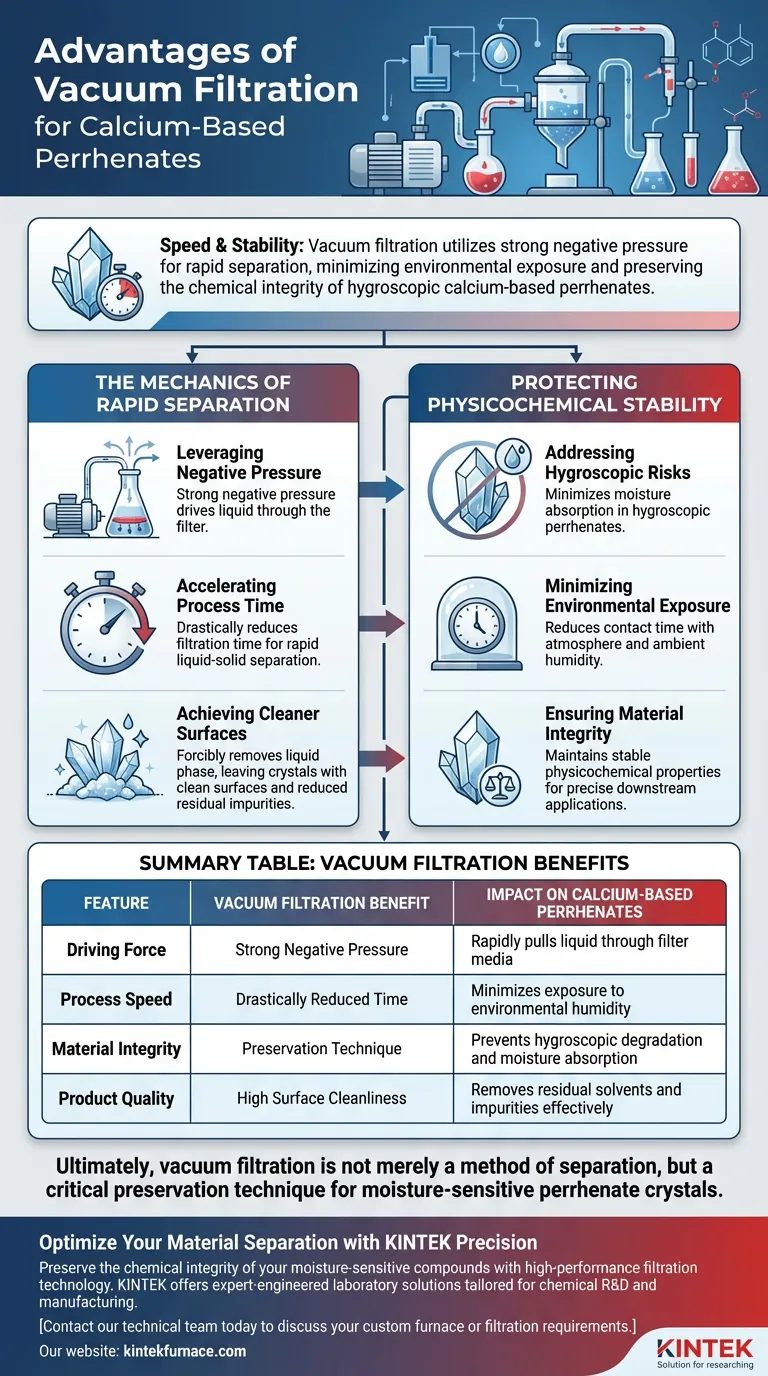
Vacuum filtration systems provide a decisive advantage by utilizing strong negative pressure to accelerate the separation of crystals from the mother liquor. This rapid processing is essential for minimizing the exposure of calcium-based perrhenates to the environment, thereby preserving their chemical integrity and ensuring surface cleanliness.
The core benefit lies in the relationship between speed and stability. Because calcium-based perrhenates are hygroscopic, the rapid separation provided by vacuum filtration minimizes contact with humid air, preventing moisture absorption that would otherwise compromise the physicochemical properties of the crystals.
The Mechanics of Rapid Separation
Leveraging Negative Pressure
Vacuum filtration systems do not rely on gravity alone; they generate a strong negative pressure driving force. This differential pressure actively pulls liquid through the filter medium.
Accelerating Process Time
The primary operational benefit is the drastic reduction in filtration time. This allows for the rapid separation of solid crystals from the surrounding mother liquor.
Achieving Cleaner Surfaces
By forcibly removing the liquid phase, the system leaves behind crystals with clean surfaces. This reduces the amount of residual solvent or impurities clinging to the final product.
Protecting Physicochemical Stability
Addressing Hygroscopic Risks
Calcium-based perrhenate crystals are hygroscopic, meaning they have a tendency to absorb moisture from the surrounding environment. If left exposed during a slow filtration process, the quality of the crystal degrades.
Minimizing Environmental Exposure
The speed of vacuum filtration is a quality control measure, not just a time-saver. By minimizing the contact time with the atmosphere, the system prevents the crystals from reacting with ambient humidity.
Ensuring Material Integrity
Rapid isolation ensures the crystals maintain stable physicochemical properties. This is critical for downstream applications where precise chemical composition and surface characteristics are required.
Operational Considerations and Trade-offs
Equipment Complexity
Unlike simple gravity filtration, vacuum systems require pumps, seals, and pressure-rated vessels. This introduces a layer of mechanical complexity and maintenance requirements to the workflow.
Managing Seal Integrity
To maintain the necessary pressure differential, system integrity is paramount. Leaks in the vacuum line can reduce efficiency and potentially re-introduce contaminants or moisture into the process.
Making the Right Choice for Your Goal
To determine if vacuum filtration is necessary for your specific application, consider your primary constraints:
- If your primary focus is Crystal Purity: Prioritize vacuum filtration to minimize environmental exposure and prevent moisture absorption in hygroscopic materials.
- If your primary focus is Process Efficiency: Implement vacuum systems to significantly reduce the time required for liquid-solid separation compared to gravity methods.
Ultimately, vacuum filtration is not merely a method of separation, but a critical preservation technique for moisture-sensitive perrhenate crystals.
Summary Table:
| Feature | Vacuum Filtration Benefit | Impact on Calcium-based Perrhenates |
|---|---|---|
| Driving Force | Strong Negative Pressure | Rapidly pulls liquid through filter media |
| Process Speed | Drastically Reduced Time | Minimizes exposure to environmental humidity |
| Material Integrity | Preservation Technique | Prevents hygroscopic degradation and moisture absorption |
| Product Quality | High Surface Cleanliness | Removes residual solvents and impurities effectively |
Optimize Your Material Separation with KINTEK Precision
Preserve the chemical integrity of your moisture-sensitive compounds with high-performance filtration technology. KINTEK provides expert-engineered laboratory solutions tailored to the rigorous demands of chemical R&D and manufacturing.
Backed by expert R&D and manufacturing, KINTEK offers a comprehensive range of Muffle, Tube, Rotary, Vacuum, and CVD systems, alongside specialized lab equipment, all customizable for your unique processing needs. Whether you are handling hygroscopic perrhenates or advanced ceramic slurries, our systems ensure maximum stability and purity.
Contact our technical team today to discuss your custom furnace or filtration requirements.
Visual Guide
References
- New calcium perrhenates: synthesis and crystal structures of Ca(ReO<sub>4</sub>)<sub>2</sub> and K<sub>2</sub>Ca<sub>3</sub>(ReO<sub>4</sub>)<sub>8</sub>·4H<sub>2</sub>O. DOI: 10.1515/zkri-2025-0008
This article is also based on technical information from Kintek Furnace Knowledge Base .
Related Products
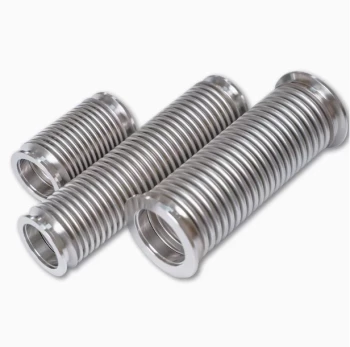
- High Performance Vacuum Bellows for Efficient Connection and Stable Vacuum in Systems
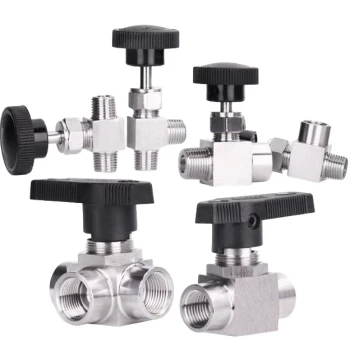
- 304 316 Stainless Steel High Vacuum Ball Stop Valve for Vacuum Systems
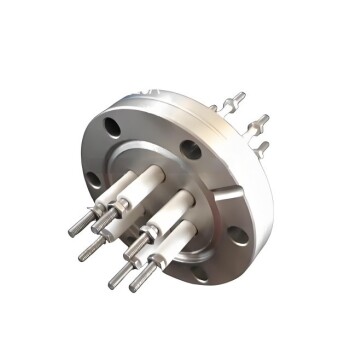
- CF KF Flange Vacuum Electrode Feedthrough Lead Sealing Assembly for Vacuum Systems
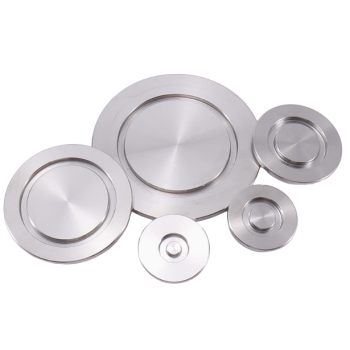
- Stainless Steel KF ISO Vacuum Flange Blind Plate for High Vacuum Systems
- Vacuum Induction Melting Furnace
People Also Ask
- Why is an Ultra-High Vacuum (UHV) System Required for In2Se3? Achieving Atomic-Level Ferroelectric Clarity
- Why is an environmental laboratory chamber equipped with an optical window required for synthesizing Hafnium Carbide?
- What role does a closed pressure vessel play during the carbonation of gamma-C2S? Unlock Rapid Mineralization
- Why are desiccators containing saturated salt solutions used when evaluating the hygroscopicity of modified wood?
- How does the pressure environment affect the metallic thermal reduction for titanium? Master Precision Control