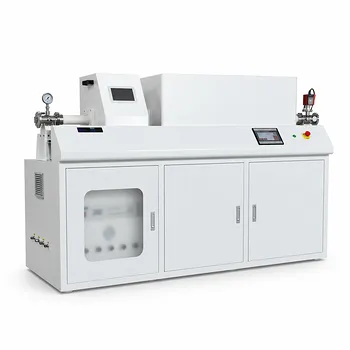
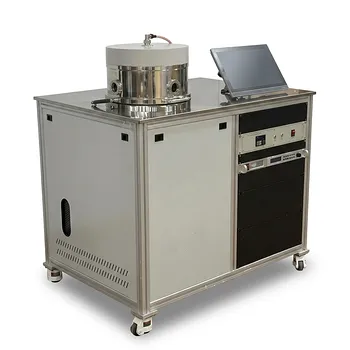
The integration of a vertical split tube furnace with a hydraulic loading system provides a unique environment where mechanical stress and high temperatures are applied simultaneously to HSECC specimens. This setup is superior to traditional testing because it captures the real-time evolution of matrix softening and fiber bridging effects, providing data that reflects the actual performance of structural components during a fire or industrial heat event.
This in-situ testing configuration moves beyond "post-heating" analysis to provide a high-fidelity simulation of how HSECC behaves under simultaneous thermal and mechanical loads. It ensures that the critical transition phases of the material are captured with precision, rather than inferred after the specimen has cooled.
Realistic Simulation of Engineering Conditions
Real-Time Mechanical and Thermal Synergy
The vertical configuration allows loading rods to pass directly through the furnace body to the cylindrical specimen. This enables the simultaneous application of mechanical loads and high temperatures, which is essential for simulating the stress states of load-bearing structural members.
Capturing Micro-Mechanical Behavior
Traditional tests often measure material properties after the specimen has cooled (post-heating), which can mask the true behavior of the composite. This in-situ system captures the real-time softening of the cementitious matrix and the critical fiber bridging mechanism that gives HSECC its unique ductility.
Accurate Simulation of Structural Stress
Engineers can simulate both stress and non-stress states by adjusting the hydraulic load during the heating cycle. This provides a more realistic representation of how a building column or beam would respond to a fire while supporting a structural load.
Operational Efficiency and Precision
Enhanced Accessibility via Split Design
The split-tube design allows the furnace to be opened completely, which simplifies the positioning of the specimen and the alignment of the hydraulic loading rods. This significantly reduces downtime between tests and facilitates the complex setup required for in-situ instrumentation.
Temperature Uniformity and Stability
Vertical tube furnaces provide excellent temperature uniformity along the length of the specimen, which is vital for consistent results in cementitious composites. These systems can maintain stable isothermal heating and support precise heating rates (e.g., 2°C/min) up to 800°C.
Space Efficiency in Laboratory Settings
The vertical footprint of these furnaces is much smaller than horizontal models, making them ideal for laboratories where space is at a premium. This design also minimizes gas movement within the chamber, reducing unwanted convection currents that could interfere with thermal stability.
Understanding the Trade-offs
Mechanical Alignment Challenges
The primary difficulty with this setup is ensuring perfect axial alignment between the hydraulic rods and the specimen within the furnace. Even slight misalignments can introduce bending moments, which may lead to premature failure and inaccurate compressive strength data.
Thermal Expansion of Loading Rods
The loading rods themselves are subject to thermal expansion during the test, which can interfere with displacement measurements. Highly specialized materials or sophisticated compensation software are required to differentiate between the deformation of the specimen and the expansion of the equipment.
Complexity of Instrumentation
Installing internal sensors, such as high-temperature strain gauges or thermocouples, is more difficult in a closed, pressurized environment. The presence of loading rods limits the available space for additional monitoring equipment, requiring careful planning of the experimental layout.
Making the Right Choice for Your Goal
How to Apply This to Your Project
- If your primary focus is material development: Use the in-situ setup to observe the specific temperature intervals where fiber-matrix debonding occurs to optimize your mix design.
- If your primary focus is structural safety standards: Focus on the simultaneous load application to generate conservative and realistic fire-resistance ratings for HSECC components.
- If your primary focus is laboratory throughput: Leverage the split-body feature to enable faster sample turnover and more efficient batch processing of cylindrical specimens.
By combining hydraulic force with precise thermal control, researchers can finally see how High-Strength Engineered Cementitious Composites truly perform when the heat is on and the pressure is high.
Summary Table:
| Key Feature | Advantage for HSECC Testing | Research Impact |
|---|---|---|
| In-Situ Loading | Simultaneous mechanical & thermal stress | Realistic fire/heat event simulation |
| Split-Body Design | Easy specimen and loading rod alignment | Faster setup and reduced laboratory downtime |
| Vertical Alignment | Uniform heating & minimal gas convection | Consistent results for cylindrical specimens |
| Real-Time Analysis | Captures matrix softening & fiber bridging | Accurate data on micro-mechanical behavior |
Elevate Your Material Research with KINTEK Precision
Achieving high-fidelity results in in-situ compression experiments requires thermal equipment that integrates seamlessly with your mechanical systems. KINTEK specializes in high-performance laboratory equipment, offering a comprehensive range of tube, muffle, vacuum, CVD, and atmosphere furnaces, all customizable to accommodate complex hydraulic loading and instrumentation setups.
From optimizing HSECC mix designs to setting new structural safety standards, our team provides the reliable, high-temperature solutions you need to push the boundaries of material science.
Ready to customize your testing environment? Contact KINTEK experts today and let’s build your ideal furnace solution.
References
- S. Rawat, Y. X. Zhang. In‐situ compressive and tensile performances of high strength engineered cementitious composite at elevated temperatures. DOI: 10.1002/suco.202300724
This article is also based on technical information from Kintek Furnace Knowledge Base .
Related Products
- Vertical Laboratory Quartz Tube Furnace Tubular Furnace
- 1200℃ Split Tube Furnace Laboratory Quartz Tube Furnace with Quartz Tube
- Split Multi Heating Zone Rotary Tube Furnace Rotating Tube Furnace
- Split Chamber CVD Tube Furnace with Vacuum Station CVD Machine
- Custom Made Versatile CVD Tube Furnace Chemical Vapor Deposition CVD Equipment Machine
People Also Ask
- What are the key differences between single-zone and multi-zone vertical tube furnaces? Choose the Right Furnace for Your Lab
- What is the purpose of using an industrial-grade vertical tube furnace in phosphorus recovery? High-Fidelity Simulation
- What are the main characteristics of vertical tube furnaces? Optimize Your Lab with Space-Saving, Uniform Heating
- What is a vertical tube furnace and how does it function? Optimize Material Processing with Precision
- How do heat treatment processes influence the configuration of a vertical tube furnace? Optimize for Quenching, Annealing, and More