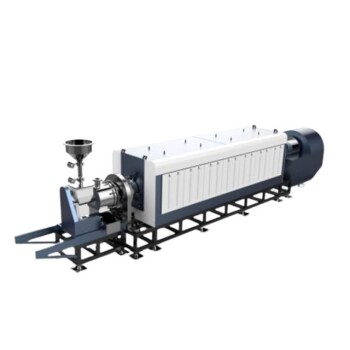
The horizontal process forced pyrolysis furnace provides a highly controlled, high-temperature, hypoxic environment specifically designed to transform biomass into high-performance catalysts. This equipment excels by facilitating the rapid discharge of volatiles and ensuring uniform thermal distribution, which results in biomass char with a stable, porous graphite structure.
This technology bridges the gap between raw organic waste and functional materials by providing the precise thermal and atmospheric conditions required to engineer specific pore structures and electronic properties. Its design ensures that biomass is not merely burned, but chemically restructured into a high-value catalytic agent.
Precision Control of the Reaction Environment
Maintaining a Strictly Oxygen-Free Atmosphere
A primary advantage of this furnace is its ability to create a strictly oxygen-free environment using continuous high-purity nitrogen flushing or vacuum systems. This prevents the oxidative combustion of the biomass, ensuring that the carbon structure is preserved rather than turned to ash.
Programmed Multi-Stage Heating
These furnaces support a wide temperature range—typically from 300°C to 1100°C—and allow for precise heating rates (e.g., 1.5 to 15°C per minute). This granularity enables researchers to simulate different thermal processing stages, such as an initial dehydration phase followed by a high-temperature carbonization and activation phase.
In-Situ Electronic Regulation
By maintaining a vacuum or specific gas flow, the furnace can guide solid-phase reactions between carbon sources and metal ions. This is critical for converting metal components into specific carbide clusters, achieving a level of electronic structure regulation that is difficult to reach with traditional batch heating methods.
Optimization of Catalyst Structural Characteristics
Uniform Heating for Graphitic Stability
The horizontal design creates a uniform heating field, which is essential for producing biomass char with a consistent porous graphite structure. This uniformity ensures that the resulting catalyst has stable mechanical and chemical properties throughout the entire batch.
Enhanced Pore Development
Through the use of chemical activators like phosphoric acid within the furnace, the equipment facilitates dehydration and cross-linking. This process results in activated carbon with a high specific surface area and a rich microporous structure, both of which are vital for catalytic efficiency.
High-Temperature Resistance and Purity
Many horizontal furnaces utilize high-purity quartz tubes as the core reaction zone. Quartz is chemically inert and can withstand temperatures above 550°C without reacting with the biomass, ensuring the chemical purity of the produced aromatic compounds and catalysts.
Process Efficiency and Quantitative Analysis
Integrated Product Recovery
The structural design of the horizontal reactor facilitates the flow of pyrolysis-generated oil and gas mixtures into condensation systems. This allows for the classified collection and quantitative analysis of bio-oil and gas, providing a complete picture of the mass balance.
Rapid Volatile Discharge
The "forced" nature of the process allows for the rapid discharge of volatiles, which are then converted into bio-oil. This speed prevents secondary reactions that could degrade the quality of the solid biomass char intended for catalyst use.
Ease of Maintenance and Observation
The use of transparent or semi-transparent reaction tubes allows for the visual observation of the pyrolysis process. Additionally, the horizontal layout makes it significantly easier to clean carbon deposits and recover solid residues compared to vertical or complex batch reactors.
Understanding the Trade-offs
Equipment Throughput vs. Precision
While these furnaces offer extreme precision for catalyst synthesis, they are often designed for laboratory or pilot scales. Transitioning these exact thermal profiles to industrial-scale mass production can be challenging due to the difficulty of maintaining uniform heat transfer in much larger volumes.
Material Limitations
The reliance on quartz tubes or specific alloys for purity introduces fragility and cost concerns. Quartz is susceptible to thermal shock if cooled too rapidly, and specific chemical activators used in biomass preparation may eventually etch or degrade the tube surface over time.
How to Apply This to Your Project
Making the Right Choice for Your Goal
- If your primary focus is high-activity carbon catalysts: Utilize a nitrogen-flushed horizontal furnace with programmed multi-stage heating to maximize the development of microporous structures.
- If your primary focus is metal-doped catalyst synthesis: Use a vacuum-capable horizontal furnace to facilitate in-situ solid-phase reactions between metal ions and the carbon matrix.
- If your primary focus is byproduct recovery (Bio-oil/Gas): Select a reactor integrated with a multi-stage condensation system to ensure the integrity of your product distribution data.
By leveraging the uniform heating and atmospheric precision of a horizontal forced pyrolysis furnace, you can transform raw biomass into a sophisticated, high-value tool for modern chemical synthesis.
Summary Table:
| Feature | Benefit | Catalyst Outcome |
|---|---|---|
| Oxygen-Free Environment | Prevents oxidative combustion | Preserves stable, high-purity carbon structure |
| Uniform Heating Field | Consistent thermal distribution | Stable porous graphite structure throughout batch |
| Multi-Stage Heating | Precise ramp rates (1.5-15°C/min) | Optimized dehydration and activation phases |
| Forced Volatile Discharge | Prevents secondary reactions | Enhanced development of microporous structures |
| Integrated Recovery | Rapid condensation of bio-oils | Precise quantitative mass balance analysis |
Elevate Your Catalyst Research with KINTEK Precision
Maximize the potential of your biomass conversion with KINTEK, your specialist in high-performance laboratory equipment and consumables. We understand that precise thermal engineering is the key to superior catalyst synthesis.
Whether you require tube furnaces for horizontal pyrolysis, vacuum or atmosphere furnaces for oxygen-free reactions, or advanced CVD and rotary systems, KINTEK provides a comprehensive range of high-temperature solutions. From muffle and dental furnaces to induction melting systems, all our equipment is fully customizable to meet your unique research specifications and ensure repeatable, high-purity results.
Ready to optimize your lab’s thermal processing? Contact our technical experts today to discuss your project requirements and discover the KINTEK advantage!
References
- Mohammad Siddique, Mohammad Asif. Lignin extraction and green-like lignocellulose biomass pyrolysis as an alternative sustainable biofuel. DOI: 10.15406/mojbm.2023.08.00190
This article is also based on technical information from Kintek Furnace Knowledge Base .
Related Products
- Electric Rotary Kiln Small Rotary Furnace Biomass Pyrolysis Plant Rotating Furnace
- Electric Rotary Kiln Continuous Working Small Rotary Furnace Kiln for Pyrolysis Plant Heating
- Electric Rotary Kiln Pyrolysis Furnace Plant Machine Small Rotary Kiln Calciner
- Spark Plasma Sintering SPS Furnace
- Multi Heating Zones CVD Tube Furnace Machine for Chemical Vapor Deposition Equipment
People Also Ask
- What are the main applications of a rotary kiln electric furnace? Achieve Uniform Heat Treatment for Powders
- What are the key components of a rotary kiln electric furnace? Unlock Efficient Thermal Processing
- What is the significance of the refractory lining in a rotary kiln electric furnace? Unlock Efficiency and Longevity
- What is the benefit of adjustable speed control in rotary kilns? Optimize Efficiency and Quality
- What are the main advantages of using rotary kilns for bulk solids processing? Achieve High-Volume, Uniform Thermal Processing