
In short, Chemical Vapor Deposition (CVD) furnaces are critical in any field that requires the creation of ultra-pure, high-performance solid materials and thin films. They are most widely applied in the manufacturing of semiconductors, aerospace components, solar panels, and advanced optical coatings, serving as the foundational technology for much of the modern digital and industrial world.
The core value of a CVD furnace is its ability to build materials atom by atom from a gas phase. This precise control allows for the creation of exceptionally pure, thin, and uniform layers that give products advanced properties—from the processing power of a microchip to the durability of a jet engine blade.
The Core Function: Building Materials Atom by Atom
What is Chemical Vapor Deposition?
Chemical Vapor Deposition is a process where volatile precursor gases react or decompose on a heated surface, known as a substrate. This chemical reaction results in the deposition of a high-quality solid film onto that surface.
The furnace provides the strictly controlled environment—specifically high temperature and pressure—necessary for these reactions to occur repeatably and with high purity. It is less like baking and more like high-tech spray-painting with individual molecules.
Why This Method is Essential
This atomic-level control is crucial for creating materials with specific, enhanced properties that are impossible to achieve through traditional melting or machining. The resulting films can be harder, more conductive, more resistant to heat, or have unique optical qualities.
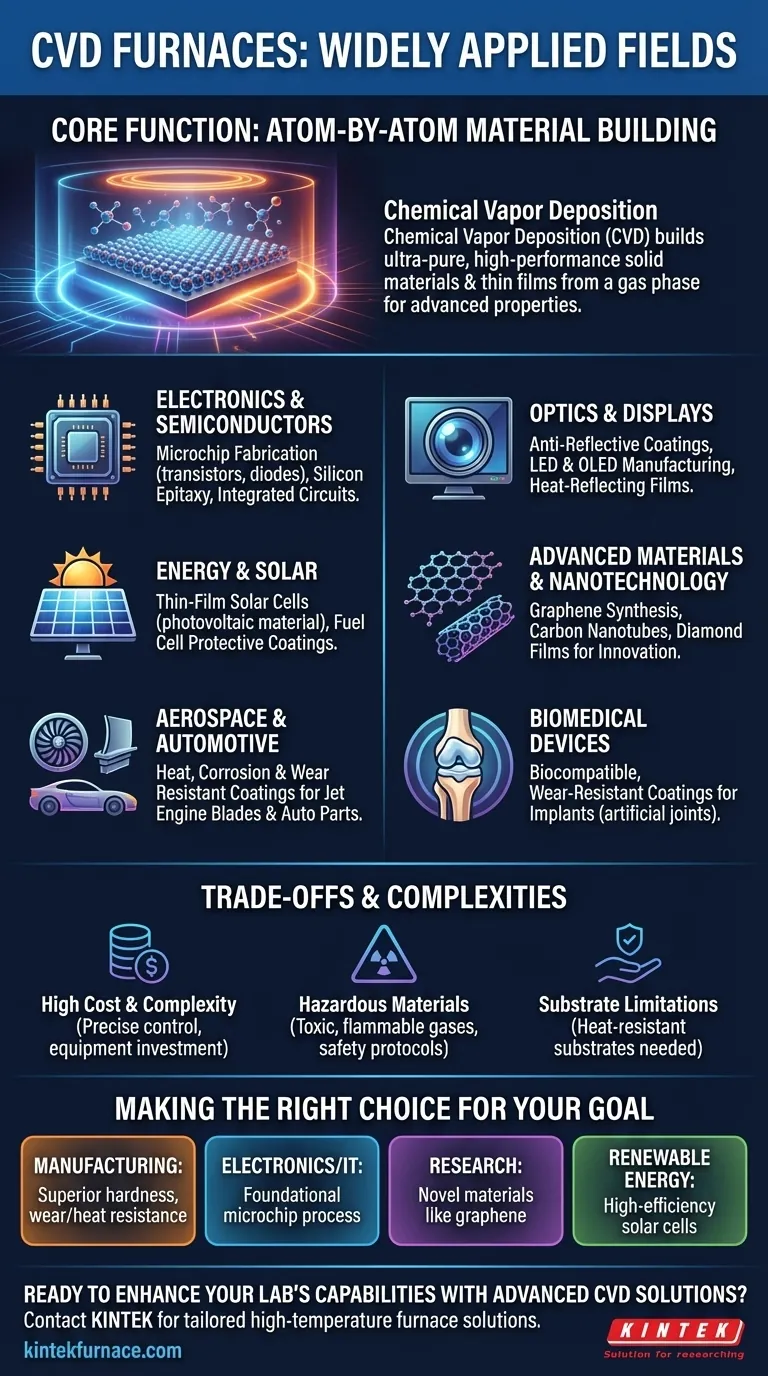
Key Applications by Industry
CVD's versatility makes it a cornerstone technology across numerous high-value sectors.
Electronics and Semiconductors
This is arguably the most significant application of CVD. Modern electronics would not exist without it.
The process is used to deposit the critical thin films of materials like silicon, silicon nitride, and other dielectrics that form the transistors, diodes, and integrated circuits at the heart of every microchip. It is also used for the epitaxial growth of silicon wafers.
Energy and Solar
CVD is vital for manufacturing next-generation energy systems.
It is a key step in fabricating thin-film solar cells, where layers of photovoltaic material are deposited onto a substrate. The technology is also used to create specialized protective coatings for components within fuel cells.
Aerospace and Automotive
In industries where performance and reliability are paramount, CVD provides essential durability.
High-performance coatings are applied to components like jet engine turbine blades and automotive parts to provide exceptional resistance to heat, corrosion, and wear. These hard coatings dramatically extend the operational life of critical parts.
Optics and Displays
CVD is used to create a wide range of advanced optical coatings.
This includes anti-reflective coatings on lenses and sunglasses, heat-reflecting films on architectural glass, and protective layers on mirrors. It is also instrumental in manufacturing LEDs and OLEDs for modern displays and lighting.
Advanced Materials and Nanotechnology
For researchers and scientists, CVD furnaces are essential tools for innovation.
The technology enables the synthesis of groundbreaking materials like graphene sheets, carbon nanotubes, and diamond films. These materials have revolutionary potential in fields ranging from TV displays and water filtration to advanced electronics.
Biomedical Devices
CVD provides a way to make medical implants safer and more durable.
Extremely hard and biocompatible wear-resistant coatings are deposited on biomedical implants, such as artificial joints, to improve their longevity and reduce friction within the body.
Understanding the Trade-offs
While powerful, CVD technology is not without its complexities and limitations.
High Cost and Complexity
CVD systems are sophisticated and expensive. They require precise control over temperature, pressure, and the flow of highly pure gases, making the initial investment and operational costs significant.
Hazardous Materials
The precursor gases used in the CVD process can be toxic, flammable, or corrosive. This necessitates strict safety protocols, specialized handling equipment, and robust exhaust management systems, adding to the complexity of the operation.
Substrate Limitations
The CVD process often requires very high temperatures. This limits the types of substrate materials that can be used, as the substrate must be able to withstand the heat without melting, warping, or degrading.
Making the Right Choice for Your Goal
Understanding the role of CVD is essential for anyone involved in high-technology fields. Your focus determines which application is most relevant.
- If your primary focus is manufacturing and engineering: See CVD as a tool for creating parts with superior hardness, wear resistance, and heat tolerance for demanding environments like aerospace and automotive.
- If your primary focus is electronics or IT: Recognize that CVD is the foundational process that enables the very existence of microchips, processors, and advanced displays.
- If your primary focus is research and academia: View CVD furnaces as essential platforms for synthesizing novel materials like graphene and carbon nanotubes, pushing the boundaries of material science.
- If your primary focus is renewable energy: Understand that CVD is a key manufacturing step for improving the efficiency and scalability of thin-film solar cells and other clean energy components.
Ultimately, the widespread application of CVD furnaces stems from their unique ability to construct high-performance materials with atomic precision, making them an indispensable engine of modern innovation.
Summary Table:
| Field | Key Applications |
|---|---|
| Electronics & Semiconductors | Microchip fabrication, silicon epitaxy |
| Aerospace & Automotive | Heat-resistant coatings for turbine blades, wear-resistant parts |
| Energy & Solar | Thin-film solar cells, fuel cell coatings |
| Optics & Displays | Anti-reflective coatings, LED/OLED manufacturing |
| Advanced Materials & Nanotechnology | Graphene synthesis, carbon nanotubes |
| Biomedical Devices | Biocompatible coatings for implants |
Ready to enhance your lab's capabilities with advanced CVD solutions? At KINTEK, we leverage exceptional R&D and in-house manufacturing to provide high-temperature furnace solutions tailored to your needs. Our product line includes CVD/PECVD Systems, Muffle, Tube, Rotary, Vacuum & Atmosphere Furnaces, all backed by strong deep customization to meet your unique experimental requirements. Whether you're in semiconductors, aerospace, or research, we can help you achieve precise material synthesis and superior performance. Contact us today to discuss how our expertise can benefit your projects!
Visual Guide
Related Products
- Custom Made Versatile CVD Tube Furnace Chemical Vapor Deposition CVD Equipment Machine
- Split Chamber CVD Tube Furnace with Vacuum Station CVD Machine
- Multi Heating Zones CVD Tube Furnace Machine for Chemical Vapor Deposition Equipment
- Slide PECVD Tube Furnace with Liquid Gasifier PECVD Machine
- Controlled Inert Nitrogen Hydrogen Atmosphere Furnace
People Also Ask
- Why are CVD tube furnace sintering systems indispensable for 2D material research and production? Unlock Atomic-Scale Precision
- What is a CVD tube furnace and what is its primary function? Discover Precision Thin-Film Deposition
- Which industries and research fields benefit from CVD tube furnace sintering systems for 2D materials? Unlock Next-Gen Tech Innovations
- How does CVD tube furnace sintering enhance graphene growth? Achieve Superior Crystallinity and High Electron Mobility
- What future trends are expected in the development of CVD tube furnaces? Discover Smarter, More Versatile Systems



















