
Precision temperature control is the single most critical factor in converting sugarcane bagasse into reactive ash. A muffle furnace allows you to maintain a strict calcination range, typically between 600°C and 800°C, ensuring organic carbon is fully burned off while preventing the silica from becoming unreactive.
By effectively balancing heat intensity, the muffle furnace creates an amorphous silica structure. This specific non-crystalline state is essential for maximizing pozzolanic activity, allowing the ash to react effectively with cement hydration products.
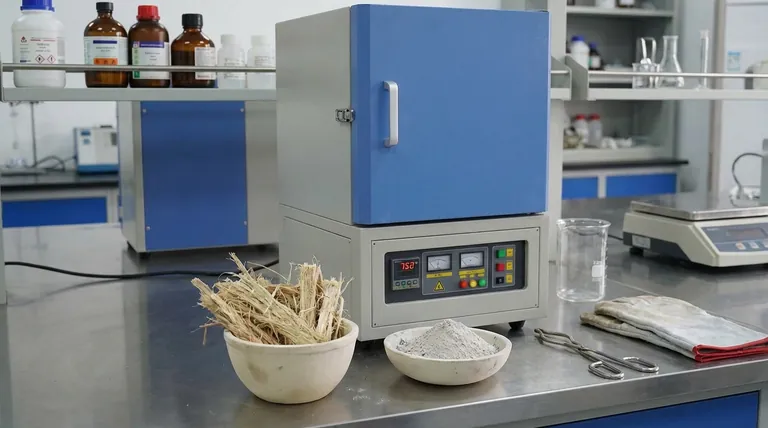
The Mechanics of Calcination
Achieving Complete Combustion
The primary function of the muffle furnace in this context is calcination.
This process involves heating the bagasse to a temperature sufficient to burn off organic matter.
Without reaching the lower threshold of approximately 600°C, carbon residues remain, resulting in "black ash" that negatively impacts the final material's quality.
Preventing Crystallization
While high heat is necessary to remove impurities, too much heat is detrimental.
If temperatures exceed the 800°C upper limit, the silica within the bagasse begins to crystallize.
The muffle furnace’s precise control prevents this transition, ensuring the material does not turn into unreactive quartz or cristobalite.
The Link Between Temperature and Reactivity
Preserving Amorphous Structure
The "activity" of bagasse ash refers to its chemical reactivity.
For the ash to be useful in industrial applications, specifically as a cement replacement, the silica must remain amorphous (non-crystalline).
A muffle furnace maintains the environment necessary to keep the silica atoms in a disordered, highly reactive state.
Maximizing Pozzolanic Activity
When the silica is amorphous, it possesses high pozzolanic activity.
This allows the ash to undergo secondary reactions with calcium hydroxide (a byproduct of cement hydration).
These reactions produce additional binding gels, significantly enhancing the strength and durability of concrete composites.
Understanding the Trade-offs
The Risk of Under-heating
Operating below the 600°C threshold preserves the amorphous structure but fails to remove carbon.
High carbon content increases water demand in concrete and reduces strength, rendering the ash unsuitable for high-performance applications.
The Danger of Over-heating (Sintering)
Exceeding 800°C leads to sintering, where particles fuse together.
This drastically reduces the surface area of the ash and converts reactive silica into inert crystalline forms.
Once sintering occurs, the ash loses its ability to react with cement, effectively becoming just an inert filler rather than an active binder.
Making the Right Choice for Your Goal
To optimize your production of bagasse ash, consider your specific end-use requirements:
- If your primary focus is maximum chemical reactivity: strictly maintain the furnace temperature between 600°C and 800°C to guarantee an amorphous silica structure.
- If your primary focus is material purity: ensure the furnace reaches at least 600°C to achieve complete carbon combustion and eliminate organic impurities.
Control the temperature accurately, and you transform agricultural waste into a high-value industrial resource.
Summary Table:
| Temperature Range | Material State | Resulting Ash Quality | Pozzolanic Activity |
|---|---|---|---|
| < 600°C | Incomplete Combustion | High Carbon (Black Ash) | Low (Contaminated) |
| 600°C - 800°C | Amorphous Silica | High-Activity Ash | Maximum (Optimal) |
| > 800°C | Crystalline/Sintered | Inert Filler (Quartz) | Minimal (Inactive) |
Transform Agricultural Waste into High-Value Resources with KINTEK
Precision is the difference between reactive ash and inert waste. Backed by expert R&D and manufacturing, KINTEK offers high-performance Muffle, Tube, Rotary, Vacuum, and CVD systems designed to maintain the strict thermal thresholds required for your material science breakthroughs. Whether you are researching amorphous silica structures or scaling industrial production, our lab high-temperature furnaces are fully customizable to meet your unique needs.
Ready to achieve superior calcination results? Contact KINTEK today to discuss your project requirements and see how our advanced heating solutions can optimize your lab's efficiency and output.
References
- Partial Replacement of Cement with Bagasse Ash in Concrete. DOI: 10.55041/ijsrem44544
This article is also based on technical information from Kintek Furnace Knowledge Base .
Related Products
- 1400℃ Muffle Oven Furnace for Laboratory
- 1700℃ High Temperature Muffle Oven Furnace for Laboratory
- 1800℃ High Temperature Muffle Oven Furnace for Laboratory
- 1200℃ Muffle Oven Furnace for Laboratory
- High Temperature Muffle Oven Furnace for Laboratory Debinding and Pre Sintering
People Also Ask
- What is the primary function of a high-temperature laboratory muffle furnace in chemical synthesis? Achieve Precision.
- How does a high-temperature laboratory muffle furnace affect material properties? Transform Anodic Oxide Films Fast
- How is a laboratory high-temperature muffle furnace used in agloporite preparation? Optimize Material Synthesis
- How does a muffle furnace facilitate Ag/ATP catalyst preparation? Optimize Calcination for Superior Performance
- What is the role of a laboratory high-temperature muffle furnace in H13 steel treatment? Optimize Tool Performance



















