
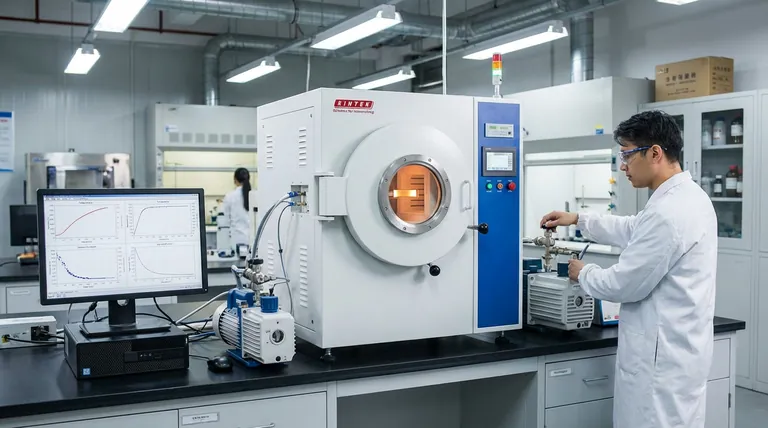
The vacuum tube furnace serves as the foundational processing environment for FePC amorphous alloys, enabling the precise modification of their internal structure without compromising surface integrity. Its primary contribution is creating a strictly controlled, oxygen-free thermal zone that allows researchers to fine-tune the material's transition from an amorphous state to a nanocrystalline state.
Core Insight: The utility of a vacuum tube furnace lies in its ability to decouple thermal treatment from chemical reaction. By eliminating oxygen, it ensures that changes in the FePC alloy’s performance are solely the result of intended microstructural evolution, such as $\alpha$-Fe precipitation, rather than unintended surface oxidation.
The Role of Environmental Control
Eliminating Surface Oxidation
The primary function of the vacuum tube furnace is the creation of an oxygen-free environment.
FePC amorphous alloys are susceptible to intense oxidation when exposed to high temperatures in standard atmospheres. This furnace technology effectively prevents the formation of oxide layers on the ribbon surface. This preservation is critical for ensuring that subsequent testing reflects the true properties of the alloy rather than a degraded surface layer.
Ensuring Experimental Integrity
The vacuum environment acts as a variable control mechanism.
By guaranteeing a pristine surface state, the furnace allows researchers to attribute changes in performance directly to internal structural shifts. This is essential for accurately studying both magnetic properties and catalytic degradation performance, which would otherwise be skewed by surface contamination.
Driving Microstructural Evolution
Facilitating Structural Relaxation
The furnace provides the precise thermal regulation required for structural relaxation.
Before crystallization occurs, amorphous materials often undergo a relaxation phase where internal stresses are relieved. The precise temperature control of the tube furnace allows the material to reach this state without overshooting into full crystallization, maintaining the amorphous nature if desired.
Controlled Nanocrystallization
The furnace enables the targeted precipitation of specific phases, most notably alpha-Fe ($\alpha$-Fe) particles.
By holding specific annealing temperatures, the furnace drives the controlled growth of these nanocrystals within the amorphous matrix. This ability to dictate the exact degree of crystallization is what allows for the customization of the material's magnetic and mechanical characteristics.
Understanding the Trade-offs
Sensitivity to Process Parameters
While the vacuum tube furnace offers high precision, it also introduces a high penalty for parameter errors.
Because the process drives subtle phase transformations (like the precipitation of $\alpha$-Fe), even minor deviations in temperature or holding time can lead to undesirable microstructures. A temperature overshoot may result in excessive grain growth, which can deteriorate the soft magnetic properties the treatment aims to enhance.
Dependency on Vacuum Integrity
The reliability of the data is entirely dependent on the quality of the vacuum seal.
Unlike atmosphere furnaces that might tolerate slight leakage due to positive gas pressure, a vacuum furnace relies on the absolute absence of gas. Any breach during the high-temperature phase will instantly oxidize the FePC ribbon, rendering the sample useless for catalytic or magnetic surface analysis.
Making the Right Choice for Your Goal
The vacuum tube furnace is a tool for precision. How you configure it depends on the specific property you are trying to optimize in the FePC alloy.
- If your primary focus is Magnetic Permeability: Prioritize precise temperature holding to induce controlled structural relaxation and limited $\alpha$-Fe precipitation, avoiding full crystallization which increases coercivity.
- If your primary focus is Catalytic Performance: Prioritize the integrity of the vacuum level to ensure the surface remains chemically active and free of passivating oxide layers during the heat treatment.
The vacuum tube furnace converts the theoretical potential of FePC alloys into realized performance by acting as a strict gatekeeper against oxidation and thermal inconsistency.
Summary Table:
| Feature | Contribution to FePC Annealing | Benefit to Material Properties |
|---|---|---|
| Oxygen-Free Zone | Prevents surface oxidation of FePC ribbons | Ensures chemical activity and surface integrity |
| Thermal Regulation | Facilitates precise structural relaxation | Relieves internal stresses without over-crystallization |
| Phase Control | Drives targeted $\alpha$-Fe nanocrystal precipitation | Enhances magnetic and catalytic performance |
| Vacuum Integrity | Decouples thermal treatment from chemical reactions | Ensures experimental accuracy and data reliability |
Elevate Your Material Research with KINTEK
Precision annealing of FePC alloys requires the absolute control that only high-performance thermal systems can provide. Backed by expert R&D and manufacturing, KINTEK offers specialized Vacuum, Tube, Muffle, Rotary, and CVD systems designed to meet the rigorous demands of laboratory and industrial high-temperature processing. Our furnaces are fully customizable to ensure your FePC ribbons achieve the perfect nanocrystalline state without the risk of oxidation.
Ready to optimize your heat treatment process? Contact our technical experts today to find the ideal furnace solution for your unique research needs.
References
- Zhengqiu Qi, Weimin Wang. Improving the degradation and magnetization performance of FePC amorphous alloys by annealing treatment. DOI: 10.1038/s41529-024-00449-7
This article is also based on technical information from Kintek Furnace Knowledge Base .
Related Products
- Vacuum Hot Press Furnace Machine Heated Vacuum Press Tube Furnace
- Vacuum Sealed Continuous Working Rotary Tube Furnace Rotating Tube Furnace
- High Pressure Laboratory Vacuum Tube Furnace
- Laboratory Vacuum Tilt Rotary Tube Furnace Rotating Tube Furnace
- Magnesium Extraction and Purification Condensing Tube Furnace
People Also Ask
- Why use Vacuum Hot Press (VHP) for ZnS Ceramics? Achieve Superior IR Transparency and Mechanical Strength
- What safety features are incorporated in vacuum hot press furnaces? Ensure Operator and Equipment Protection
- What are the benefits of the vacuum environment system in a vacuum hot press furnace? Unlock High-Density Sintering
- What is the significance of the vacuum environment for sintering stainless steel? Unlock High-Density Purity
- What considerations guide the selection of heating elements and pressurization methods for a vacuum hot press furnace?



















