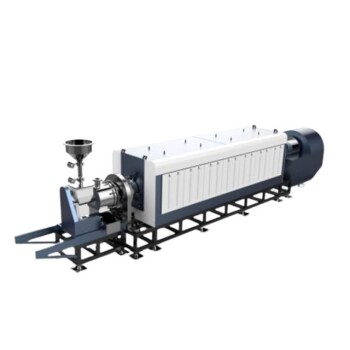
A rotary evaporator serves as the primary tool for precise solvent removal during the concentration phase of titanium dioxide and zirconium dioxide paste production. By utilizing vacuum distillation, the device lowers the boiling point of the solvent—typically ethanol—allowing it to be extracted at controlled, low temperatures around 55°C. This mechanism concentrates the solids into a viscous paste suitable for screen printing without subjecting the chemical components to degrading heat.
The rotary evaporator facilitates the transition from a dilute suspension to a functional paste by balancing two critical needs: achieving the exact viscosity required for screen printing and preserving the organic binders through low-temperature processing.
The Mechanics of Gentle Concentration
Utilizing Vacuum Distillation
The core function of the rotary evaporator in this context is vacuum distillation. By reducing the pressure inside the system, the device lowers the boiling point of the ethanol solvent.
Controlled Thermal Exposure
This pressure reduction allows the solvent to evaporate efficiently at a set bath temperature, often 55°C. This is significantly lower than the boiling point of ethanol at standard atmospheric pressure.
Efficient Solvent Separation
The rotation of the flask increases the surface area of the liquid, speeding up evaporation. This ensures the excess ethanol is removed quickly and uniformly from the titanium or zirconium dioxide mixture.
Optimizing Paste Rheology
Achieving Target Viscosity
The primary goal of this phase is to adjust the viscosity of the paste. The concentration process is continued until the material reaches the specific thickness and flow characteristics (rheology) necessary for screen printing.
Meeting Screen Printing Standards
If the paste is too thin, it will run; if too thick, it will clog the mesh. The rotary evaporator allows the operator to stop the process at the exact moment the paste suits the mechanical requirements of the printing equipment.
Protecting Chemical Integrity
Preventing Organic Decomposition
These pastes contain essential organic components, such as binders and plasticizers, which hold the metal oxides together. High temperatures can cause these organics to decompose prematurely.
Maintaining Binder Functionality
By capping the temperature at 55°C, the rotary evaporator ensures these organic chains remain intact. This guarantees that the paste maintains its structural integrity during the printing and subsequent sintering phases.
Understanding the Trade-offs
The Risk of Over-Concentration
While removing solvent is necessary, there is a risk of removing too much. Over-drying the paste in the evaporator can lead to a material that is too stiff to print or prone to cracking, requiring the re-addition of solvent which can affect homogeneity.
Monitoring "Bumping"
Because the process occurs under vacuum, the mixture is susceptible to bumping (sudden, violent boiling). This requires careful monitoring of the vacuum level and rotation speed to ensure the expensive metal oxide mixture is not lost into the condenser.
Ensuring Quality in Paste Production
To maximize the effectiveness of the rotary evaporator in your production line, consider these operational priorities:
- If your primary focus is printability: Stop the evaporation process frequently to test viscosity, ensuring you meet the strict rheological window required for your screen mesh.
- If your primary focus is chemical stability: strictly adhere to the 55°C temperature limit to ensure no thermal degradation occurs within the organic binder system.
The rotary evaporator is not just a drying tool; it is a precision instrument that defines the physical and chemical quality of your final printed layers.
Summary Table:
| Feature | Function in TiO2/ZrO2 Paste Production | Benefit |
|---|---|---|
| Vacuum Distillation | Lowers ethanol boiling point (approx. 55°C) | Prevents thermal degradation of organic binders |
| Flask Rotation | Increases liquid surface area | Accelerates solvent removal and ensures uniformity |
| Viscosity Control | Precise adjustment of paste rheology | Optimizes material for high-quality screen printing |
| Thermal Precision | Constant bath temperature monitoring | Maintains chemical integrity of metal oxide mixtures |
Elevate Your Material Processing with KINTEK
Precision is critical when handling sensitive metal oxide pastes. Backed by expert R&D and manufacturing, KINTEK offers high-performance Rotary Evaporators designed to achieve the exact rheology your screen printing processes demand. From Muffle and Tube furnaces to specialized Vacuum and CVD systems, our equipment is fully customizable to meet your unique laboratory and production needs.
Ready to optimize your concentration phase? Contact us today to find the perfect solution for your lab!
References
- Takaya Shioki, Seigo Ito. Designed Mesoporous Architecture by 10–100 nm TiO2 as Electron Transport Materials in Carbon-Based Multiporous-Layered-Electrode Perovskite Solar Cells. DOI: 10.3390/photonics11030236
This article is also based on technical information from Kintek Furnace Knowledge Base .
Related Products
- Electric Rotary Kiln Continuous Working Small Rotary Furnace Kiln for Pyrolysis Plant Heating
- Electric Rotary Kiln Pyrolysis Furnace Plant Machine Small Rotary Kiln Calciner
- Electric Rotary Kiln Small Rotary Furnace Biomass Pyrolysis Plant Rotating Furnace
- Inclined Rotary Plasma Enhanced Chemical Deposition PECVD Tube Furnace Machine
- Electric Rotary Kiln Small Rotary Furnace for Activated Carbon Regeneration
People Also Ask
- What are the advantages of electric rotary kilns compared to fuel-fired ones? Boost Precision and Efficiency in Your Process
- What materials can be processed in an electric rotary kiln? Versatile Solutions for Advanced Materials
- What advantages do electric rotary kilns offer over fuel-based kilns? Boost Efficiency and Purity in Your Process
- What are the primary applications of electric rotary kilns? Precision Thermal Processing for High-Value Materials
- In what ways are electric rotary kilns more environmentally friendly? Achieve Zero On-Site Emissions