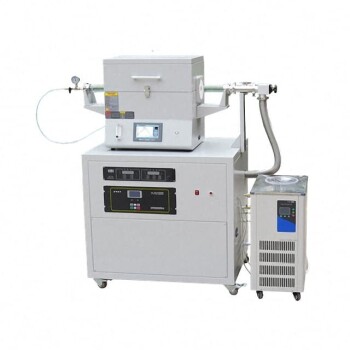
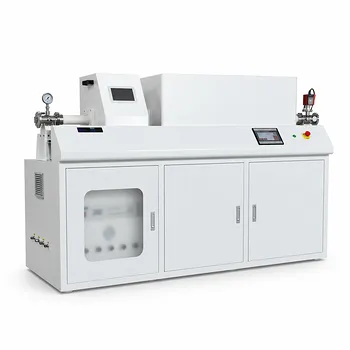
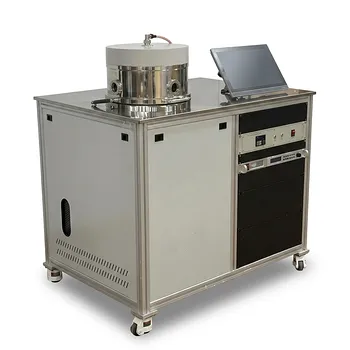
The horizontal tube furnace is the primary tool for achieving high-density sintering in sealing glass-based composites while maintaining chemical purity. It provides a highly regulated environment that combines precise temperature control with a protective atmospheric flow, typically using high-purity nitrogen to prevent the oxidation of reinforcement particles and molds.
The horizontal tube furnace acts as a controlled reactor that facilitates atomic diffusion and material densification while simultaneously flushing out volatile impurities to ensure the structural integrity of the composite.
Atmospheric Protection and Purity
Preventing Oxidation of Reinforcement Particles
The furnace creates a strictly controlled environment, often employing high-purity nitrogen at specific flow rates (such as 1000 ml/min). This inert atmosphere is critical because it prevents the oxidation of reinforcement particles and the molds themselves when exposed to high sintering temperatures.
Managing Impurity Gas Discharge
A stable flow field within the horizontal tube is essential for maintaining the quality of the glass-based composite. As the material heats, it may generate trace impurity gases; the constant gas flow effectively discharges these byproducts, preventing them from becoming trapped and creating voids or weaknesses.
Removing Residual Surface Films
In many sintering applications, a reducing atmosphere (such as hydrogen) is used to remove residual oxide films from powder surfaces. This cleaning process at the atomic level is a prerequisite for promoting the strong atomic diffusion bonding required for high-strength components.
Thermal Precision and Material Integrity
Enhancing Atomic Diffusion and Densification
The furnace provides the thermal energy necessary for atomic migration between powder particles. This process transforms the initial "green body" into a dense, high-strength metallic or glass-based component by reducing porosity through controlled heat.
Maintaining Phase Stability
Precise temperature programs ensure that the material reaches its sintering point without undergoing undesirable structural transformations. For instance, it allows for the thermal decomposition of precursors or binders while ensuring the core reinforcement phases remain stable and functional.
Ensuring Uniformity in the Constant Temperature Zone
Horizontal tube furnaces are designed with a constant temperature zone that provides uniform heat distribution. This uniformity is vital for creating robust physical and chemical bonds between the glass matrix and the reinforcement fibers or particles, ensuring the final product has consistent mechanical properties.
Understanding the Trade-offs
Flow Rate and Thermal Gradients
While high gas flow rates are excellent for removing impurities, they can introduce thermal gradients within the tube. If the gas is not pre-heated or the flow is too aggressive, it may cause uneven cooling across the sample, leading to internal stresses or cracking in brittle glass composites.
Atmospheric Limitations
Horizontal tube furnaces are highly effective for gas-shielded processes but may struggle with complex vacuum requirements compared to dedicated vacuum furnaces. Achieving an absolute oxygen-free environment requires high-purity gas sources and meticulous sealing of the tube ends, which increases operational complexity.
Applying This to Your Project
Recommendations for Sintering Success
- If your primary focus is material purity: Prioritize a furnace with a high-precision flow meter to maintain a consistent nitrogen or argon shield, ensuring all binder byproducts are flushed out.
- If your primary focus is structural strength: Focus on the length of the constant temperature zone to ensure the entire composite undergoes uniform atomic diffusion and densification.
- If your primary focus is preventing phase changes: Utilize a furnace with a programmable logic controller (PLC) to execute highly specific ramp and soak cycles that avoid critical transformation temperatures.
By mastering the balance between gas flow dynamics and thermal precision, you can leverage the horizontal tube furnace to produce glass-based composites with superior hermeticity and mechanical endurance.
Summary Table:
| Key Feature | Role in Sintering Process | Primary Benefit |
|---|---|---|
| Atmospheric Control | Provides inert (N2) or reducing (H2) flow | Prevents oxidation & removes surface films |
| Thermal Precision | Regulates atomic diffusion and migration | Achieves high density and structural integrity |
| Impurity Discharge | Flushes out volatile trace gases | Eliminates voids and internal weaknesses |
| Uniform Heat Zone | Maintains constant temperature distribution | Ensures consistent physical & chemical bonds |
Elevate Your Sintering Precision with KINTEK
Achieving superior hermeticity and mechanical endurance in glass-based composites requires uncompromising thermal control. KINTEK specializes in advanced laboratory equipment and consumables, offering a comprehensive range of high-temperature furnaces tailored for precision research and industrial applications.
Our expertise covers:
- Tube & Rotary Furnaces: Perfect for controlled atmospheric sintering.
- Muffle & Atmosphere Furnaces: Ensuring uniform heat for diverse material phases.
- Vacuum, CVD, & Induction Melting Furnaces: For specialized, high-purity thermal processing.
- Custom Solutions: All systems are customizable to meet your unique laboratory needs.
Ready to optimize your material density and purity? Contact KINTEK today to discuss your project requirements!
References
- Yangyang Cai, Yong Zhang. The effect of reinforcement particle size on the mechanical and fracture properties of glass matrix composites. DOI: 10.1016/j.heliyon.2023.e21895
This article is also based on technical information from Kintek Furnace Knowledge Base .
Related Products
- Vertical Laboratory Quartz Tube Furnace Tubular Furnace
- Vacuum Sealed Continuous Working Rotary Tube Furnace Rotating Tube Furnace
- Split Multi Heating Zone Rotary Tube Furnace Rotating Tube Furnace
- High Pressure Laboratory Vacuum Tube Furnace
- Multi Zone Laboratory Quartz Tube Furnace Tubular Furnace
People Also Ask
- What are the key differences between single-zone and multi-zone vertical tube furnaces? Choose the Right Furnace for Your Lab
- How do heat treatment processes influence the configuration of a vertical tube furnace? Optimize for Quenching, Annealing, and More
- How does a vertical tube furnace achieve precise temperature control? Unlock Superior Thermal Stability for Your Lab
- What are the main characteristics of vertical tube furnaces? Optimize Your Lab with Space-Saving, Uniform Heating
- How does a vertical single-temperature zone tube furnace facilitate the growth of high-quality PdSe2 single crystals?