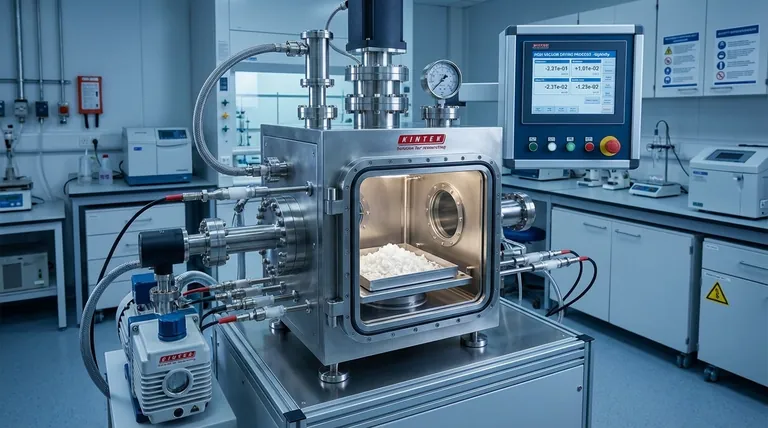
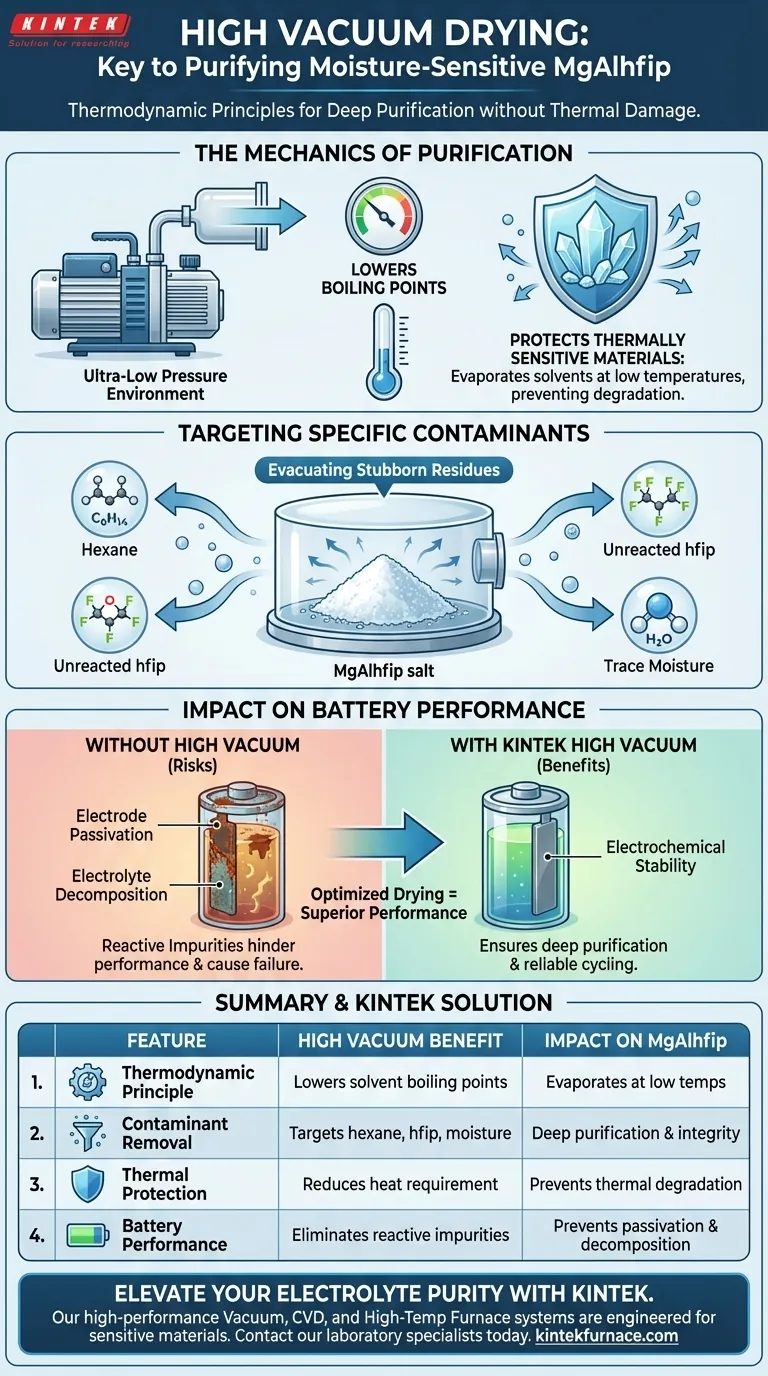
High vacuum drying operates on thermodynamic principles to drastically lower the boiling points of volatile residues within the salt. By creating an extremely low-pressure environment, the system facilitates the evaporation of stubborn solvents—specifically hexane, unreacted hfip, and trace moisture—without requiring excessive heat. This protects the moisture-sensitive MgAlhfip salt from thermal degradation while ensuring deep purification.
High vacuum drying is not merely about removing water; it is a critical purification step that safeguards electrochemical stability. By lowering the boiling point of solvents, it removes impurities without thermal damage, preventing electrode passivation and electrolyte decomposition.
The Mechanics of Purification
Manipulating Boiling Points
The primary mechanism relies on reducing the atmospheric pressure surrounding the salt. This significantly reduces the boiling points of residual solvents and organic matter trapped within the crystal structure.
Protecting Thermally Sensitive Materials
Because the boiling points are lowered, contaminants can be boiled off at much lower temperatures. This is vital for MgAlhfip, which is moisture-sensitive and potentially prone to thermal degradation if exposed to high heat.
Targeting Specific Contaminants
Removing Synthesis Byproducts
The synthesis of MgAlhfip often leaves behind volatile organic compounds. The high vacuum system specifically targets hexane and unreacted hfip (hexafluoroisopropanol), ensuring they are fully evacuated from the final product.
Eliminating Trace Moisture
Water is the enemy of magnesium electrolytes. The vacuum system removes even trace moisture that may have adhered to the salt during handling or synthesis.
Impact on Battery Performance
Preventing Electrode Passivation
If impurities like unreacted hfip or moisture remain, they react chemically within the battery cell. This leads to electrode passivation, where a non-conductive layer forms on the electrode surface, hindering performance.
Maintaining Electrochemical Stability
Thorough drying prevents the electrolyte from decomposing during operation. By removing the catalysts for decomposition (impurities), the vacuum process ensures the electrochemical stability of the salt is maintained.
Understanding the Risks of Inadequate Drying
The Cost of Residual Impurities
If the vacuum level is insufficient, volatile organics may remain trapped in the salt lattice. These residuals are not benign; they actively contribute to electrolyte decomposition once voltage is applied.
The Sensitivity Factor
MgAlhfip is highly sensitive to its environment. Failing to achieve a high enough vacuum forces operators to use higher temperatures to dry the salt, which risks damaging the salt's chemical structure before it ever enters a battery.
Making the Right Choice for Your Goal
To optimize the performance of magnesium electrolyte salts, consider these priorities:
- If your primary focus is Electrochemical Stability: Ensure the vacuum system is capable of removing "heavy" organic residues like unreacted hfip, not just surface water.
- If your primary focus is Cycle Life: Prioritize the complete removal of trace moisture to prevent passivation layers that degrade battery capacity over time.
A high vacuum system is the only reliable method to purify MgAlhfip without compromising its structural integrity.
Summary Table:
| Feature | High Vacuum Drying Benefit | Impact on MgAlhfip |
|---|---|---|
| Thermodynamic Principle | Lowers solvent boiling points | Evaporates residues at low temperatures |
| Contaminant Removal | Targets hexane, hfip, & moisture | Ensures deep purification & chemical integrity |
| Thermal Protection | Reduces heat requirement | Prevents thermal degradation of sensitive salts |
| Battery Performance | Eliminates reactive impurities | Prevents electrode passivation & decomposition |
Elevate Your Electrolyte Purity with KINTEK
Don't let residual moisture or solvents compromise your battery research. KINTEK’s high-performance vacuum systems are engineered to provide the precise low-pressure environments required for sensitive materials like MgAlhfip. Backed by expert R&D and world-class manufacturing, we offer customizable Vacuum, CVD, and High-Temp Furnace systems designed to protect your samples from thermal damage while ensuring maximum electrochemical stability.
Ready to optimize your drying process? Contact our laboratory specialists today to find the perfect system for your unique needs.
Visual Guide
References
- Andrijana Marojević, Jan Bitenc. Influence of Salt Concentration on the Electrochemical Performance of Magnesium Hexafluoroisopropoxy Aluminate Electrolyte. DOI: 10.1002/batt.202500497
This article is also based on technical information from Kintek Furnace Knowledge Base .
Related Products
- 304 316 Stainless Steel High Vacuum Ball Stop Valve for Vacuum Systems
- HFCVD Machine System Equipment for Drawing Die Nano Diamond Coating
- Vacuum Induction Melting Furnace
- 9MPa Air Pressure Vacuum Heat Treat and Sintering Furnace
- 2200 ℃ Tungsten Vacuum Heat Treat and Sintering Furnace
People Also Ask
- What role do vacuum-sealed high-purity silica ampoules play in phase equilibrium experiments? Enhance Sample Integrity
- What is the function of quartz vacuum encapsulation in RhSeCl CVT? Mastering Pure Crystal Growth
- What role does a closed pressure vessel play during the carbonation of gamma-C2S? Unlock Rapid Mineralization
- What type of pump is used in water circulating vacuum pumps and how is it installed? Discover Robust Fluid-Based Vacuum Solutions
- What is the specific function of the water circulation cooler in zirconium sponge processing? Key for Purity & Safety