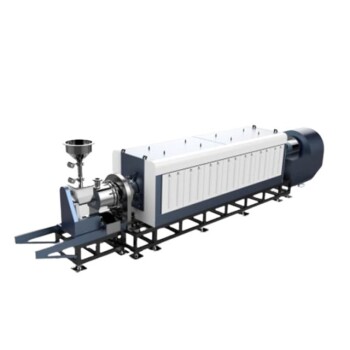
A controlled atmosphere muffle furnace ensures sludge-based biochar quality by maintaining a strictly anaerobic, nitrogen-rich environment. This prevents the biomass from combusting while allowing it to undergo precise thermochemical decomposition. By eliminating oxygen and controlling temperature variables, the furnace facilitates the conversion of raw sludge into stable, carbon-rich materials with optimized physical and chemical properties.
The core function of a controlled atmosphere muffle furnace is to isolate the pyrolysis process from oxygen, replacing it with an inert gas like nitrogen. This isolation allows for the precise regulation of heat and residence time, ensuring the biomass transforms into high-quality biochar rather than ash.
Establishing an Oxygen-Free Environment
The Role of Nitrogen Saturation
The furnace maintains a constant flow of nitrogen (N2) to create a saturated, inert atmosphere. This displacement of oxygen is critical because it prevents the raw sludge from undergoing oxidative combustion at high temperatures.
Maintaining Anaerobic Integrity
By ensuring a pure anaerobic environment, the furnace facilitates the thermochemical conversion of biomass. This allows complex organic structures like hemicellulose, cellulose, and lignin to undergo depolymerization without burning, preserving the carbon skeleton of the material.
Precision Thermal Control
Regulating Pyrolysis Temperature
Muffle furnaces provide stable environments for specific temperatures, often ranging from 400°C to 600°C. This precise control directly dictates the specific surface area and the development of the biochar’s internal pore structure.
Controlling Heating Rates and Residence Time
The furnace allows users to set specific heating rates, such as 10°C/min or 30°C/min, and define the exact residence time. These variables are essential for optimizing the biochar yield and ensuring the removal of volatile components without destroying the carbon matrix.
Enhancing Physicochemical Properties
Developing Pore Structure and Surface Area
Under controlled high-temperature conditions, the furnace drives off volatile matter to create a preliminary pore structure. This physical foundation is necessary for the biochar to function effectively in subsequent chemical modifications or adsorption tasks.
Preserving Functional Groups
The stable, oxygen-limited environment facilitates the formation of oxygen-containing functional groups and rich aromatic structures. These chemical features are vital for the biochar's performance as a stable carbon substrate in environmental applications.
Understanding the Trade-offs
Operational Costs and Gas Consumption
Maintaining a continuous flow of nitrogen increases the operating cost compared to standard air-fired furnaces. Users must balance the need for high-purity inert environments with the logistical requirements of gas supply and consumption.
Scaling and Temperature Uniformity
While muffle furnaces offer high precision at the laboratory scale, achieving uniform temperature distribution becomes more difficult as chamber size increases. Inconsistent heating can lead to "hot spots," resulting in biochar with non-uniform chemical properties.
How to Apply This to Your Project
Making the Right Choice for Your Goal
- If your primary focus is maximizing adsorption performance: Focus on higher temperatures (near 600°C) and longer residence times to maximize specific surface area and pore development.
- If your primary focus is biochar yield and carbon stability: Use moderate temperatures (around 400°C-500°C) and slower heating rates to prevent excessive loss of volatile matter.
- If your primary focus is chemical purity and analysis: Use the furnace for standardized proximate analysis at 850°C (for volatiles) or 600°C (for ash content) to verify the quality of your output.
By mastering the balance of inert atmosphere and thermal precision, you can transform waste sludge into a high-value, engineered carbon material.
Summary Table:
| Key Feature | Role in Pyrolysis | Impact on Biochar Quality |
|---|---|---|
| Inert Atmosphere (N2) | Prevents oxidative combustion | Maximizes carbon yield and stability |
| Precise Temp Control | Regulates thermochemical decay | Optimizes specific surface area and pores |
| Variable Heating Rate | Controls volatile matter release | Determines internal pore structure density |
| Residence Time | Ensures complete conversion | Stabilizes the aromatic carbon matrix |
Elevate Your Biochar Research with KINTEK Precision
Achieving high-quality, engineered carbon from sludge requires absolute control over your thermal environment. KINTEK specializes in advanced laboratory equipment, offering a comprehensive range of high-temperature furnaces—including muffle, tube, rotary, vacuum, CVD, and atmosphere furnaces—all customizable to meet your specific research parameters.
Whether you are focusing on maximizing adsorption performance or ensuring long-term carbon stability, our technical experts are ready to help you configure the perfect setup for your lab.
Ready to optimize your pyrolysis process? Contact KINTEK today for a custom solution!
References
- Zaineb Bakari, Massimo Del Bubba. Biochar from co-pyrolysis of biological sludge and woody waste followed by chemical and thermal activation: end-of-waste procedure for sludge management and biochar sorption efficiency for anionic and cationic dyes. DOI: 10.1007/s11356-024-33577-3
This article is also based on technical information from Kintek Furnace Knowledge Base .
Related Products
- Mesh Belt Controlled Atmosphere Furnace Inert Nitrogen Atmosphere Furnace
- 1400℃ Controlled Inert Nitrogen Atmosphere Furnace
- Laboratory Muffle Oven Furnace with Bottom Lifting
- 1700℃ Controlled Inert Nitrogen Atmosphere Furnace
- 1200℃ Muffle Oven Furnace for Laboratory
People Also Ask
- How is a controlled atmosphere furnace used in material research? Achieve Precise Material Synthesis and Heat Treatment
- What are the two main purposes of controlled atmosphere conditions in furnaces? Protect or Transform Materials for Peak Performance
- What types of gases can a controlled atmosphere furnace handle? Master Inert and Reactive Gases for Your Lab
- How does a controlled atmosphere furnace improve product quality and consistency? Master Precise Heat Treatment for Superior Results
- What types of furnaces have controlled atmosphere furnaces largely replaced? Boost Metallurgical Precision & Safety