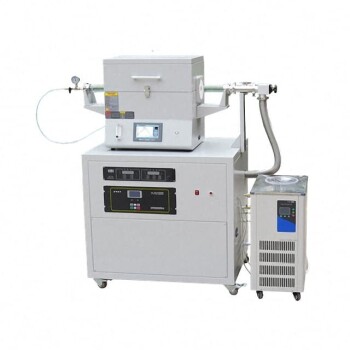
Entrapped gas is the invisible bottleneck to full density.
During final-stage sintering, isolated pores form within the powder compact. If these pores trap insoluble gases like nitrogen or argon, the shrinking pore compresses the gas until its internal pressure exactly balances the capillary driving force—densification stops cold. High-temperature vacuum furnaces resolve this by removing the ambient gas before pore closure, while controlled atmosphere furnaces with highly soluble gases (such as hydrogen or oxygen) allow the trapped species to diffuse out through the solid matrix, enabling complete pore elimination and near-theoretical density.
The deep challenge of final densification is not simply reaching high temperature; it is controlling the atmosphere within each closing pore. Insoluble entrapped gases set a hard limit on density by creating a counter-pressure that neutralizes the sintering stress. Switching to vacuum or a soluble-gas atmosphere removes this limit, letting capillary forces work to their full potential and unlocking the last critical percentage of density.
The Physics of Pore Closure and Gas Entrapment
The final stage of sintering is defined by isolated, closed porosity. Understanding how gas gets trapped in these pores—and why that matters—begins with the mechanics of pore shrinkage.
How Isolated Pores Form in Final-Stage Sintering
During initial and intermediate sintering, interconnected pore channels allow gases to flow freely to the part surface. As grain growth and mass transport progress, those channels pinch off into spherical, isolated pores. Once a pore is sealed from the outside environment, its internal atmosphere becomes a closed system—any gas present is now permanently trapped unless it can escape by diffusion through the solid.
The Pressure Balance That Stops Densification
Shrinking a pore against a trapped gas compresses that gas, rapidly raising its internal pressure. In liquid-phase sintering, the capillary pressure that drives pore filling is given by the Laplace pressure: ( P_{\text{cap}} = \frac{4\gamma_{LV}}{d_P} ), where ( \gamma_{LV} ) is the liquid-vapor surface energy and ( d_P ) is the pore diameter. As the pore gets smaller, both the capillary pressure and the internal gas pressure increase—but the gas pressure rises much faster. Densification halts when the two pressures become equal. For solid-state sintering, the same principle holds: the compressive stress from the trapped insoluble gas counters the sintering stress, locking in residual porosity.
The Role of Gas Solubility and Diffusivity
The only escape for trapped gas is diffusion through the solid matrix. If the gas species has high solubility and rapid diffusivity in the host material—like hydrogen in many metals or oxygen in certain oxides—it can dissolve into the lattice, migrate to a free surface, and be released. If solubility is near zero (e.g., nitrogen or argon in alumina), the gas remains trapped, and pore closure stops permanently. This is why atmosphere choice is not a secondary detail but a primary determinant of final density.
Why Atmospheric Sintering Leaves Residual Porosity
Many conventional furnaces operate in air or inert gas environments. In these systems, final-stage densification is capped by the very atmosphere that surrounds the part.
The Insoluble Gas Problem
Gases with large atomic radii, low polarizability, or unfavorable bonding with the host lattice exhibit negligible solubility. Common examples include:
- Argon and nitrogen in oxide ceramics like Al₂O₃
- Nitrogen in many refractory metals
- Ambient air (primarily N₂) in a broad range of ceramic systems
When these gases are trapped, pore shrinkage compresses them into high-pressure micro-reactors inside the material. Even if the sintering stress continues to increase with grain growth, the internal gas pressure keeps pace, capping the achievable density well below the theoretical limit.
Example: Alumina and the Nitrogen Barrier
Consider dense alumina (Al₂O₃) sintered in air. Nitrogen, the primary component of air, is virtually insoluble in the corundum lattice. As pores pinch off, trapped N₂ creates a back-pressure that prevents full densification. The result is a component that looks dense but harbors a fine dispersion of gas-filled pores that degrade transparency, strength, and dielectric properties. Only by removing N₂ before pore closure—or replacing it with a soluble species like oxygen—can full compaction occur.
How Vacuum Furnaces Eliminate the Conflict
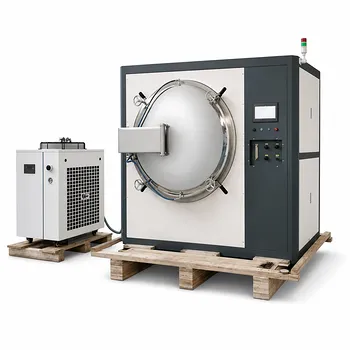
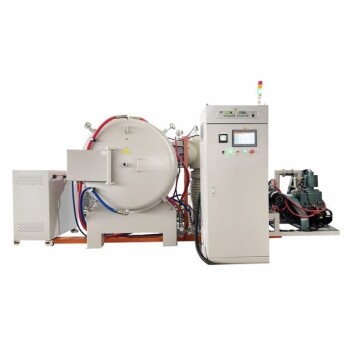
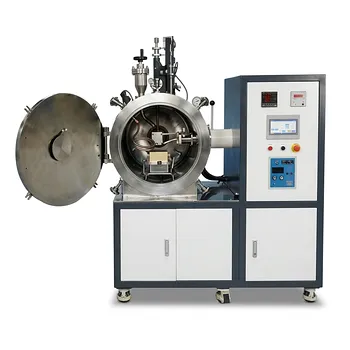
A high-temperature vacuum furnace takes the most direct approach: it removes the gas entirely before pores can close.
Evacuation Before Pore Closure
In a vacuum furnace, the chamber is pumped down to pressures well below 10⁻³ mbar. This removes ambient gases from the powder compact’s interconnected pore network during the early and intermediate stages of sintering. By the time pore pinch-off occurs, there is virtually no gas left to trap. The remaining pore volume is effectively a vacuum, offering no resistance to capillary-driven shrinkage.
Complete Capillary Action
With no internal pressure to fight, the sintering stress can act unopposed. Pores shrink until they disappear entirely or until kinetic limitations from grain growth take over. This allows liquid-phase systems to achieve full liquid filling and solid-state systems to reach near-theoretical density with minimal residual porosity. Vacuum processing is especially critical for transparent ceramics, structural components requiring ultimate fatigue life, and materials where even 0.1% porosity is unacceptable.
How Controlled Atmosphere Furnaces Provide a Chemical Path
When vacuum is impractical—due to material volatility or phase stability concerns—controlled atmosphere furnaces offer a chemical escape route for entrapped gas.
Soluble Gas Species as Escape Routes
Instead of removing gas, a controlled atmosphere furnace floods the sintering environment with a highly soluble, rapidly diffusing gas. After pore closure, this gas dissolves into the solid and diffuses out to the surface. Classic examples include:
- Hydrogen (H₂) for alumina, many oxide ceramics, and most metals (except hydride-formers). Hydrogen’s small atomic radius and high mobility enable it to permeate many lattices at sintering temperatures.
- Oxygen (O₂) for MgO-doped Al₂O₃ or other oxide systems where oxygen ions are mobile, allowing trapped O₂ to dissolve and diffuse via vacancy mechanisms.
The key is that the trapped gas species is no longer an immovable obstacle but a fugitive that can escape through the solid as the pore shrinks. The sintering stress compresses the gas, which raises its chemical potential and accelerates diffusion out of the pore, enabling complete densification.
Preserving Stoichiometry in Advanced Ceramics
For multivalent oxides or non-oxide ceramics (e.g., SiC, Si₃N₄), vacuum may cause deleterious reduction reactions or volatilization. A controlled reducing, inert, or oxidizing atmosphere precisely sets the oxygen partial pressure to maintain the correct oxidation states and defect structures. By simultaneously providing a soluble gas species and preventing phase decomposition, these furnaces unlock high density without sacrificing chemical integrity.
Understanding the Trade-offs
Adopting vacuum or controlled-atmosphere sintering is not a universal, cost-free upgrade. Several practical limitations and risks must be weighed.
- Material decomposition in vacuum: Some oxides lose oxygen or disproportionate at high temperature under low pressure, creating non-stoichiometric defects that degrade properties rather than improve them.
- Hydrogen safety and embrittlement: Hydrogen atmospheres pose explosion risks and can cause embrittlement in certain metals (e.g., titanium, zirconium) or decarburization in steels, requiring careful material compatibility checks.
- Furnace cost and complexity: Vacuum furnaces require robust sealing systems, high-speed pumping, and advanced thermal insulation, significantly raising capital and maintenance costs versus simple air furnaces.
- Kinetic limits of gas dissolution: Even soluble gases have finite diffusion rates. If the pore shrinkage rate outpaces gas escape, a residual pressure can still build, making precise cycle control essential.
- Not all materials have a soluble-gas partner: For certain highly refractory materials, no practically usable soluble gas exists, locking the process into costly vacuum or external pressure-assisted sintering (HIP) to push past the pressure limit.
Making the Right Choice for Your Process
The core decision hinges on your material system, required density, and tolerance for residual defects. Use the following guidance to align atmosphere strategy with your goals.
- If your primary focus is achieving absolute maximum density in oxide ceramics: Prioritize vacuum sintering, or use a hydrogen/oxygen atmosphere where solubility is proven, to eliminate trapped N₂ and reach transparency or near-theoretical mechanical properties.
- If you are working with non-oxide ceramics sensitive to oxidation or volatilization: Use a controlled inert or reducing atmosphere furnace to stabilize stoichiometry while selecting a gas species (often H₂ or reactive gases) that can dissolve and diffuse.
- If budget and equipment simplicity are critical: Recognize that an air or inert atmosphere will leave a fixed residual porosity. For less demanding applications, this may be acceptable; for critical parts, factor in the inevitable density cap.
- If processing metals prone to hydrogen embrittlement: Avoid hydrogen atmospheres entirely; vacuum sintering or argon/partial-pressure systems with a post-sinter hot isostatic pressing (HIP) step may be the only path to full density.
The furnace atmosphere is not a background detail—it is the active ingredient that determines whether your final pores are emptied or permanently locked. By choosing vacuum to remove the enemy or a soluble gas to give it a way out, you give capillary forces the final word.
Summary Table:
| Sintering Atmosphere | Trapped Gas Mechanism | Final Density Outcome | Key Material Applications |
|---|---|---|---|
| Air / Ambient Inert | Insoluble gas compresses; counter-pressure halts pore shrinkage. | Densification capped below theoretical limit. | General structural ceramics, non-critical components |
| High Vacuum (<10⁻³ mbar) | Evacuates gas before pore pinch-off; zero internal back-pressure. | Achieves near-theoretical or 100% full density. | Transparent ceramics, high-fatigue metals, critical optics |
| Soluble Gas (H₂/O₂) | Gas dissolves into matrix lattice and diffuses out as pores shrink. | High density reached via chemical escape routes. | Alumina (Al₂O₃), MgO, stoichiometric oxide ceramics |
Eliminate Residual Porosity & Unlock Near-Theoretical Density
Don't let entrapped gases compromise your material's strength, transparency, or performance. KINTEK specializes in premium laboratory equipment and consumables, offering tailored solutions to optimize your sintering atmosphere.
Our extensive range of high-temperature furnaces includes:
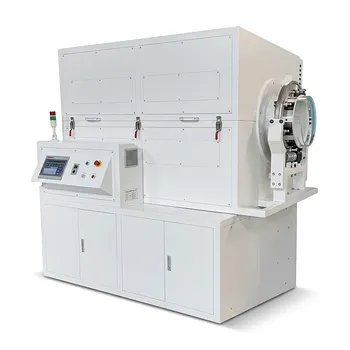
- Vacuum Furnaces for total gas elimination prior to pore closure
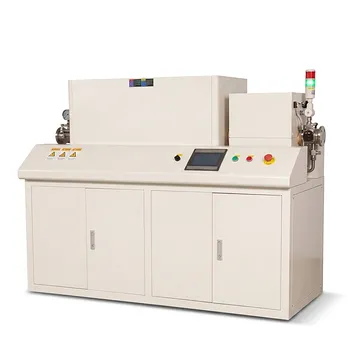
- Controlled Atmosphere Furnaces (H₂, O₂, inert gases) for optimized diffusion paths
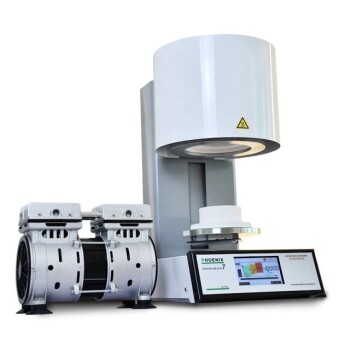
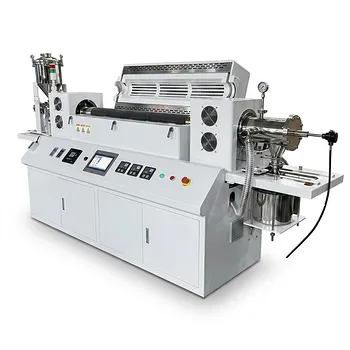
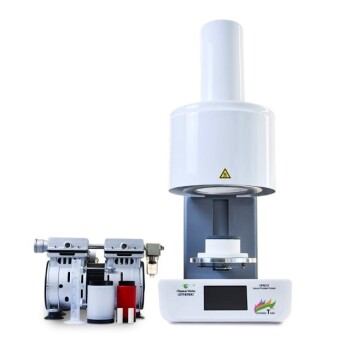
- Tube, Muffle, Rotary, CVD, Dental, and Induction Melting Furnaces
All KINTEK systems are fully customizable to meet your specific thermal profile and chemical compatibility needs.
👉 Contact KINTEK today to consult with our high-temperature equipment experts!
Related Products
- 600T Vacuum Induction Hot Press Vacuum Heat Treat and Sintering Furnace
- Vacuum Hot Press Furnace Machine Heated Vacuum Press
- 2200 ℃ Tungsten Vacuum Heat Treat and Sintering Furnace
- Vacuum Hot Press Furnace Machine Heated Vacuum Press Tube Furnace
- Vacuum Heat Treat Furnace with Ceramic Fiber Liner
People Also Ask
- Why use Vacuum Hot Press (VHP) for ZnS Ceramics? Achieve Superior IR Transparency and Mechanical Strength
- How does a vacuum hot press sintering furnace mitigate copper sintering swelling? Solve Fe-Cu Expansion Issues
- What are the benefits of using a vacuum hot press sintering furnace for the preparation of SiCw/2024 aluminum matrix composites? Achieve High-Performance Aerospace Materials
- What are the key advantages of vacuum hot press sintering furnaces? Achieve Superior Density and Purity in Materials
- What is the core function of a vacuum hot press sintering furnace in the preparation of high-density RuTi alloys? Achieve Maximum Density and Purity