The 24-Hour Wait That Ends in Failure
Imagine this: your team has spent weeks perfecting the "as-cast" structure of a Titanium-Aluminum (Ti-Al) alloy ingot. You’ve set the furnace to 1200°C for a critical 24-hour homogenization cycle, expecting a uniform, high-performance material at the end.
But when the cooling cycle finishes, the results are devastating. The ingot is brittle, the surface is discolored, and the chemical composition is off-spec. Despite following the temperature profile to the letter, the material has failed. This isn't just a lost sample; it’s a bottleneck that delays aerospace projects, inflates R&D costs, and leaves engineers questioning their process.
The Common Struggle: Why "Standard" Protection Isn't Enough
When faced with failed Ti-Al batches, many labs try to "patch" the problem. They might increase the flow of industrial-grade argon or attempt to "shield" the samples in foil. While these methods might work for less sensitive metals, they often fail with titanium.
The reason? These "solutions" only treat the symptoms. Even trace amounts of moisture or oxygen in a standard inert environment are enough to ruin a Ti-Al alloy at 1200°C. The result is a cascade of negative business consequences:
- Material Wastage: Scrapping expensive titanium ingots is a heavy financial blow.
- Project Delays: Every failed annealing cycle adds days or weeks to the production timeline.
- Reliability Risks: Inconsistent microstructures lead to unpredictable mechanical properties, which is unacceptable in high-stakes industries like medical implants or jet engine manufacturing.
The Root of the Problem: Titanium’s "Hunger" for Gas
To solve this, we have to look at the chemistry. Titanium and Aluminum have an incredibly high "affinity" for oxygen, nitrogen, and hydrogen. When you heat these alloys to high temperatures, they don't just sit there; they actively "suck in" gases from the surrounding air.
At 1200°C, oxygen doesn't just stay on the surface—it diffuses into the metal. This creates a brittle "alpha case" and causes hydrogen embrittlement. Furthermore, if the atmosphere isn't strictly controlled, critical alloying elements can actually evaporate or oxidize, leading to "elemental segregation"—where the chemistry at the center of your ingot is different from the chemistry at the edges.
The standard "inert" atmosphere often fails because it cannot reach the ultra-low oxygen partial pressure required to stop this chemical hunger. To get a truly uniform, ductile alloy, you don't just need heat; you need a vacuum so deep that there are virtually no gas molecules left to react.
The Solution: The High-Vacuum Furnace as a Precision Shield
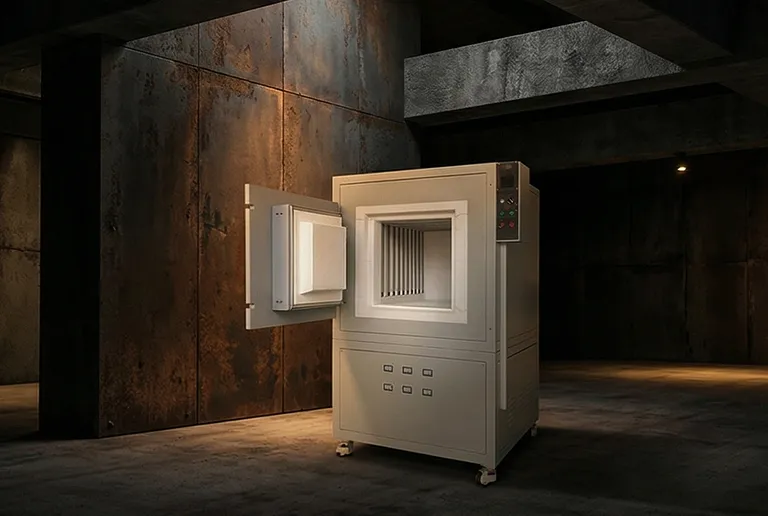
True homogenization requires an environment where the metal can "relax" and its elements can redistribute naturally without external interference. This is where a High-Vacuum Furnace becomes the essential tool rather than a luxury.
Our high-vacuum systems are engineered specifically to address the root causes of Ti-Al failure:
- Eliminating the "Gaseous Threat": By reaching vacuum levels of $10^{-3}$ Pa or better, the furnace removes oxygen and water vapor before they can penetrate the alloy. This prevents the formation of brittle oxides and ensures metallic bonding.
- Promoting Pure Diffusion: In a strict vacuum, chemical components can diffuse freely within the structure. This reduces segregation and ensures macroscopic uniformity across the entire ingot.
- Stabilizing the Microstructure: Whether you are dealing with carbon-containing alloys that need spherical carbides at grain boundaries or Ti-55531 alloys requiring a controlled beta matrix, the vacuum environment ensures that these transformations happen without contamination.
A KINTEK high-vacuum furnace isn't just a heating box; it is a controlled pressure vessel designed to stabilize the most reactive materials on the planet.
Beyond the Fix: Unlocking New Material Potential
When you solve the problem of oxidation and embrittlement, you do more than just "fix" a process—you unlock new engineering possibilities.
With a reliable high-vacuum homogenization process, you can now:
- Post-Process 3D Printed Parts: Effectively eliminate residual stresses in Selective Laser Melting (SLM) components without the risk of hydrogen embrittlement.
- Refine Grain Strengthening: Achieve fine-grain structures that were previously impossible to maintain due to grain growth during contaminated heating cycles.
- Accelerate Innovation: Move from R&D to production faster, knowing that your material properties will be consistent from batch to batch.
By mastering the environment, you master the material. The complex challenges of Ti-Al alloys become a streamlined, repeatable success.
Solving the "Titanium problem" requires more than just high heat; it requires a deep understanding of atmospheric chemistry and vacuum engineering. At KINTEK, we specialize in helping laboratories transition from "unstable results" to "material excellence" through our customizable high-temperature vacuum solutions. Whether you are working on aerospace components or advanced dental alloys, our team is ready to help you design a thermal process that eliminates contamination and maximizes performance. Contact Our Experts today to discuss your specific Ti-Al project requirements.
Related Products
- 2200 ℃ Tungsten Vacuum Heat Treat and Sintering Furnace
- High Pressure Laboratory Vacuum Tube Furnace
- Molybdenum Vacuum Heat Treat Furnace
- 2200 ℃ Graphite Vacuum Heat Treat Furnace
- 9MPa Air Pressure Vacuum Heat Treat and Sintering Furnace
Related Articles
- Why Your High-Strength Titanium Biomaterials Are Brittle—and How Vacuum Heat Treatment Fixes It
- Why Your Alloy Phase Separation Observations Are Inconsistent—And the "Invisible" Variable You’re Missing
- The Unseen Engine: Why Graphite Dominates High-Temperature Vacuum Furnaces
- Heat, Void, and Control: Designing the Heart of a High-Temperature Vacuum Furnace
- The Paradox of Strength: Why Graphite Dominates High-Temperature Vacuum Furnaces



















