In the world of advanced materials science, the difference between a breakthrough and a failed experiment often comes down to seconds. For researchers studying the phase transformation kinetics of zirconium alloys, those seconds are frequently lost to "thermal lag."
You may have meticulously prepared your cold-worked samples, intending to study how their deformed structures influence phase transitions. Yet, when you analyze the data, the results are frustratingly generic. The "fingerprint" of the original deformation seems to have vanished. If your experimental data feels inconsistent or fails to capture the nuances of structural evolution, the culprit isn't your sample—it’s likely your furnace.
The Invisible Barrier to Accurate Material Characterization
When investigating alloy kinetics, the goal is to observe how a specific starting state (like a cold-worked or deformed structure) transforms into a new phase. To do this, you must reach the target temperature while the original structure is still intact.
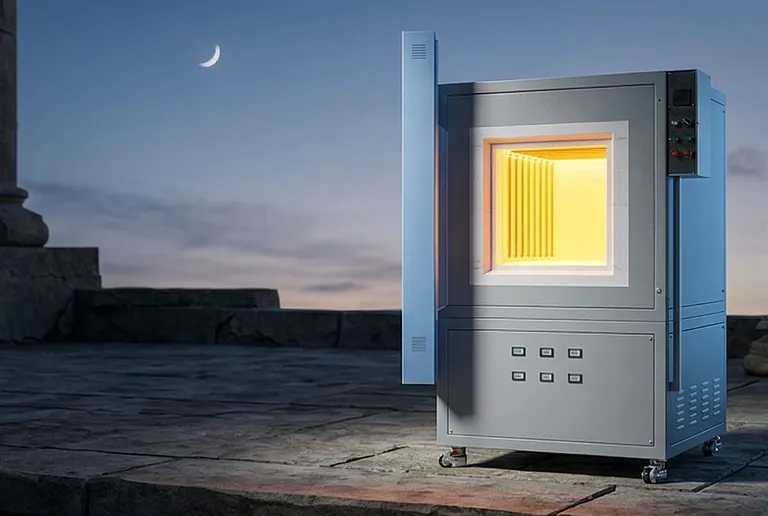
However, most laboratories rely on conventional muffle furnaces for these studies. While reliable for general heat treatment, these furnaces are inherently "slow." They heat the chamber air and radiation shields, which then transfer heat to the sample. This process is plagued by high thermal inertia.
The business and scientific consequences of this slowness are significant:
- Contaminated Data: By the time a standard furnace reaches the target temperature, the alloy has often undergone complete recrystallization. You aren't studying a deformed alloy anymore; you're studying a pristine one.
- Wasted Resources: Weeks of sample preparation are rendered moot because the furnace effectively "erased" the features you were trying to measure.
- Misleading Models: If your kinetic models are built on these "pre-annealed" samples, they will fail when applied to real-world industrial processes where heating rates vary.
The Root Cause: The Race Against Recrystallization
Why does the heating rate matter so much? The answer lies in the competition between two different physical processes: Recrystallization and Phase Transformation.
Zirconium alloys, especially those that have been cold-worked, contain high stored energy. As temperature rises, the metal wants to "relax" through recrystallization—a process where new, strain-free grains replace the deformed ones.
In a conventional muffle furnace, the heating rate is so low that the alloy has ample time to recrystallize before it ever hits the phase transformation threshold. This "masks" the actual influence of the original deformed structure on variant selection and transformation kinetics. To see the truth, you must "outrun" the recrystallization. You need a method that can bridge the temperature gap in a fraction of a second, preserving the internal stress and dislocation density of the sample long enough to witness the phase change.
The Solution: Precision High-Rate Resistance Heating
To capture the true kinetics of zirconium alloys, the industry is shifting toward Resistance Heating (Joule Heating). Unlike conventional methods that heat the sample from the outside in, resistance heating passes an electric current directly through the sample.
This approach fundamentally changes the thermodynamic equation:
- Minimal Thermal Inertia: Since the sample itself is the heating element, there is no need to wait for a chamber to heat up.
- Extreme Heating Rates: Systems can achieve rates as high as 100ºC/s. This "flash" heating suppresses or delays recrystallization, allowing researchers to observe phase transformation kinetics in their raw, deformed state.
- Synchronization: High-rate resistance heating, particularly when integrated into Silicon Carbide (SiC) tube furnaces, allows for precise synchronization with data acquisition tools. For instance, in-situ synchrotron experiments require rapid thermal response to match the high-frequency "snapshots" taken by X-ray beams.
At KINTEK, we design our high-temperature tube and vacuum furnaces to provide this exact level of control. By utilizing materials like SiC for infrared-assisted heating and advanced resistance configurations, we provide the rapid response times and uniform thermal fields necessary to stop "masking" your data.
Unlocking New Frontiers in Alloy Research
When you eliminate the "thermal lag" of conventional heating, the potential for discovery expands. Solving the recrystallization problem isn't just about better data; it’s about enabling entirely new types of research.
With high-rate resistance heating, you can:
- Map Variant Selection: Observe exactly how deformed grain boundaries dictate the orientation of new phases.
- Optimize Industrial Processing: Simulate high-speed manufacturing environments (like welding or rapid forging) with far greater accuracy.
- Real-Time Monitoring: Perform in-situ studies of zirconia grain growth and the kinetics of tetragonal-to-monoclinic transformations without the interference of parasitic thermal effects.
By choosing equipment designed around the physics of your sample, you move from merely "heating materials" to "mastering kinetics."
Whether you are performing fundamental research on zirconium alloys or developing the next generation of high-performance materials, your furnace should be a bridge to discovery, not a barrier. At KINTEK, we specialize in tailoring high-temperature solutions—from customizable tube furnaces to specialized vacuum systems—that align with your specific kinetic requirements. Let’s ensure your equipment is as advanced as your research.
Contact Our Experts to discuss how our high-rate heating solutions can bring your material's true kinetics to light.
Related Products
- 1400℃ Muffle Oven Furnace for Laboratory
- 1700℃ High Temperature Muffle Oven Furnace for Laboratory
- 1800℃ High Temperature Muffle Oven Furnace for Laboratory
- 1200℃ Muffle Oven Furnace for Laboratory
- High Temperature Muffle Oven Furnace for Laboratory Debinding and Pre Sintering
Related Articles
- Why Your Ceramic Sintering Fails Before It Even Starts—And How Strategic Pretreatment Rescues Your Yields
- The Hidden Saboteur in Your HT-LiCoO2 Synthesis: Why Precise Ramp Rates Can Make or Break Your Battery Materials
- Why High-Purity Gas Fails Your High-Temp Brazing—And How Mono-Silane Doping Fixes It
- Why Your High-Temperature Experiments Fail: The Hidden Flaw in Your Furnace
- Why Your High-Temperature Experiments Fail—And How to Fix Them for Good