The Perfectionist’s Nightmare: When the Recipe is Correct but the Result Fails
Imagine you have spent weeks meticulously calculating the precise chemical proportions for a new 718-type superalloy. You’ve balanced the Niobium (Nb) for strength and the Aluminum (Al) and Titanium (Ti) for phase stability. Yet, when the resulting ingot comes out of the furnace, the data is a mess. The alloy is brittle, the microstructure is inconsistent, and the reactive elements you carefully measured seem to have "vanished" or transformed into unwanted oxides.
For many researchers and materials scientists, this is a recurring frustration. You are following the science, but the hardware is betraying the chemistry. In the world of high-performance alloys, the transition from a theoretical formula to a physical reality is where most projects stumble.
The Common Struggle: Chasing Ghost Impurities
When faced with inconsistent experimental results, many labs attempt to "compensate" for the problem. They might over-alloy with extra Niobium to account for expected losses, or they might try localized shielding with basic inert gas setups.
However, these "band-aid" solutions often lead to even greater problems:
- Compositional Shifting: Without a true vacuum, reactive elements like Titanium and Aluminum act as "oxygen magnets," oxidizing instantly at high temperatures.
- Poor Homogeneity: Refractory metals with high melting points, such as Niobium or Molybdenum, often fail to fuse completely with the base metal, leaving "clumps" or un-melted inclusions in the ingot.
- Contamination Loops: Traditional crucibles can react with the molten metal, leaching ceramic impurities into your high-purity sample.
The business consequence is clear: wasted man-hours, expensive raw material loss, and a significant delay in the R&D cycle for aerospace or energy-sector components.
The Root of the Problem: Atmosphere and Temperature
The fundamental reason these common fixes fail is that 718-type superalloys and high-entropy alloys (HEAs) are physically incompatible with "standard" heating environments.
The struggle boils down to two factors: Atmospheric Contamination and Thermal Insufficiency.
Many of the elements that make superalloys "super"—like Niobium (Nb), Tantalum (Ta), and Hafnium (Hf)—require extreme temperatures to melt. More importantly, they must be melted in an environment where oxygen levels are virtually zero. If even a trace of oxygen or nitrogen is present, these active elements oxidize, significantly altering the phase stability and weldability of the final product. For example, in alloys like 617occ, even a tiny failure to regulate carbon or boron levels during the melt can lead to hot cracks during subsequent laser welding.
The Solution: Precision High-Energy Vacuum Arc Melting
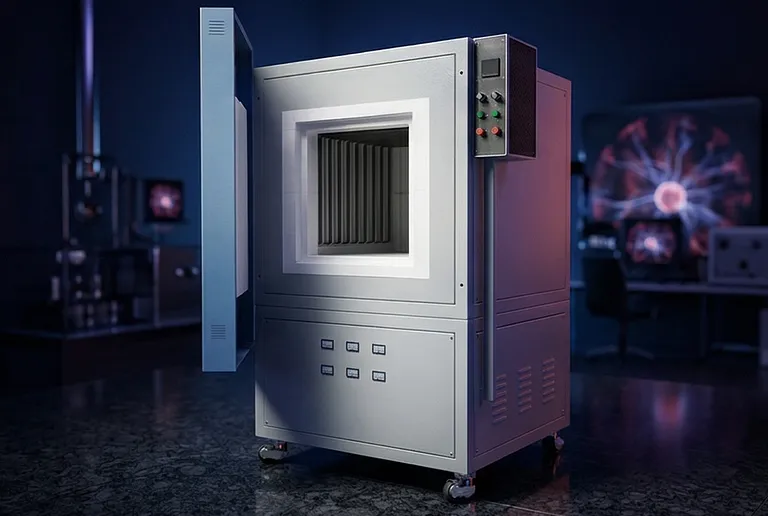
To solve the root cause, you need a tool designed specifically to isolate the melt and master the temperature. This is where the Laboratory-Scale Vacuum Arc Melting (VAM) Furnace becomes the bridge between theory and reality.
Instead of traditional radiant heating, a VAM furnace utilizes a high-energy electric arc—essentially controlled lightning—to generate localized extreme heat. At KINTEK, our VAM systems are engineered to address the specific pain points of modern metallurgy:
- Purity through Isolation: By utilizing a high-vacuum pump-down followed by high-purity Argon shielding, the furnace prevents the oxidation of reactive rare earth and refractory elements.
- The Water-Cooled Copper Hearth: Unlike ceramic crucibles, our water-cooled copper hearth allows the alloy to be melted in its own "skull." This eliminates contamination from the container itself, ensuring the highest possible cleanliness.
- Compositional Homogeneity: To ensure multi-component elements with vastly different melting points are completely fused, the system allows for repeated "flip-melting." By melting and flipping the ingot multiple times (often 5 to 6 cycles), the liquid state undergoes thorough convective mixing, resulting in a perfectly uniform chemical composition.
- Scalable Precision: For R&D, you don't need tons of material. Our systems are optimized for small-batch preparation (e.g., 600 grams), providing a cost-effective way to fine-tune chemical compositions before moving to industrial-scale production.
New Possibilities: Beyond the "Standard" Ingot
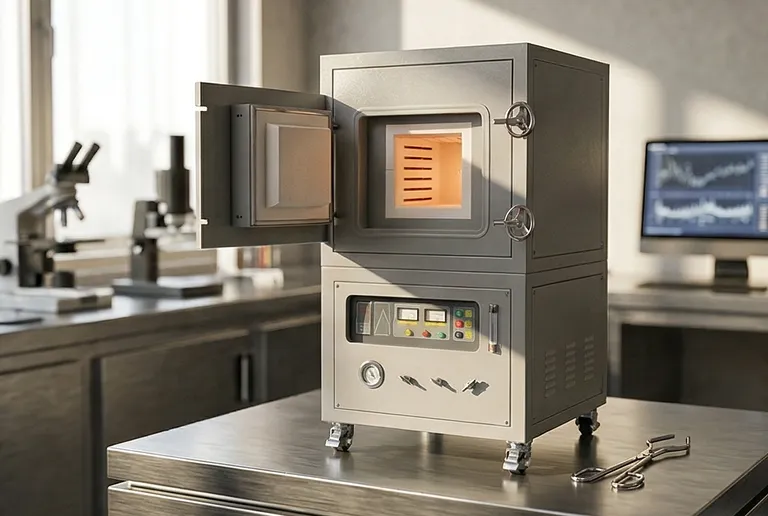
When you solve the problem of melting stability, the horizon of your research expands. You are no longer limited by the "typical" limitations of alloy R&D.
With a high-performance vacuum arc furnace, you can move into the frontier of materials science:
- Advanced HEAs: Synthesize complex high-entropy alloys involving Cobalt, Chromium, Iron, and Manganese with total confidence in their purity.
- Nb-Si Based Superalloys: Prepare master alloys involving high-melting-point refractory metals that were previously impossible to fuse uniformly.
- Enhanced Weldability: Produce cleaner base materials that prevent liquefaction cracks during advanced manufacturing processes like Laser-MPNG welding.
By mastering the melt, you turn your laboratory from a place of "trial and error" into a center of precision engineering.
At KINTEK, we understand that your research is only as good as the material you start with. Our customizable laboratory vacuum arc furnaces are built to deliver the purity and homogeneity that your most challenging projects demand. Whether you are working on the next generation of 718-type superalloys or exploring the potential of refractory high-entropy alloys, our team is ready to help you configure the perfect thermal solution for your specific goals.
Contact Our Experts to discuss how we can tailor our high-temperature technology to solve your toughest metallurgical challenges.
Related Products
- Vacuum Induction Melting Furnace
- Vacuum Heat Treat Sintering Furnace with Pressure for Vacuum Sintering
- Vacuum Heat Treat Sintering Furnace Molybdenum Wire Vacuum Sintering Furnace
- Vacuum Heat Treat Sintering and Brazing Furnace
- 2200 ℃ Tungsten Vacuum Heat Treat and Sintering Furnace
Related Articles
- The Physics of Perfection: How Vacuum Furnaces Redefine Material Integrity
- Beyond the Void: Why a Vacuum Furnace Isn't Just a Hot Chamber
- The Anatomy of Precision: A Strategic Framework for Choosing Your Vacuum Furnace
- The Unseen Enemy: How Vacuum Furnaces Redefine Material Perfection
- Why Your High-Purity Metals Oxidize in a Perfect Vacuum—And How to Stop It