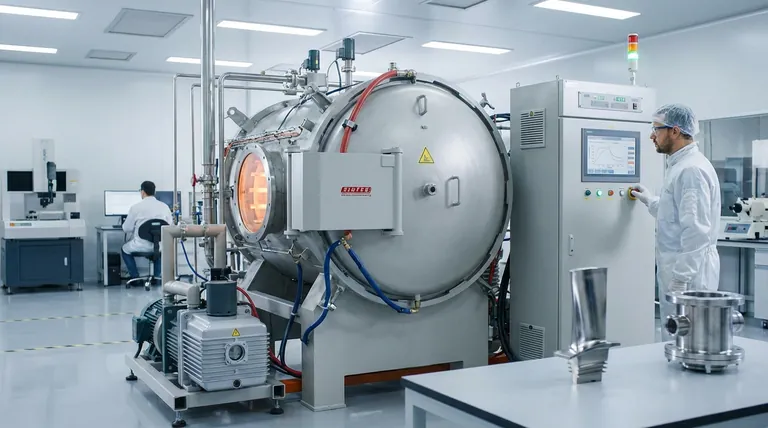
Imagine an engineer tasked with creating a single crystal turbine blade for a next-generation jet engine. The alloy must be perfect. At 1500°C, a single stray oxygen molecule could introduce a microscopic point of weakness—a flaw that, under immense stress, could lead to catastrophic failure miles above the earth.
This isn't just about getting something hot. It's about forging perfection in a controlled, invisible shield.
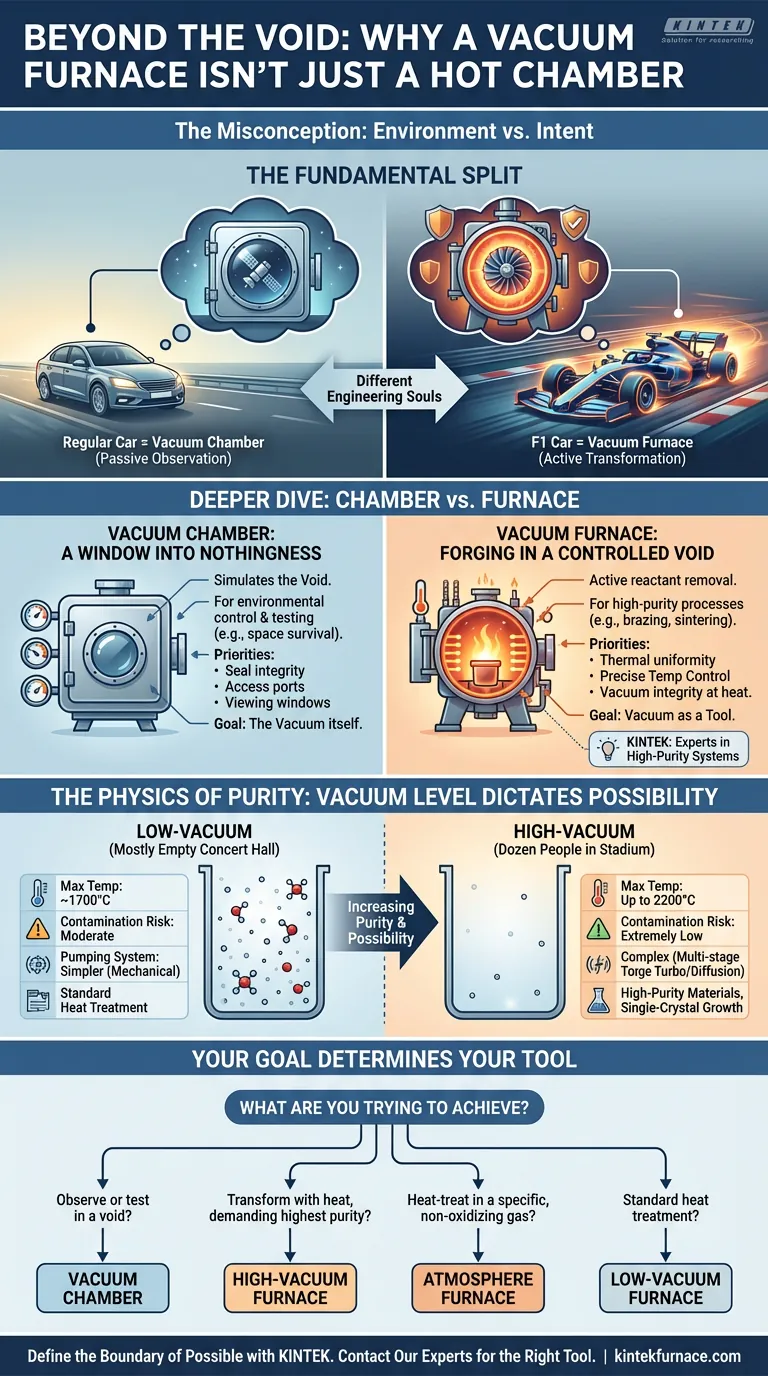
This scenario reveals a common but critical misunderstanding in materials science and engineering. Many see a vacuum furnace as simply a vacuum chamber that can get hot. This is like saying a Formula 1 car is just a regular car that can go fast. The underlying design philosophy is fundamentally different.
The Misconception: Environment vs. Intent
At their core, both systems remove atmosphere to create a low-pressure environment. But their purpose, their engineering soul, is worlds apart.
A vacuum chamber is a passive stage. Its job is to create and hold an empty space for observation.
A vacuum furnace is an active crucible. Its job is to use that empty space as a protective barrier for transformation.
One is for looking; the other is for creating.
The Chamber: A Window into Nothingness
A vacuum chamber is engineered to simulate the void. Its primary function is environmental control.
Think of testing satellite components to see if they can survive the vacuum of space. Or verifying that an electronic device won't fail at high altitudes. The chamber provides a stable, low-pressure stage for an experiment, typically at or near room temperature. The engineering priorities are seal integrity, access ports for instrumentation, and often, viewing windows. The vacuum is the end goal.
The Furnace: Forging Materials in a Controlled Void
In a vacuum furnace, the vacuum is not the goal. It is a critical tool.
When you heat metals or ceramics to extreme temperatures, they become incredibly reactive. The oxygen and nitrogen in our normal atmosphere become potent contaminants, leading to oxidation and structural impurities.
The vacuum furnace actively removes these reactants. By creating a near-perfect void, it serves as an invisible shield, allowing processes like brazing, sintering, and annealing to occur without compromising the material's integrity. The engineering priorities are thermal uniformity, precise temperature control, and maintaining vacuum integrity under immense thermal stress.
This is where specialized manufacturing becomes non-negotiable. Systems from expert R&D and manufacturing firms like KINTEK are designed for this very challenge. Their vacuum furnaces are engineered not just to get hot, but to maintain an immaculate, protective environment while doing so, ensuring the purity required for aerospace, medical, and advanced electronics applications.
The Physics of Purity: Why Vacuum Level Dictates Possibility
Not all vacuums are created equal. The "emptiness" of the space directly correlates to the purity of the result. This is measured by the vacuum level.
Low Vacuum vs. High Vacuum: A Tale of Two Worlds
The difference isn't just a number; it's a completely different environment at the molecular level.
- Low-Vacuum: Removes most of the air. It's like having a mostly empty concert hall. It's sufficient for many standard heat treatments where minor contamination is tolerable.
- High-Vacuum: Removes vastly more molecules using multi-stage pumps (e.g., a mechanical pump paired with a turbomolecular pump) . It's like having only a dozen people inside a giant football stadium. The chance of an unwanted molecular interaction is almost zero.
The Inseparable Link: Vacuum, Temperature, and Purity
The quality of the vacuum is directly tied to the process outcome. This relationship governs what you can create.
| Feature | Low-Vacuum Furnace | High-Vacuum Furnace |
|---|---|---|
| Max Temperature | ~1700°C | Up to 2200°C |
| Contamination Risk | Moderate | Extremely Low |
| Pumping System | Simpler (e.g., mechanical pumps) | Complex (multi-stage turbo or diffusion pumps) |
| Typical Use Case | Standard heat treatment, less sensitive materials | High-purity metals, ceramics, single-crystal growth |
A high vacuum allows for higher temperatures because there are fewer gas molecules to transfer heat or cause unwanted reactions. This direct link between vacuum level and purity is why choosing the right furnace is a strategic decision about the quality and performance of your final material.
The Right Tool for Your Ambition
Choosing between these systems isn't just a technical choice; it's a reflection of your project's goals.
-
When a furnace is overkill: If you only need to simulate a low-pressure environment for testing, a vacuum chamber is the correct, more cost-effective tool. A furnace is an unnecessarily complex and expensive solution.
-
When a vacuum isn't what you need: Sometimes, the goal isn't to remove the atmosphere but to replace it. Processes like nitriding require a specific gas (like nitrogen or argon) to be present during heating. For this, a modified atmosphere furnace is necessary.
Your Goal Determines Your Tool
Your final decision should be driven by a single question: What are you trying to achieve?
- To observe or test in a void? You need a vacuum chamber.
- To transform a material with heat, demanding the highest purity? You need a high-vacuum furnace.
- To heat-treat in a specific, non-oxidizing gas? You need an atmosphere furnace.
- To perform a standard heat treatment where some contamination is acceptable? A low-vacuum furnace may suffice.
Understanding this distinction is the first step toward material perfection. The real challenge is finding a system engineered to meet your exact specifications. Whether it's a standard tube furnace or a fully customized CVD system, the quality of your equipment defines the boundary of what's possible.
If your work demands precision, purity, and performance at high temperatures, let's talk about the right tool for your ambition. Contact Our Experts
Visual Guide
Related Products
- Vacuum Hot Press Furnace Machine Heated Vacuum Press Tube Furnace
- Vacuum Hot Press Furnace Machine Heated Vacuum Press
- 600T Vacuum Induction Hot Press Vacuum Heat Treat and Sintering Furnace
- 2200 ℃ Tungsten Vacuum Heat Treat and Sintering Furnace
- Vacuum Heat Treat Sintering Furnace with Pressure for Vacuum Sintering
Related Articles
- How Vacuum Hot Press Furnaces Transform Advanced Material Engineering
- How to Select the Right Vacuum Hot Pressing Furnace Temperature for Your Materials
- Beyond the Parts List: The Real Reason Your Vacuum Hot Press Fails (And How to Fix It)
- Why Your High-Temperature Materials Fail: The Hidden War Inside Your Furnace
- Is Your Material Data Real? Why Temperature Gradients Are Sabotaging Your Cu2Se Resistivity Measurements



















