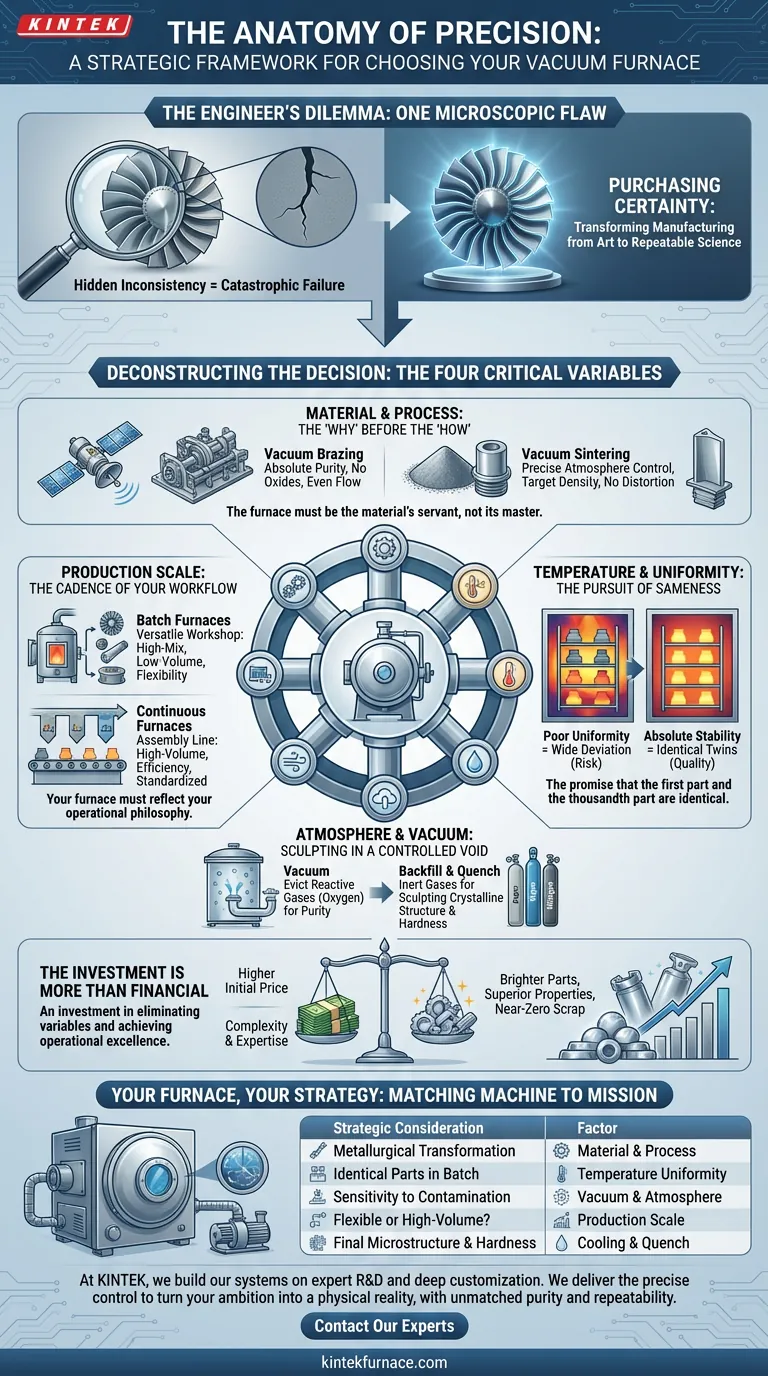
The Engineer's Dilemma: One Microscopic Flaw
An aerospace engineer inspects a turbine blade. To the naked eye, it's perfect. But they know that a single microscopic inconsistency—a brittle spot, an improper grain structure—born from an imperfect heat treatment cycle, could lead to catastrophic failure miles above the earth.
This isn't just an engineering problem; it's a crisis of control.
Choosing a vacuum furnace isn't about buying a piece of equipment. It's about purchasing certainty. It's a decision that forces a deep reckoning with your materials, your processes, and your ultimate goals. The wrong choice introduces randomness and risk; the right one transforms manufacturing from an art into a repeatable science.
Deconstructing the Decision: The Four Critical Variables
The selection process is often presented as a technical checklist. In reality, it's a system of interconnected dependencies. Focusing on temperature while ignoring atmosphere is like tuning an instrument in a hurricane. Each factor is a pillar supporting the final quality of your product.
H3: Material and Process: The 'Why' Before the 'How'
Before you ask what a furnace can do, you must define precisely what you need to achieve. The alloy you're using and the process you're performing—be it hardening, annealing, sintering, or brazing—dictate every subsequent requirement.
- Vacuum Brazing: Joining complex assemblies for a satellite demands absolute purity. The high vacuum isn't a feature; it's a necessity to prevent oxides from compromising the joint's integrity. Exceptional temperature uniformity ensures the brazing alloy flows evenly into every crevice.
- Vacuum Sintering: Creating a dense part from metal powder is a different challenge. The focus is on precise atmosphere control during heating and cooling to achieve the target density and mechanical strength without distortion.
The material’s needs are non-negotiable. The furnace must be its servant, not its master.
H3: Temperature and Uniformity: The Pursuit of Sameness
Reaching a target temperature is simple. Holding it with absolute stability and uniformity across every cubic centimeter of the hot zone is the true challenge.
Poor uniformity is the hidden source of inconsistent quality. It means the parts on the edge of the rack receive a different treatment than those in the center, leading to a batch of products with a wide statistical deviation in their properties. For medical implants or critical automotive components, this deviation is unacceptable.
Uniformity is the promise that the first part and the thousandth part are identical twins.
H3: Atmosphere and Vacuum: Sculpting in a Controlled Void
We call it a "vacuum," but it's not truly empty. It is the most controlled environment imaginable. The primary purpose of the vacuum is to violently evict the reactive gases—especially oxygen—that are the enemy of metallurgical purity.
The level of vacuum required depends on the material's sensitivity. Titanium, for example, is notoriously reactive and demands a high vacuum to prevent contamination.
But the process doesn't end there. Modern furnaces allow for backfilling with inert gases like argon or nitrogen. This isn't just for cooling; it's a tool for sculpting. High-pressure gas quenching is how we lock in a specific crystalline structure, defining the metal's final hardness and strength.
H3: Production Scale: The Cadence of Your Workflow
Your production volume reveals your operational philosophy, and your furnace must reflect it.
- Batch Furnaces: These are the versatile workshops of the heat-treating world. They are perfect for high-mix, low-volume production, R&D, and job shops where flexibility is paramount. Each cycle is a discrete project.
- Continuous Furnaces: These are the assembly lines. Parts flow through optimized heating and cooling zones in an uninterrupted stream. They offer unmatched throughput and efficiency for standardized, high-volume products, but sacrifice the flexibility of their batch counterparts.
The Investment is More Than Financial
A vacuum furnace is a significant capital investment, but the true cost lies in misunderstanding its role as a complex system.
The higher initial price tag is an investment in eliminating variables. It buys you brighter parts that need no post-processing, superior mechanical properties that command higher value, and scrap rates that approach zero.
The complexity of the system—the pumps, controls, and cooling circuits—is the price of that precision. This demands skilled operators and a diligent maintenance culture. It's a commitment to a higher standard of operational excellence. This is why the right choice isn't just about the machine, but the expertise behind it. A partner who understands the nuance of customization becomes a strategic asset.
Your Furnace, Your Strategy: Matching Machine to Mission
Ultimately, selecting a vacuum furnace is an act of strategic alignment. You are matching a powerful technology to a specific commercial or scientific ambition. The best furnace is the one that flawlessly executes your mission.
| Factor | Strategic Consideration |
|---|---|
| Material & Process | What metallurgical transformation are you trying to achieve? |
| Temperature Uniformity | How identical must every part in a batch be? |
| Vacuum & Atmosphere | How sensitive is your material to contamination and oxidation? |
| Production Scale | Are you a flexible workshop or a high-volume factory? |
| Cooling & Quench | What final microstructure and hardness do you need to engineer? |
At KINTEK, we build our systems on a foundation of expert R&D and dedicated manufacturing. We recognize that no two challenges are identical. Our portfolio, including Muffle, Tube, Vacuum, and CVD furnaces, serves as a toolkit. But our true strength lies in our ability to deeply customize these systems to meet your unique requirements. We deliver the precise control you need to turn your ambition into a physical reality, with unmatched purity and repeatability.
To find the system that aligns with your strategy, Contact Our Experts
Visual Guide
Related Products
- Vacuum Hot Press Furnace Machine Heated Vacuum Press Tube Furnace
- Vacuum Hot Press Furnace Machine Heated Vacuum Press
- 600T Vacuum Induction Hot Press Vacuum Heat Treat and Sintering Furnace
- 2200 ℃ Tungsten Vacuum Heat Treat and Sintering Furnace
- Vacuum Heat Treat Sintering Furnace with Pressure for Vacuum Sintering
Related Articles
- How Vacuum Hot Press Furnaces Transform Advanced Material Engineering
- How to Select the Right Vacuum Hot Pressing Furnace Temperature for Your Materials
- Beyond the Parts List: The Real Reason Your Vacuum Hot Press Fails (And How to Fix It)
- Why Your High-Temperature Materials Fail: The Hidden War Inside Your Furnace
- Is Your Material Data Real? Why Temperature Gradients Are Sabotaging Your Cu2Se Resistivity Measurements