The Hidden Variable in Heat Treatment
Every engineer lives with a healthy fear of the unseen flaw. A microscopic imperfection in a critical component—a turbine blade, a surgical implant, a high-performance gear—can cascade into catastrophic failure.
For decades, heat treatment has focused on managing this risk by controlling a chaotic environment. We flooded furnaces with inert gases, trying to hold back the reactive elements in the air. But this is a defensive posture.
The real breakthrough came from a psychological shift. What if, instead of trying to control the atmosphere, we simply got rid of it?
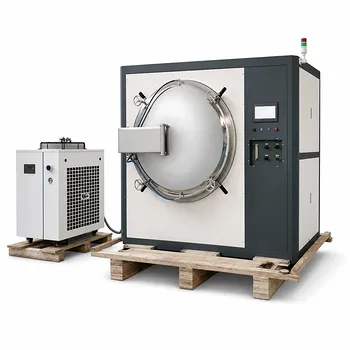
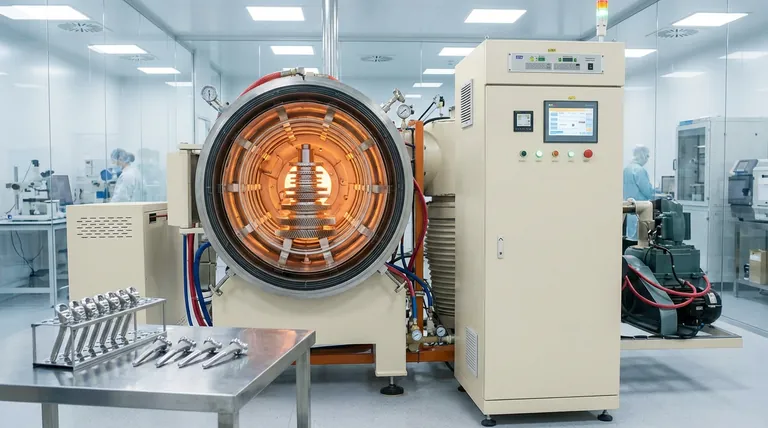
This is the elegant premise of the vacuum furnace. It's not just a better oven; it's a fundamentally different paradigm. By removing the air, you remove the unpredictable variables. You move from managing risk to engineering certainty.
At its core, a vacuum furnace shifts the goal from merely protecting a part's surface to actively purifying and enhancing the material itself.
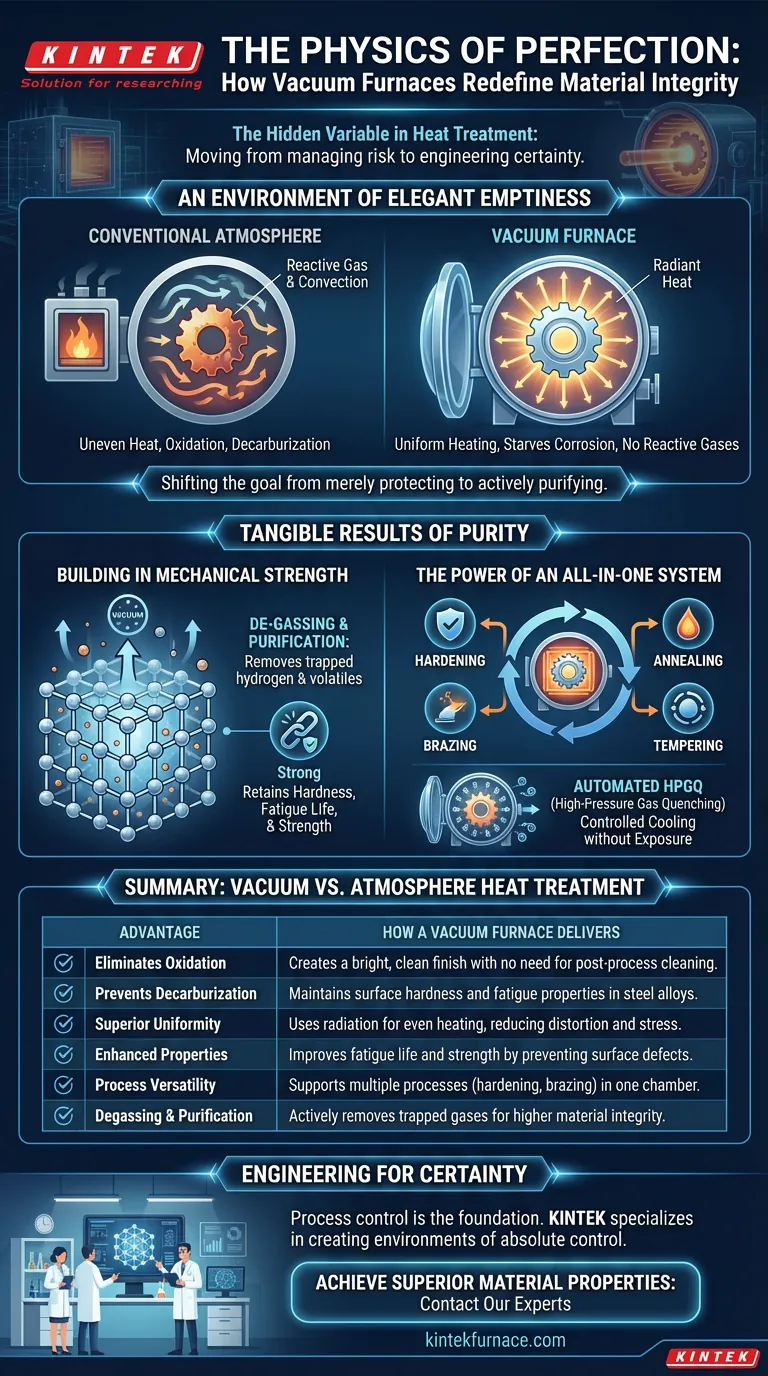
An Environment of Elegant Emptiness
The primary advantages of a vacuum furnace all stem from this single, powerful act of removal.
From Reactive to Radiant Heat
In a conventional furnace, the atmosphere is a medium. Heat travels through it unevenly, creating hot spots and thermal gradients that warp and stress a component.
In a vacuum, heat transfer occurs primarily through thermal radiation. Like the sun warming the earth, energy is applied evenly to every surface of the part, regardless of its complexity. This exceptional uniformity is the key to achieving dimensional stability, minimizing the internal stresses that shorten a part's life.
Starving the Agents of Corrosion
The air we breathe is hostile to hot metal. Oxygen molecules are eager to bond, creating oxide scale that discolors the surface and must be blasted or pickled away. Other gases can leach carbon from the surface of steel, a process called decarburization that leaves a soft, weak outer layer.
A vacuum furnace starves these reactions before they can begin. By removing the oxygen and reactive gases, parts emerge with a bright, clean, and metallurgically unaltered surface. The integrity of the material, as designed by the engineer, is perfectly preserved.
The Tangible Results of Purity
This controlled, pure environment translates directly into superior components and a more efficient process.
Building In Mechanical Strength
Because a vacuum furnace prevents the formation of surface defects, the finished component retains its intended hardness, fatigue life, and strength.
Furthermore, the vacuum actively pulls contaminants out of the material. This degassing effect removes trapped gases like hydrogen, which can cause embrittlement, and other volatile substances from prior manufacturing steps. It's a final purification that enhances the material's internal integrity—a non-negotiable for medical and aerospace applications.
The Power of an All-in-One System
Modern vacuum furnaces are marvels of integration. A single, automated cycle within one chamber can perform multiple processes: hardening, annealing, tempering, and even brazing.
Most systems incorporate high-pressure gas quenching (HPGQ) using inert nitrogen or argon. This allows for rapid, controlled cooling without ever exposing the part to the outside world, giving process engineers an unprecedented level of control over the final microstructure.
A Question of Intent, Not Just Technology
While incredibly powerful, a vacuum furnace is a specialized tool. Its value is tied directly to the intended outcome.
- When ultimate quality is the goal, for critical aerospace, medical, or tooling applications, the purity and repeatability of a vacuum furnace are indispensable.
- When dealing with complex geometries, the uniform radiant heating of a vacuum furnace minimizes distortion and makes it the safest choice for high-value parts.
- When high-volume, low-cost processing is the priority, and minor surface oxidation is acceptable, a traditional atmosphere furnace may be more economical.
The decision is a strategic one, balancing upfront investment against the long-term cost of inconsistency, post-processing, and part failure.
Summary: Vacuum vs. Atmosphere Heat Treatment
| Advantage | How a Vacuum Furnace Delivers |
|---|---|
| Eliminates Oxidation | Creates a bright, clean finish with no need for post-process cleaning. |
| Prevents Decarburization | Maintains surface hardness and fatigue properties in steel alloys. |
| Superior Uniformity | Uses radiation for even heating, reducing distortion and stress. |
| Enhanced Properties | Improves fatigue life and strength by preventing surface defects. |
| Process Versatility | Supports multiple processes (hardening, brazing) in one chamber. |
| Degassing & Purification | Actively removes trapped gases for higher material integrity. |
Engineering for Certainty
For laboratories and manufacturers pushing the boundaries of material science, process control is not a luxury—it is the entire foundation of their work. Achieving this requires more than just a furnace; it requires a precisely engineered and reliable system tailored to a specific application.
At KINTEK, we specialize in creating these environments of absolute control. Our customizable Muffle, Tube, and Vacuum furnace systems are built on a foundation of expert R&D and precision manufacturing. We design solutions for the unique demands of industries where there is no margin for error. If your goal is to move from managing variables to eliminating them, we can help you engineer the perfect process.
To achieve superior material properties and absolute process repeatability in your lab, Contact Our Experts.
Visual Guide
Related Products
- Vacuum Hot Press Furnace Machine Heated Vacuum Press Tube Furnace
- Vacuum Hot Press Furnace Machine Heated Vacuum Press
- 600T Vacuum Induction Hot Press Vacuum Heat Treat and Sintering Furnace
- 2200 ℃ Tungsten Vacuum Heat Treat and Sintering Furnace
- Vacuum Heat Treat Sintering Furnace with Pressure for Vacuum Sintering
Related Articles
- How Vacuum Hot Press Furnaces Transform Advanced Material Engineering
- How to Select the Right Vacuum Hot Pressing Furnace Temperature for Your Materials
- Beyond the Parts List: The Real Reason Your Vacuum Hot Press Fails (And How to Fix It)
- Why Your High-Temperature Materials Fail: The Hidden War Inside Your Furnace
- Is Your Material Data Real? Why Temperature Gradients Are Sabotaging Your Cu2Se Resistivity Measurements