The Illusion of Space
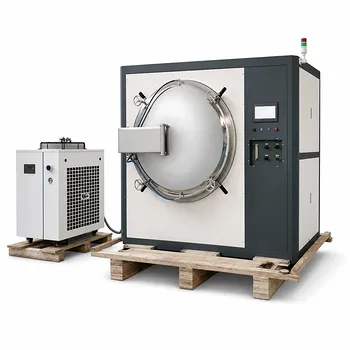
When you look at a horizontal vacuum furnace, the first thing you notice is the chamber—a vast, empty space. It’s easy to fall into the psychological trap of seeing it as just a big, hot box. The primary challenge, it seems, is simply fitting your parts inside.
This is a fundamental misunderstanding.
The furnace's true flexibility and precision don't come from its internal volume. They are born from the intelligent engineering of what goes inside that volume. The real work—the art and science that dictates the final quality of the part—happens long before the door is ever sealed. It lies in the choreography of loading.
The Choreography of Loading: A Tale of Two Parts
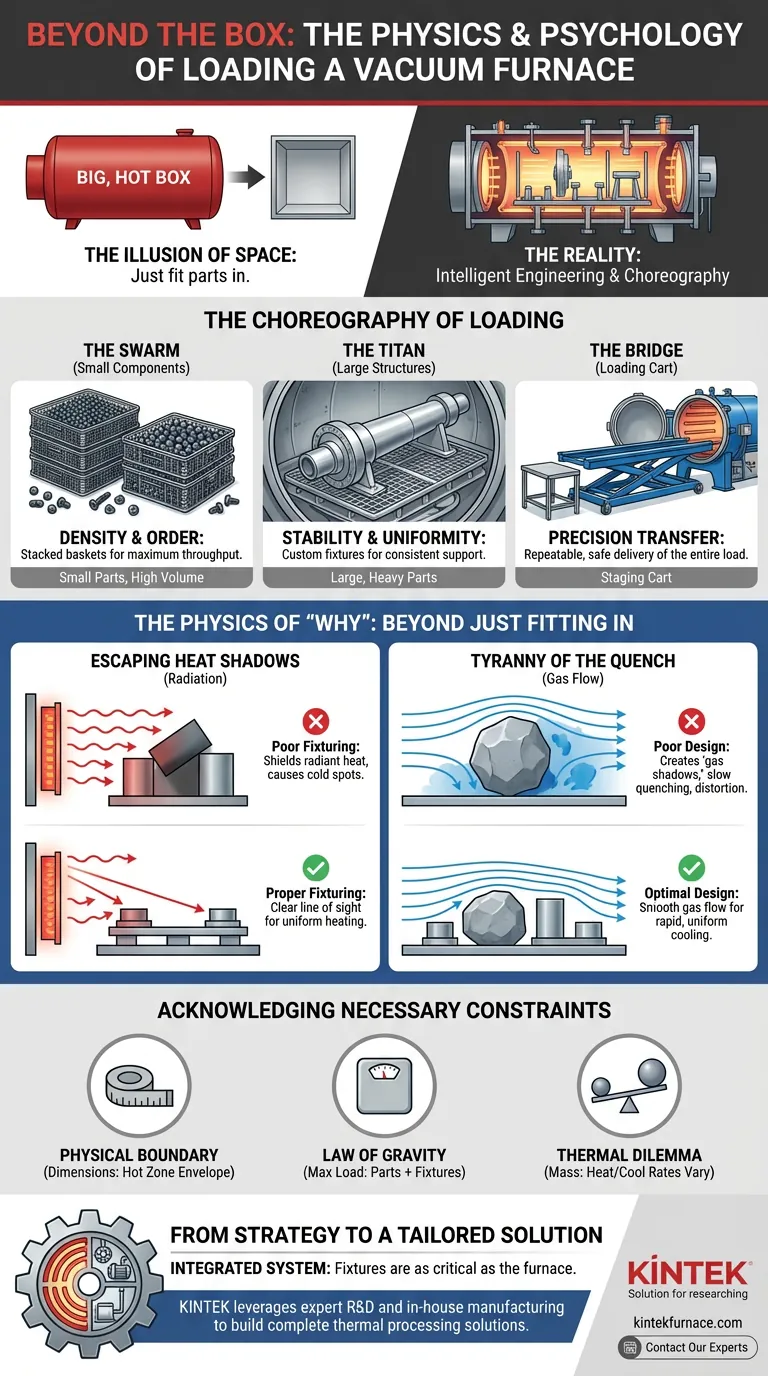
The ability to process a wide array of components depends entirely on the systems designed to hold and position them within the hot zone. It's a methodical process, tailored to the geometry and quantity of the parts.
The Swarm: Handling Small Components
Consider the challenge of heat-treating thousands of small, critical parts at once—ball bearings, medical screws, or turbine blade fasteners. The goal isn't just treatment; it's throughput.
Here, the solution is density and order. These parts are loaded into stackable baskets, typically crafted from graphite or molybdenum alloys. By stacking these baskets on a single base, operators create a dense, multi-layered load that maximizes the number of parts per cycle, turning a potential logistical nightmare into a model of efficiency.
The Titan: Accommodating Large Structures
Now, picture the opposite: a single, massive die-casting mold or a long, slender aerospace shaft. Here, the challenge is stability and absolute uniformity over a large surface area.
These titans are placed on custom-designed grids, trays, or specialized fixtures. The horizontal orientation of the furnace is a distinct advantage, allowing long parts to be laid flat. This provides consistent support, preventing the sag or distortion that could occur during the intense thermal cycle.
The Bridge: The Unsung Hero of Loading
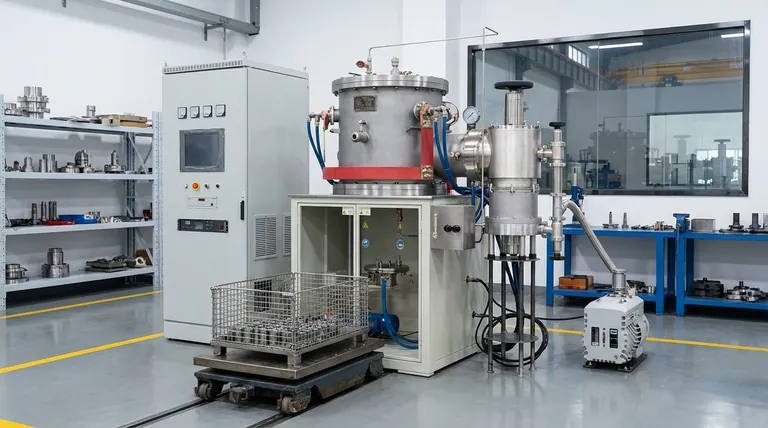
Connecting the staging area to the furnace chamber is the loading cart. It's far more than a simple trolley; it's a robust piece of precision machinery, engineered to handle the immense weight of a full load and align perfectly with the furnace opening.
This cart allows an operator to smoothly and safely transfer the entire arrangement into the hot zone. It ensures that this carefully planned choreography is perfectly repeatable, cycle after cycle. It is the reliable bridge between the human world and the extreme environment within.
The Physics of "Why": Beyond Just Fitting In
Simply getting parts into the furnace is step one. Arranging them correctly—the art of fixturing—is what separates success from a batch of expensive scrap metal.
Escaping the Shadows of Heat
In a vacuum, heat travels primarily through radiation. Proper fixturing ensures a clear line of sight from the heating elements to every critical surface. It also prevents parts from touching, which would create thermal sinks, or "cold spots."
The common cognitive bias is to prioritize packing density above all else. But if parts shield each other from radiant heat, you achieve density at the cost of uniformity, compromising the metallurgical properties you set out to create.
The Tyranny of the Quench
During the rapid cooling phase, the flow of high-pressure gas is everything. Poor fixture design or overly dense packing creates "gas shadows"—areas where the quenching gas is blocked or diverted.
Like a rock in a stream, a poorly placed part creates turbulence, starving downstream surfaces of the cooling they need. This leads to slow or non-uniform quenching, resulting in soft spots, inconsistent hardness, and distortion. It's a catastrophic failure that renders the part useless.
Acknowledging the Necessary Constraints
A vacuum furnace is a highly versatile tool, but it operates under a firm set of rules. Mastering the tool means mastering its limitations.
- The Physical Boundary: The usable dimensions of the hot zone (length, width, height) are absolute. Any part and its fixture must fit within this envelope with adequate clearance from the heating elements.
- The Law of Gravity: Every furnace has a maximum load weight capacity. This isn't just the weight of your parts; it's the combined mass of the parts and the heavy graphite or alloy fixtures holding them. Overloading is a fast path to damaging the hearth and loading mechanism.
- The Thermal Dilemma: Processing massive parts alongside small, light components in the same cycle is exceptionally difficult. Their vastly different thermal masses mean they heat and cool at different rates, making it nearly impossible to achieve optimal properties for both simultaneously.
From Strategy to a Tailored Solution
Understanding these principles transforms a furnace from a simple appliance into a precision instrument. The key is to align your loading strategy with your production reality. A high-volume parts manufacturer needs a different fixturing system than a specialty aerospace workshop.
This is where expertise in both design and manufacturing becomes critical. A furnace is more than just a chamber that gets hot; it's an integrated system where the internal fixtures are just as important as the heating elements and vacuum pumps.
At KINTEK, we leverage our expert R&D and in-house manufacturing to build complete thermal processing solutions. Whether you need a Muffle, Tube, Vacuum, or CVD furnace, we understand that true performance comes from tailoring the entire system—including the often-overlooked loading strategy—to your unique components and goals. Our deep customization capability ensures your equipment is a perfect fit for your application.
If you're ready to move beyond the "box" and achieve true process control, Contact Our Experts
Visual Guide
Related Products
- Vacuum Hot Press Furnace Machine Heated Vacuum Press Tube Furnace
- Vacuum Hot Press Furnace Machine Heated Vacuum Press
- 600T Vacuum Induction Hot Press Vacuum Heat Treat and Sintering Furnace
- 2200 ℃ Tungsten Vacuum Heat Treat and Sintering Furnace
- Vacuum Heat Treat Sintering Furnace with Pressure for Vacuum Sintering
Related Articles
- How Vacuum Hot Press Furnaces Transform Advanced Material Engineering
- How to Select the Right Vacuum Hot Pressing Furnace Temperature for Your Materials
- Beyond the Parts List: The Real Reason Your Vacuum Hot Press Fails (And How to Fix It)
- Why Your High-Temperature Materials Fail: The Hidden War Inside Your Furnace
- Is Your Material Data Real? Why Temperature Gradients Are Sabotaging Your Cu2Se Resistivity Measurements