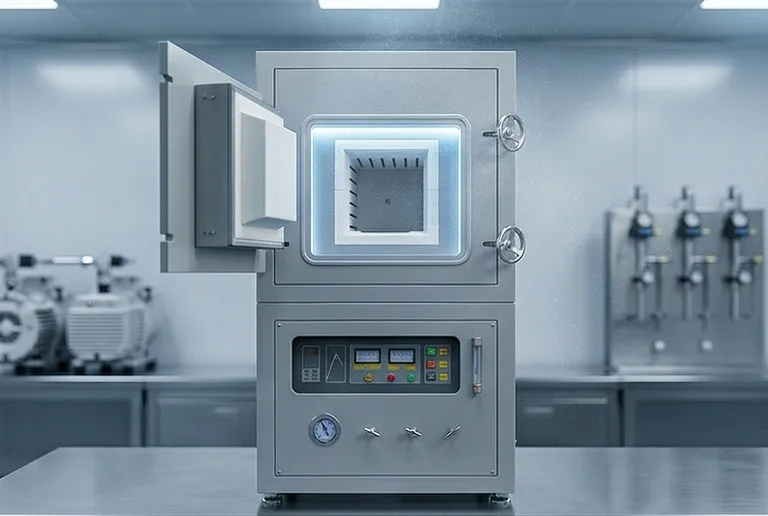
The "Perfect" Vacuum That Leads to Failed Joints
Imagine you are brazing a critical batch of stainless steel components. Your vacuum gauge displays a reassuring $10^{-6}$ mbar—a high-performance level by any industry standard. You’ve followed the protocol, the equipment is functioning perfectly, and yet, when the parts emerge, the results are devastating. The brazing filler hasn't flowed, the wetting is uneven, and the metallurgical bond is brittle.
In high-precision industries like aerospace, medical device manufacturing, and semiconductor processing, this scenario is a common and costly nightmare. Why do joints fail even when the vacuum environment appears "perfect"?
The Common Struggle: Chasing the Wrong Solution
When faced with poor brazing quality, most engineers default to the same set of "fixes":
- Increasing the "Soak" Time: Holding the vacuum longer in hopes that more impurities will be sucked out.
- Investing in More Powerful Pumps: Trying to push the vacuum from $10^{-6}$ toward $10^{-7}$ mbar.
- Aggressive Pre-Cleaning: Using harsh chemical etchants to strip oxides before the parts even enter the furnace.
While these steps seem logical, they often lead to diminishing returns. Projects still face delays, costs per part skyrocket due to energy consumption and extended cycle times, and the scrap rate remains stubbornly high. The frustration stems from a fundamental misunderstanding: the belief that a vacuum is a "void" where nothing can happen to the metal.
The Invisible Enemy: Why Residual Oxygen Still Rules at High Vacuum
The hard truth of materials science is that even at a high vacuum of $10^{-6}$ mbar, your metal surfaces are not alone. They are being continuously bombarded by residual oxygen molecules.
While $10^{-6}$ mbar sounds incredibly low, it still contains enough oxygen to cause the re-oxidation of active metals. In materials like stainless steel or alloys containing zirconium and boron, the native oxide layer ($ZrO_2$, $B_2O_3$, etc.) is incredibly stable.
Here is why a physical vacuum alone often fails:
- Continuous Bombardment: Even at low pressures, the frequency of oxygen molecules hitting the metal surface can exceed the rate at which the vacuum pump can remove them.
- Thermodynamic Stability: Many metal oxides are so stable that they will not "evaporate" or decompose simply because the pressure is low. They require a chemical "push" to break their bonds.
- Secondary Oxidation: As the temperature rises during the brazing cycle, the activity of the residual oxygen increases, often forming a new, thin oxide film faster than the brazing filler can wet the surface.
To achieve a truly clean surface, you don't just need a physical vacuum; you need a chemical environment that actively reverses oxidation.
Beyond Physics: Engineering Chemical Purity with KINTEK Furnaces
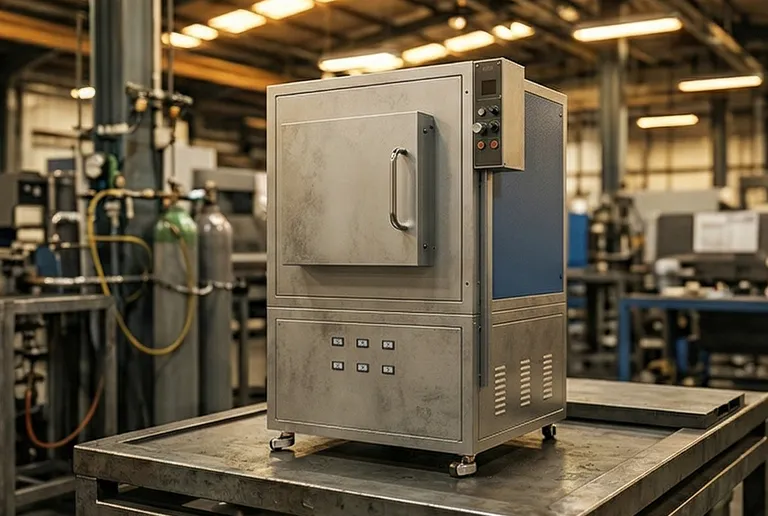
To solve the problem of persistent oxide layers, KINTEK has designed a range of high-temperature vacuum and atmosphere furnaces that go beyond mere suction. Our technology recognizes that brazing is as much a chemical process as it is a thermal one.
KINTEK furnaces are engineered to facilitate Advanced Deoxidation and Chemical Reduction:
- Promoting Carbothermal Reduction: Our systems are designed to precisely lower the partial pressure of reaction gases. This allows for carbothermal reduction—where carbon or graphene can react with stubborn surface oxides like $ZrO_2$.
- Rapid Byproduct Evacuation: As these chemical reactions occur, they produce CO gas. KINTEK’s high-efficiency vacuum systems are optimized to evacuate these gases instantly, preventing the reaction from reversing and ensuring the grain boundaries remain purified.
- Atmospheric Flexibility: For applications where vacuum alone isn't enough, our furnaces allow for the introduction of reducing atmospheres (such as hydrogen or argon-hydrogen mixes). This provides the "chemical reduction" necessary to strip the oxide layer entirely, ensuring 100% wetting of the filler metal.
By positioning our products as more than just "heating boxes," we provide a tool that directly addresses the root cause of brazing failure: the chemical stability of the oxide layer.
From Structural Integrity to New Market Possibilities
When you solve the "unsolvable" problem of oxide interference, your production capabilities shift overnight.
By achieving an ideal oxygen-free surface through a combination of high vacuum and chemical reduction, you unlock new potential:
- Superior Bond Density: Achieve dense, reliable metallurgical bonds that can withstand extreme pressure and temperature.
- Advanced Material Processing: Successfully braze graphene-reinforced metals or advanced ceramics that were previously considered "un-weldable."
- Accelerated Production: Because the chemical reduction is more efficient than "waiting out" a vacuum, you can achieve better results in shorter cycle times, significantly increasing your throughput.
Don't let residual oxygen compromise your engineering standards. If you are struggling with inconsistent brazing results or looking to push the boundaries of what your materials can do, our team is ready to help. We specialize in tailoring high-temperature environments to the specific chemical needs of your most demanding projects. Contact Our Experts today to discuss how we can optimize your thermal processes for maximum reliability and performance.
Related Products
- Vacuum Heat Treat Sintering and Brazing Furnace
- Vacuum Hot Press Furnace Machine Heated Vacuum Press
- Vacuum Hot Press Furnace Machine Heated Vacuum Press Tube Furnace
- Vacuum Hot Press Furnace Machine for Lamination and Heating
- 600T Vacuum Induction Hot Press Vacuum Heat Treat and Sintering Furnace
Related Articles
- Why Your High-Temperature Aerospace Joints Fail—and the Science of the Perfect Vacuum Weld
- Why Your 3D-Printed Maraging Steel Parts Aren't Performing—And How to Fix the Structural Weakness
- Why Your Vacuum Brazed Joints Are Failing—And the Precise Pressure Fix You’ve Been Missing
- Beyond Inert: The Physics and Psychology of Perfecting Joints in a Vacuum Furnace
- The Art of Joining in a Void: Why Critical Components Are Forged in Vacuum Furnaces



















