The Invisible Enemy in the Room
Imagine an engineer meticulously designing a critical aerospace component. They've accounted for stress, temperature, and fatigue. Yet, the greatest threat to their work isn't a flaw in the design, but the invisible, chaotic atmosphere in the room.
At high temperatures, the air we breathe becomes a highly reactive agent. It attacks, contaminates, and fundamentally alters the materials we are trying to perfect.
The core purpose of a high vacuum furnace is not to create an empty space. It is to wage a war against this chaos. It's a tool designed to establish a pristine, predictable, and chemically inert environment, giving engineers and scientists what they crave most: absolute control.
Eliminating Atmospheric Sabotage
A standard atmosphere is a cocktail of reactive gases. Removing it is the first step toward material integrity.
The Aggressive Nature of Oxygen
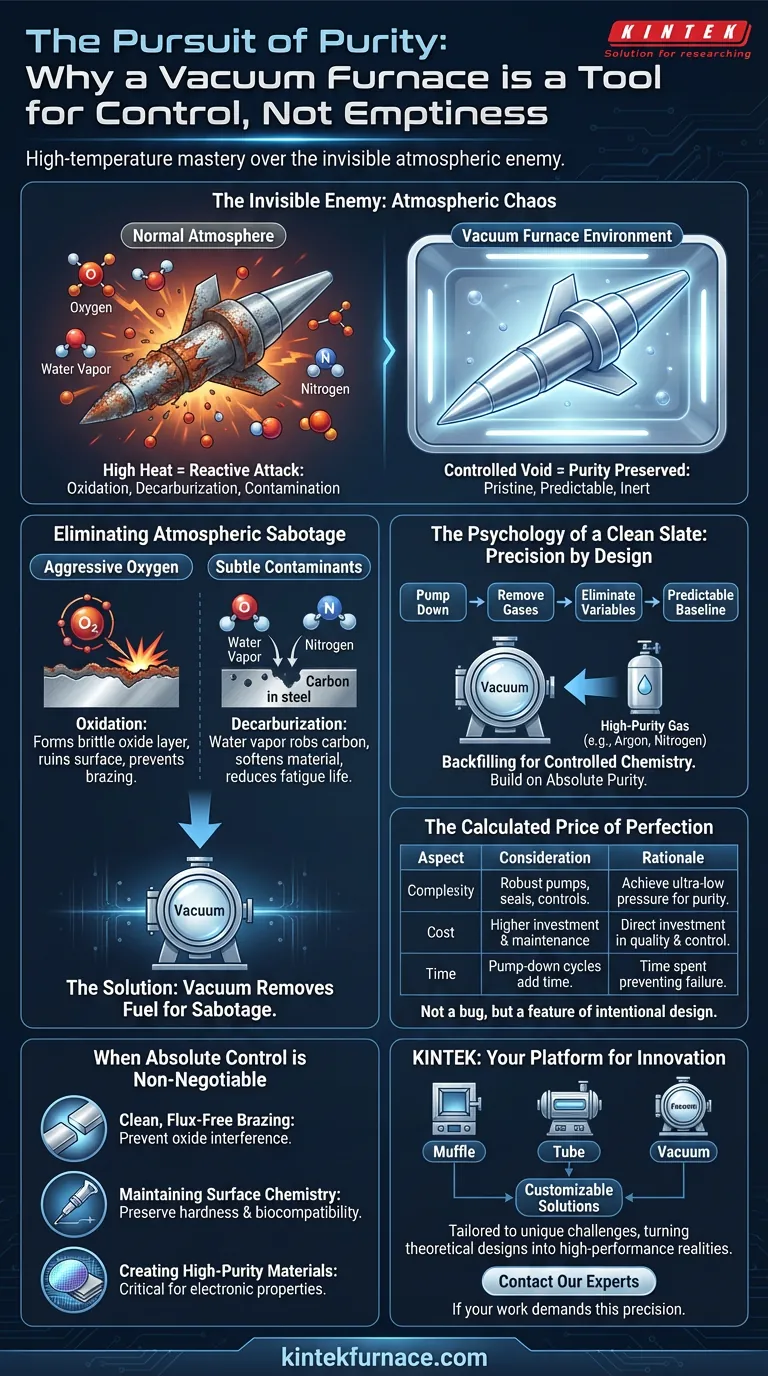
Oxygen is essential for life but is the enemy of high-temperature metallurgy. As heat increases, oxygen aggressively bonds with metal surfaces, forming a brittle, useless oxide layer.
This process, oxidation, prevents proper brazing, compromises surface finish, and can ruin a component's structural integrity. A vacuum environment removes the fuel for this fire, preserving the pure, metallic nature of the material.
The Subtlety of Contamination
The threat isn't just oxygen. Water vapor and nitrogen, abundant in the atmosphere, are subtle saboteurs.
For instance, trace amounts of water vapor can react with carbon in steel during heat treatment. This leads to decarburization—a loss of carbon from the surface that softens the material, reducing its hardness and fatigue life. The vacuum furnace creates an environment so clean that these hidden reactions cannot occur.
The Psychology of a Clean Slate
At its heart, a vacuum furnace is an instrument for imposing order on an unpredictable world. By pumping down the chamber, you aren't just removing gases; you are eliminating variables.
A Predictable Baseline
The vacuum creates a stable, repeatable baseline. Every process starts from the same near-perfectly clean state. This is the foundation of scientific and industrial repeatability.
Precision by Design
This controlled void is often just the beginning. The primary job of the vacuum is to "clean the slate" before a precisely controlled element is introduced.
Many advanced processes involve backfilling the furnace with a high-purity gas like argon or nitrogen. This allows for specific chemical interactions without the risk of contamination from atmospheric air. You get a controlled atmosphere, but one built on a foundation of absolute purity.
The Calculated Price of Perfection
This level of control is not without its trade-offs. It is a deliberate choice that prioritizes material integrity over speed or simplicity.
| Aspect | Consideration | Rationale |
|---|---|---|
| Complexity | Requires robust pumps, seals, and controls. | Necessary to achieve and maintain the ultra-low pressures required for purity. |
| Cost | Higher initial investment and maintenance. | A direct investment in process control and final product quality. |
| Time | Pump-down cycles add to total process time. | Time spent ensuring a pristine environment is an investment in preventing failure. |
The complexity is not a bug; it is a feature. It is the physical manifestation of the control you wish to exert over the material's final properties.
When Absolute Control is Non-Negotiable
For many applications, the control offered by a vacuum environment isn't a luxury—it's a fundamental requirement for success.
- Clean, Flux-Free Brazing: To join complex parts, a vacuum is essential to prevent oxide layers that interfere with the bonding of filler materials.
- Maintaining Surface Chemistry: For heat-treating precision tools or medical implants, the inert environment prevents reactions that would alter surface hardness and biocompatibility.
- Creating High-Purity Materials: In semiconductor and advanced materials research, a contamination-free environment is critical for achieving desired electronic or physical properties.
For researchers and engineers pushing the boundaries in these fields, the furnace is more than just a piece of equipment; it is an extension of their will. A system must be precise, reliable, and often, tailored to a unique challenge. This is where specialized solutions, like the customizable Muffle, Tube, and Vacuum furnaces from KINTEK, become indispensable platforms for innovation. They provide the controlled environment necessary to turn theoretical designs into tangible, high-performance realities.
Ultimately, the decision to use a vacuum furnace is a commitment to mastering a material's destiny, ensuring that its final form is a result of intentional design, not atmospheric chance.
If your work demands this level of precision, Contact Our Experts.
Visual Guide
Related Products
- Vacuum Hot Press Furnace Machine Heated Vacuum Press Tube Furnace
- Vacuum Hot Press Furnace Machine Heated Vacuum Press
- 600T Vacuum Induction Hot Press Vacuum Heat Treat and Sintering Furnace
- 2200 ℃ Tungsten Vacuum Heat Treat and Sintering Furnace
- Vacuum Heat Treat Sintering Furnace with Pressure for Vacuum Sintering
Related Articles
- How Vacuum Hot Press Furnaces Transform Advanced Material Engineering
- How to Select the Right Vacuum Hot Pressing Furnace Temperature for Your Materials
- Beyond the Parts List: The Real Reason Your Vacuum Hot Press Fails (And How to Fix It)
- Why Your High-Temperature Materials Fail: The Hidden War Inside Your Furnace
- Is Your Material Data Real? Why Temperature Gradients Are Sabotaging Your Cu2Se Resistivity Measurements