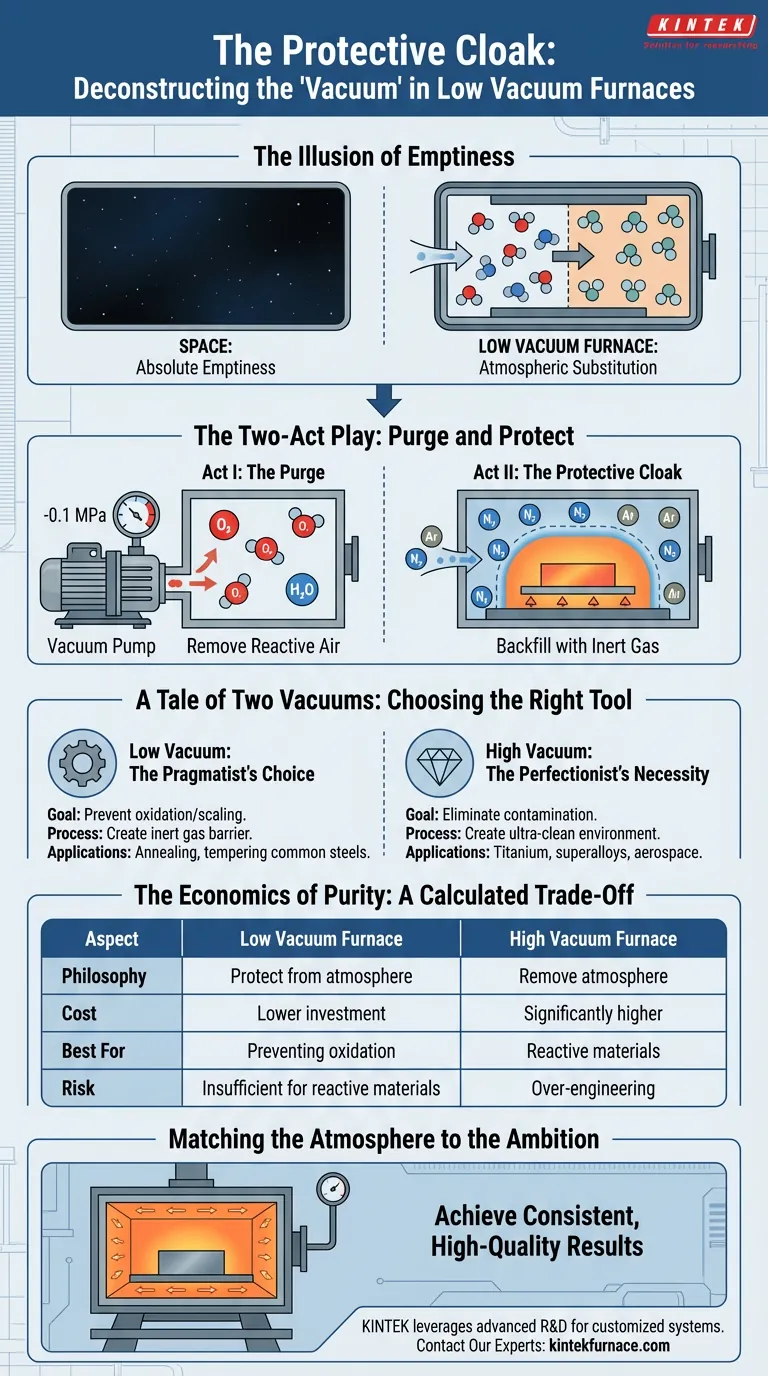
The Illusion of Emptiness
The word "vacuum" conjures images of the void of space—absolute emptiness. Our minds are drawn to this simple, powerful concept. But in the world of materials science and engineering, this simplification can be a costly misunderstanding.
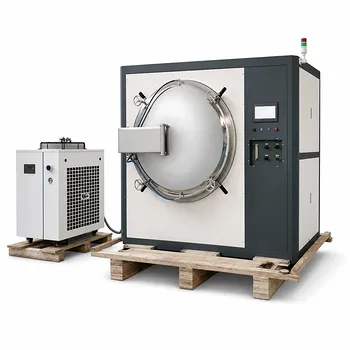
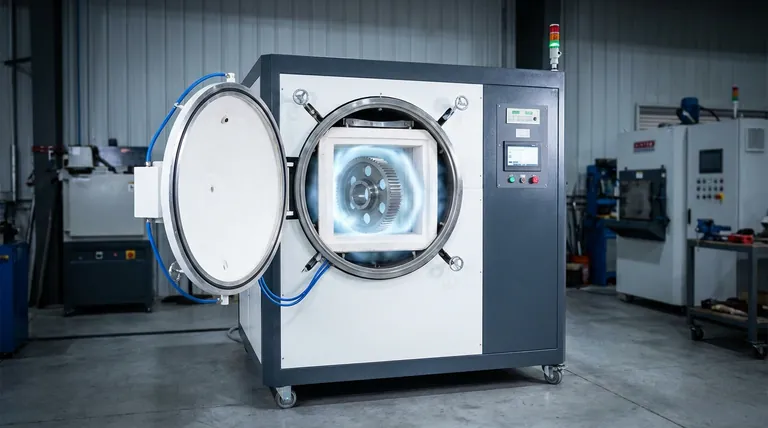
A low vacuum furnace, despite its name, has very little to do with creating a perfect void. Its primary function is far more elegant and practical: it’s a tool for atmospheric substitution. It first removes a problem—reactive air—and then replaces it with a solution—a protective, inert atmosphere.
The Two-Act Play: Purge and Protect
Think of the process not as one of subtraction, but as a deliberate two-step maneuver designed for maximum protection with pragmatic efficiency.
Act I: The Purge
The cycle begins when a vacuum pump removes the air from the furnace chamber, pulling the pressure down to a rough vacuum level of around -0.1 MPa. The enemy here isn't the presence of molecules, but the presence of the wrong molecules. Oxygen, moisture, and other atmospheric gases are aggressive actors at high temperatures, eager to react with a workpiece and cause destructive oxidation and decarburization.
The initial vacuum is simply the most efficient way to evict these reactive elements from the stage.
Act II: The Protective Cloak
Once the chamber is purged, the system is backfilled with a high-purity inert gas, typically nitrogen or argon. This gas forms a protective "cloak" around the material.
Because nitrogen and argon are chemically stable and non-reactive, they act as a neutral barrier. They fill the space, preventing any residual reactive gases from reaching the material's surface during the critical heating cycle. The material is heated not in a vacuum, but under a stable, protective blanket.
A Tale of Two Vacuums: Choosing the Right Tool
The distinction between a low vacuum and a high vacuum system is not about good versus bad; it's about matching the tool to the task. This choice reflects a deep understanding of the material's needs and the process's goals.
Low Vacuum: The Pragmatist's Choice
A low vacuum furnace is the workhorse for a vast range of heat treatments. It provides a cost-effective, highly reliable method for preventing the most common forms of atmospheric contamination.
- Goal: Prevent oxidation and scaling.
- Process: Create a protective inert gas barrier.
- Applications: Ideal for general processes like annealing, tempering, and stress-relieving common steels and alloys where absolute purity is not the primary concern.
High Vacuum: The Perfectionist's Necessity
A high vacuum furnace operates on a different principle. Its goal is to remove as many molecules as physically possible, creating an ultra-clean environment that is as close to a true void as we can achieve.
- Goal: Eliminate any potential for molecular contamination.
- Process: Create an environment of extreme purity.
- Applications: Essential for highly sensitive and reactive materials like titanium, certain superalloys, and components for medical or aerospace use, where even a few parts-per-million of a contaminant can compromise the material's integrity.
The Economics of Purity: A Calculated Trade-Off
Choosing between these systems is a fundamental engineering trade-off between cost, complexity, and the required level of atmospheric purity.
| Aspect | Low Vacuum Furnace (Inert Atmosphere) | High Vacuum Furnace (Pure Environment) |
|---|---|---|
| Philosophy | "Protect the material from the atmosphere." | "Remove the atmosphere from the material." |
| Cost | Lower initial investment and maintenance. | Significantly higher cost and complexity. |
| Best For | Preventing oxidation on most common metals. | Processing highly reactive or purity-sensitive materials. |
| Risk | Insufficient for materials that react with trace gases. | Over-engineering for applications that don't need it. |
Mismatching the furnace to the application leads to predictable failures: either catastrophic material contamination or a needless waste of capital on an overly complex system.
Matching the Atmosphere to the Ambition
Ultimately, the "vacuum" in your furnace is a means to an end. That end is a perfectly controlled atmosphere tailored to your material's specific needs. Whether you need a simple protective cloak or a near-perfect void depends entirely on your process goals.
This is why deep customization and expert guidance are critical. At KINTEK, we leverage our advanced R&D and manufacturing capabilities to build systems—from Vacuum and CVD to Tube and Muffle furnaces—that are precisely matched to your unique requirements. We understand that achieving consistent, high-quality results starts with creating the perfect environment.
For processes where precise atmospheric control is the key to quality, ensuring you have the right system is paramount. Contact Our Experts to find the perfect solution for your specific needs.
Visual Guide
Related Products
- Small Vacuum Heat Treat and Tungsten Wire Sintering Furnace
- Molybdenum Vacuum Heat Treat Furnace
- Vacuum Heat Treat Sintering Furnace with Pressure for Vacuum Sintering
- 2200 ℃ Tungsten Vacuum Heat Treat and Sintering Furnace
- 2200 ℃ Graphite Vacuum Heat Treat Furnace
Related Articles
- Why Your Stainless Steel Parts Fail Pressure Tests—and How Vacuum Sintering Fixes the Density Gap
- Why Your Electrochromic Electrodes Fail During Sintering—And How Vacuum Control Restores Transparency
- Why Your Sintered Parts Fail: It’s Not Just About Heat, But Pressure and Purity
- Beyond the Program: Why Your Sintering Fails and How to Guarantee Uniformity
- Why Your 3D-Printed Maraging Steel Parts Aren't Performing—And How to Fix the Structural Weakness