The Hidden War Within the Melt
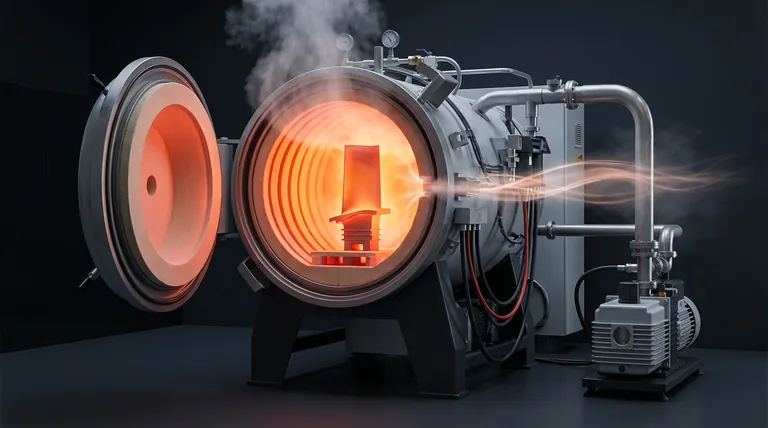
Imagine a high-performance jet engine turbine blade, spinning at 10,000 RPM while enduring temperatures that would melt steel. Its failure is not an option. We tend to think its strength comes only from the exotic alloy it's made of. But the real story is often about what isn't there.
The greatest threats to that blade's integrity are invisible enemies trapped within the metal during its creation: microscopic gas bubbles, rogue atoms of volatile elements, and unseen films of oxides.
Achieving a material's true potential is not always about adding better ingredients. It's about creating an environment of profound absence—a vacuum—to remove the flaws we can't see. This is the subtle but powerful logic of vacuum metallurgy.
Purification by Subtraction
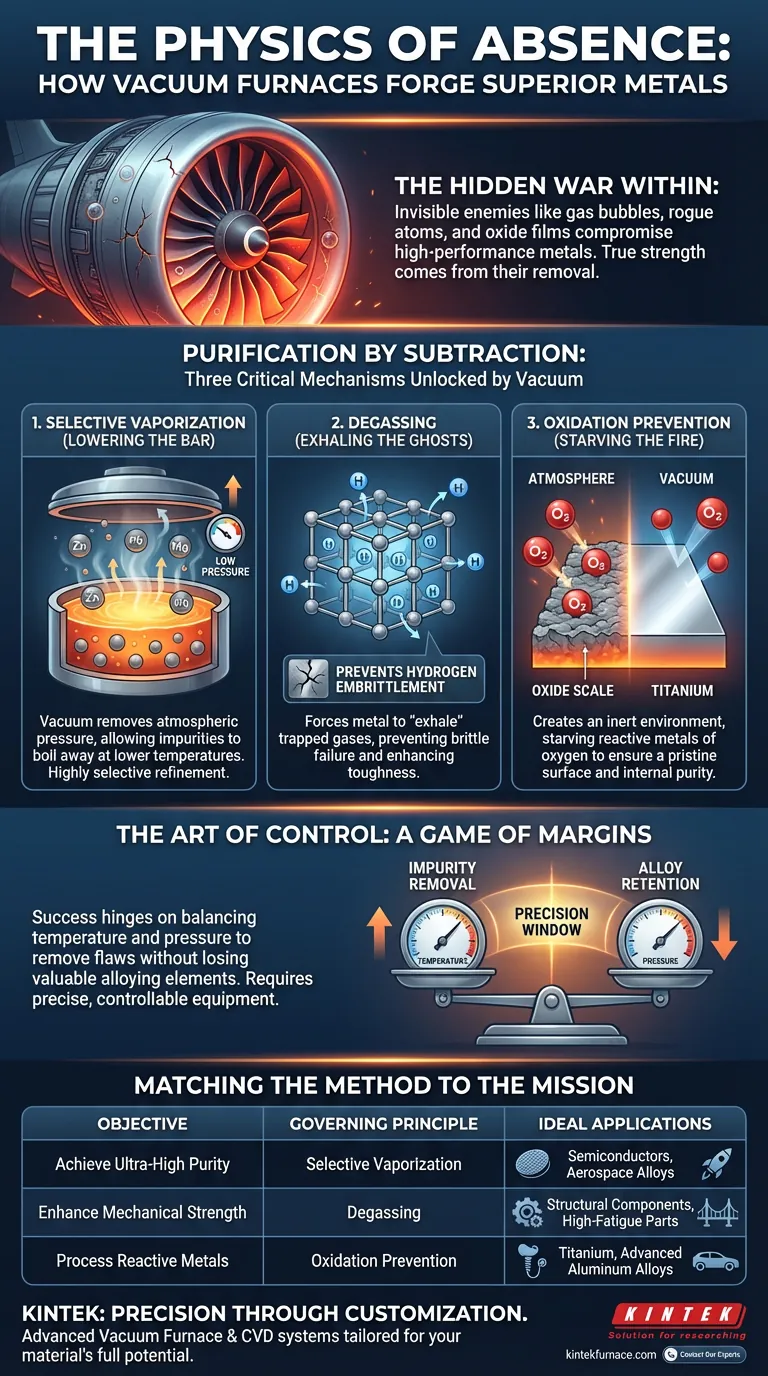
A vacuum furnace doesn’t add anything to the process. Its power comes from what it takes away: atmospheric pressure and reactive gases. This act of subtraction fundamentally alters the physics of materials at high temperatures, unlocking three critical purification mechanisms.
1. Lowering the Bar for Evaporation
Every element has a tendency to evaporate, known as its vapor pressure. In a normal atmosphere, the weight of the air acts like a lid on a pot, suppressing this tendency.
By creating a vacuum, we remove that lid.
This allows impurities with high vapor pressures—like zinc, lead, or magnesium—to boil away from the molten base metal at much lower temperatures than their standard boiling points. It's a highly selective process, enabling a level of refinement that atmospheric heating simply cannot achieve.
2. Exhaling the Ghosts in the Lattice
Metals, especially when liquid, can absorb ambient gases like a sponge. Hydrogen is particularly insidious. As the metal cools, hydrogen atoms can become trapped within its crystal structure, a condition known as hydrogen embrittlement.
This isn't a minor defect. It's a pathology that drastically reduces a metal's ductility and toughness, making it dangerously brittle and prone to catastrophic failure under stress.
A vacuum furnace forces the metal to "exhale" these trapped gases. This degassing process is one of the most direct ways to enhance the mechanical reliability and fatigue life of a finished component.
3. Starving the Fire of Oxidation
Heating reactive metals like titanium or aluminum in the open air is like inviting disaster. Oxygen aggressively attacks the hot surfaces, forming thick, contaminating oxide layers (scale) that compromise both the surface finish and the internal purity.
The near-total absence of oxygen in a vacuum chamber creates an inert, sterile environment. It starves the fire of oxidation before it can even begin, ensuring that the material remains pristine during its most vulnerable, high-temperature state.
The Art of Control: A Game of Margins
While powerful, vacuum purification is not a blunt instrument. Its successful application is a nuanced engineering challenge that requires a deep understanding of the trade-offs.
- Selectivity has Limits: The process is only effective for removing impurities that are more volatile than the base metal. It won't remove refractory contaminants.
- The Risk of Collateral Damage: If a desirable alloying element also has a high vapor pressure, it can be unintentionally removed along with the impurities.
- The Investment in Precision: Vacuum systems are inherently more complex and costly than their atmospheric counterparts. Their value is justified only when the outcome demands the highest levels of purity and performance.
This is where precision becomes paramount. Success hinges on controlling the delicate balance between temperature and pressure to create a processing window where impurities are removed while valuable alloys are retained. This isn't just a matter of having a vacuum; it's about having a controllable one.
Matching the Method to the Mission
The decision to use a vacuum furnace should be driven by a clear, specific goal. Understanding the governing principle behind each benefit allows for a more strategic application of the technology.
| Objective | Governing Principle | Ideal Applications |
|---|---|---|
| Achieve Ultra-High Purity | Selective Vaporization | Semiconductor materials, high-purity aerospace alloys |
| Enhance Mechanical Strength | Degassing | Structural components, high-fatigue parts, tooling |
| Process Reactive Metals | Oxidation Prevention | Titanium, zirconium, advanced aluminum alloys |
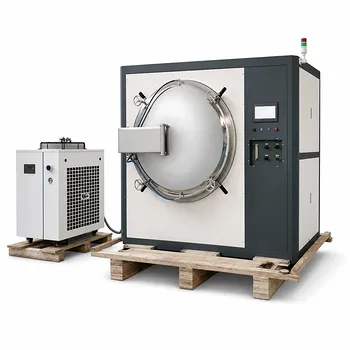
Ultimately, moving from abstract physics to tangible performance requires equipment that can execute this control flawlessly. This is why the customizability of a vacuum furnace system is so critical. The ability to tailor heating cycles, vacuum levels, and chamber design is what transforms a standard process into a solution for a unique material challenge.
As a leader in high-temperature lab furnaces, KINTEK provides advanced and highly customizable Vacuum Furnace and CVD systems designed for just this purpose. Our expert R&D and in-house manufacturing enable us to build the precise environment your materials need to reach their full potential.
To explore how a tailored vacuum system can elevate your material processing, Contact Our Experts.
Visual Guide
Related Products
- Vacuum Hot Press Furnace Machine Heated Vacuum Press Tube Furnace
- Vacuum Hot Press Furnace Machine Heated Vacuum Press
- 600T Vacuum Induction Hot Press Vacuum Heat Treat and Sintering Furnace
- 2200 ℃ Tungsten Vacuum Heat Treat and Sintering Furnace
- Vacuum Heat Treat Sintering Furnace with Pressure for Vacuum Sintering
Related Articles
- How Vacuum Hot Press Furnaces Transform Advanced Material Engineering
- How to Select the Right Vacuum Hot Pressing Furnace Temperature for Your Materials
- Beyond the Parts List: The Real Reason Your Vacuum Hot Press Fails (And How to Fix It)
- Why Your High-Temperature Materials Fail: The Hidden War Inside Your Furnace
- Is Your Material Data Real? Why Temperature Gradients Are Sabotaging Your Cu2Se Resistivity Measurements