The Moment of Truth in the Void
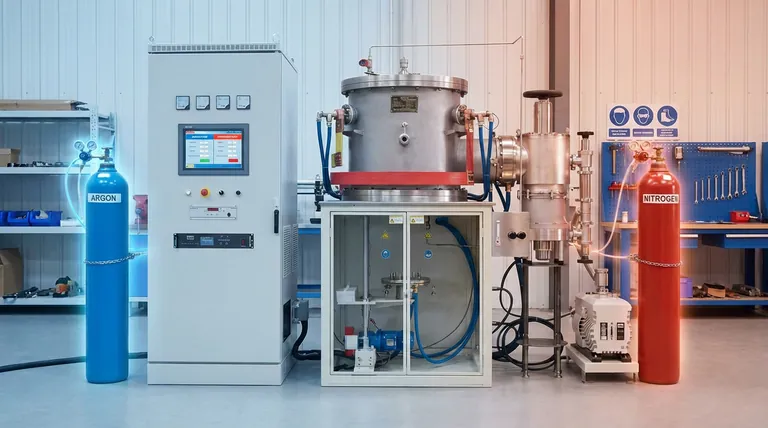
Imagine a high-value titanium component, destined for an aerospace application, emerging from the controlled environment of a vacuum furnace. The hours of careful preparation and precise heating cycles all come down to this moment. But its success was determined long before the cycle began, with a choice that seems simple on the surface: which gas to use for the backfill?
This isn't just an operational detail. It's a strategic decision. The atmosphere inside that furnace, invisible and silent, acts as either a guardian or a saboteur for your material's integrity. Choosing between Argon and Nitrogen is a fundamental exercise in balancing metallurgical perfection against economic reality.
The Core Conflict: Purity vs. Price
At the heart of the decision is a psychological and financial trade-off. We are naturally drawn to cost savings, but the hidden cost of choosing the wrong gas can be catastrophic, leading to brittle, unusable parts and wasted resources.
The choice forces us to confront a critical question: Are we processing a material that demands absolute chemical purity, or one where a "good enough" protective atmosphere will suffice?
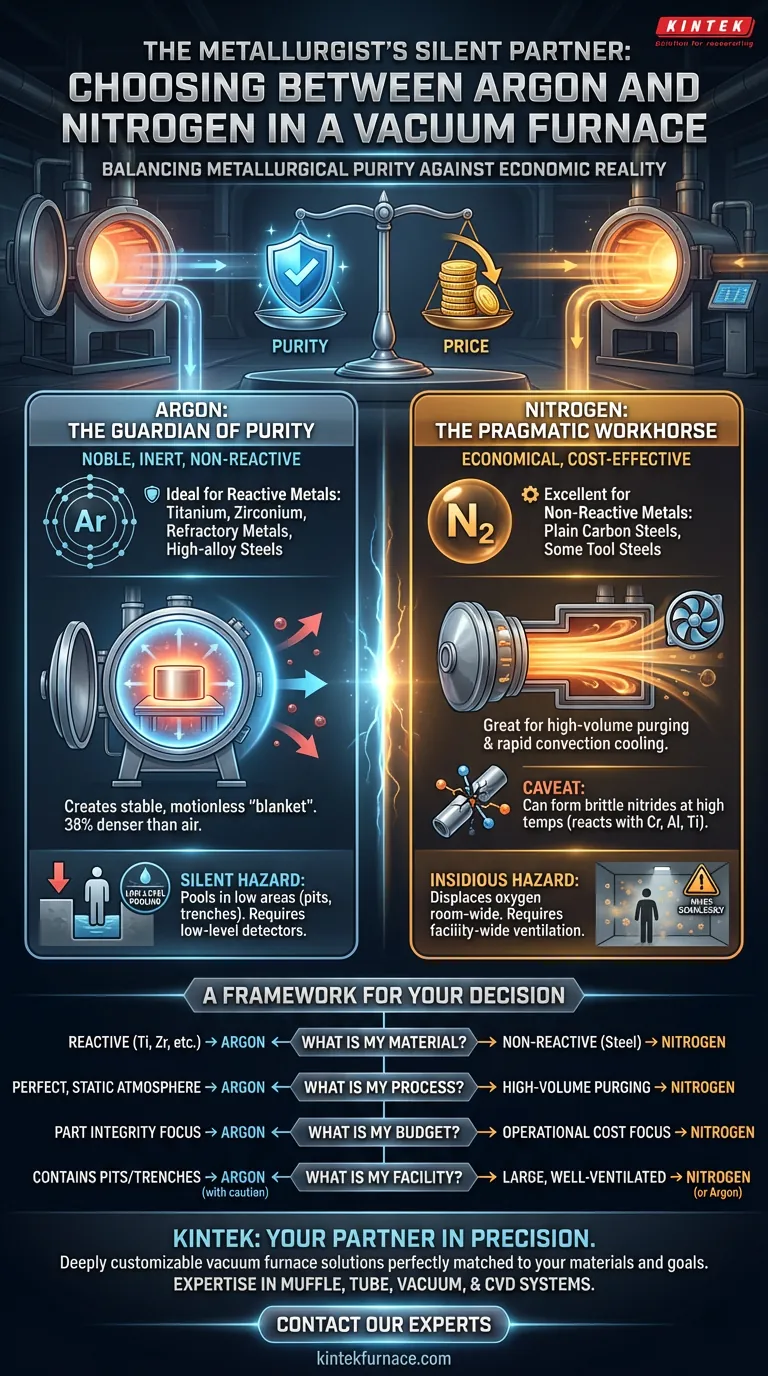
Argon: The Guardian of Purity
Argon is a noble gas. This isn't just a chemical classification; it's a description of its character. It stands apart, refusing to react or interfere, even at the punishing temperatures inside a furnace.
This inertness makes it the non-negotiable choice for highly reactive metals.
- Titanium
- Zirconium
- Refractory Metals
- Certain high-alloy or stainless steels
For these materials, using a lesser gas is like inviting a subtle poison into the process. Nitrogen would react to form brittle nitrides on the surface, compromising the very properties you sought to enhance. The higher cost of argon isn't an expense; it's an insurance policy against metallurgical failure.
Physically, argon is about 38% denser than air. This gives it a unique advantage in creating a stable, motionless "blanket" over parts, effectively pushing lighter, unwanted gases away. It guards the material with its sheer presence.
Nitrogen: The Pragmatic Workhorse
Nitrogen is the economical, practical choice for a vast range of applications. For materials like plain carbon steels or some tool steels, it provides excellent protection from oxidation at a fraction of argon's cost.
Its real power lies in its cost-effectiveness for high-volume tasks. When you need to rapidly purge a chamber of contaminants or use convection-assisted cooling cycles that require massive gas flow, nitrogen is the only sensible option.
But its pragmatism comes with a crucial caveat. At high temperatures, nitrogen sheds its generally non-reactive nature and can bond with elements like chromium, aluminum, and titanium. While this is desirable in intentional nitriding processes, it is a defect in almost every other context.
The Physics of an Invisible Hazard
Both gases are harmless to breathe in small amounts, but in a concentrated form, they are simple asphyxiants. They kill not by being toxic, but by displacing the oxygen we need to survive. Because you can't see or smell them, the danger is insidious, and their physical properties create distinct hazards.
Argon's Deceptive Weight
Because argon is heavier than air, a leak will cause it to flow downwards like water. It silently fills up maintenance pits, trenches, and any low-lying, unventilated space. An engineer descending a ladder into a pit could lose consciousness in seconds, succumbing to an invisible, odorless hazard. This risk mandates low-level gas detectors and ventilation.
Nitrogen's Insidious Spread
Nitrogen has a density very similar to air. Instead of pooling, it mixes seamlessly, gradually lowering the oxygen percentage of an entire room. The danger isn't confined to a pit; it's everywhere. This makes robust, facility-wide air circulation an absolute necessity.
A Framework for Your Decision
Making the right choice requires moving beyond simple cost analysis and looking at the entire system: the material, the process, and the facility.
| Question | If You Answer... | Your Choice Is Likely... |
|---|---|---|
| What is my material? | Reactive (titanium, zirconium, high-alloy steels). | Argon |
| Non-reactive (carbon steels, some tool steels). | Nitrogen | |
| What is my process? | Requiring a perfect, static inert atmosphere for sensitive parts. | Argon |
| Involving high-volume purging or rapid convection cooling. | Nitrogen | |
| What is my budget? | Focused on guaranteeing part integrity, where gas cost is minor compared to failure. | Argon |
| Focused on minimizing operational expenses for high-volume throughput. | Nitrogen | |
| What is my facility? | Contains pits, trenches, or low-lying areas. | Argon (with caution) |
| Is a large, open space with powerful ventilation. | Nitrogen (or Argon) |
Ultimately, selecting the right furnace and gas is a deeply technical decision that impacts quality, safety, and your bottom line. At KINTEK, we understand that an advanced furnace is more than just a heating element and a chamber; it's a precisely controlled environment. Our expertise in Muffle, Tube, Vacuum, and CVD furnace systems is built on a deep understanding of these subtle but critical process variables. We provide deeply customizable solutions to ensure your equipment is perfectly matched to your materials and your goals.
To ensure every component emerges from your furnace exactly as intended, you need a partner who appreciates the nuances of the process. Contact Our Experts
Visual Guide
Related Products
- Vacuum Hot Press Furnace Machine Heated Vacuum Press Tube Furnace
- Vacuum Hot Press Furnace Machine Heated Vacuum Press
- 600T Vacuum Induction Hot Press Vacuum Heat Treat and Sintering Furnace
- 2200 ℃ Tungsten Vacuum Heat Treat and Sintering Furnace
- Vacuum Heat Treat Sintering Furnace with Pressure for Vacuum Sintering
Related Articles
- How Vacuum Hot Press Furnaces Transform Advanced Material Engineering
- How to Select the Right Vacuum Hot Pressing Furnace Temperature for Your Materials
- Beyond the Parts List: The Real Reason Your Vacuum Hot Press Fails (And How to Fix It)
- Why Your High-Temperature Materials Fail: The Hidden War Inside Your Furnace
- Is Your Material Data Real? Why Temperature Gradients Are Sabotaging Your Cu2Se Resistivity Measurements