The Psychology of the Familiar Path
In materials science, as in finance, we often stick with what we know. A process that works is a process we trust. Vacuum distillation for magnesium purification is one such path. It’s established, understood, and it delivers a pure product.
But "working" is not the same as "optimal." Familiarity can blind us to hidden costs—the small, recurring expenses that act like a tax on our efficiency. For distillation, this tax comes from the simple, physical act of melting the metal.
A Problem Born of a Liquid State
Picture a traditional distillation furnace. The core of the operation involves heating impure magnesium until it becomes a glowing, molten, and highly corrosive liquid.
This single decision—to create a liquid phase—sets off a chain reaction of costs. Molten magnesium is aggressive. It demands to be contained. This necessity gives rise to the first major consumable: the graphite crucible. It exists for one reason only: to hold the liquid metal. It’s a recurring, significant operational expense.
The process often requires a second consumable, primary aluminum, as an additive in the molten bath. It’s another line item, another cost directly tied to the decision to work with a liquid. These consumables aren't value-adding ingredients; they are expensive crutches required to manage a fundamentally challenging physical state.
Designing the Problem Away
What if we could skip the liquid state entirely?
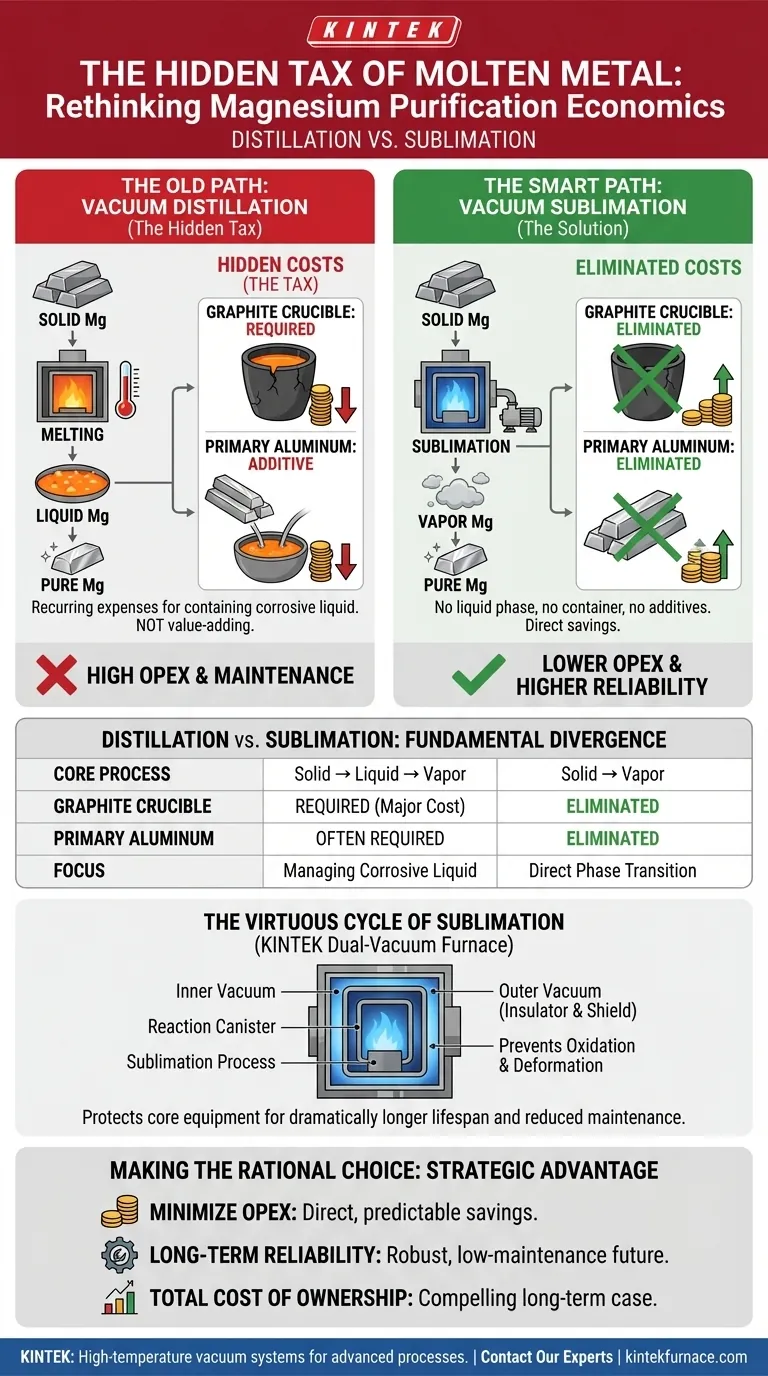
This is the elegant premise of vacuum sublimation. It's not merely an alternative method; it’s a fundamental redesign of the workflow. By heating solid magnesium directly under a vacuum, it transitions from a solid straight to a vapor (S→V), completely bypassing the troublesome liquid phase.
The consequences of this shift are profound and immediate.
- No Molten Metal: Without a liquid, the need for a container to hold it vanishes. The cost of graphite crucibles is not reduced; it is eliminated.
- No Liquid-Phase Additives: The process chemistry changes, making primary aluminum unnecessary. Another cost is eliminated.
This isn't incremental improvement. It is the removal of entire categories of operational expenditure.
Distillation vs. Sublimation: A Fundamental Divergence
| Feature | Vacuum Distillation | Vacuum Sublimation |
|---|---|---|
| Core Process | Solid → Liquid → Vapor | Solid → Vapor |
| Graphite Crucible | Required (A recurring, major cost) | Eliminated (The root cause is removed) |
| Primary Aluminum | Often Required | Eliminated |
| Operational Focus | Managing the challenges of a corrosive liquid | Managing a direct solid-to-vapor phase transition |
The Virtuous Cycle of a Superior System
The benefits of avoiding a liquid phase extend beyond consumables. They compound into a more robust and reliable system, a concept central to the engineering of modern high-temperature furnaces.
Consider the dual-vacuum furnace, a design perfected for sublimation. It creates one vacuum for the magnesium purification process itself. Crucially, it creates a second vacuum in the space between the inner reaction canister and the outer furnace wall.
This is a piece of engineering romance. This outer vacuum acts as a perfect insulator and shield. It protects the hot inner canister from being oxidized by ambient air and prevents it from deforming under immense atmospheric pressure. The result is a dramatically longer lifespan for the core equipment, reducing major maintenance and replacement costs over the long term.
This level of process control and equipment longevity is the focus of modern purification systems, such as the customizable high-temperature vacuum furnaces developed by KINTEK, which are engineered specifically for the rigors of processes like sublimation.
Making the Rational Choice
The decision between distillation and sublimation is not just about comparing two techniques. It's about choosing an operational philosophy.
- Focus on Minimizing OPEX: If your goal is to slash recurring operational costs, sublimation is the clear winner. Eliminating consumables provides direct, predictable savings on every production run.
- Focus on Long-Term Reliability: If your priority is uptime and asset longevity, the advanced furnace designs associated with sublimation offer a more robust, lower-maintenance future.
- Focus on Total Cost of Ownership: When evaluating a new installation, the significant long-term savings from eliminating consumables must be weighed against the initial capital investment. Sublimation often presents a far more compelling case over the life of the equipment.
Ultimately, the most advanced approach moves beyond simply managing problems—like corrosion and consumable logistics—and instead chooses a process that eliminates their root cause. That is the strategic advantage of sublimation. Achieving this requires a furnace designed for the specific demands of the process.
At KINTEK, we specialize in building the high-temperature vacuum systems that make these advanced, cost-effective processes possible. Contact Our Experts
Visual Guide
Related Products
- Vacuum Heat Treat Sintering Furnace Molybdenum Wire Vacuum Sintering Furnace
- Vacuum Hot Press Furnace Machine for Lamination and Heating
- Vacuum Heat Treat Sintering Furnace with Pressure for Vacuum Sintering
- 9MPa Air Pressure Vacuum Heat Treat and Sintering Furnace
- Small Vacuum Heat Treat and Tungsten Wire Sintering Furnace
Related Articles
- Why Your Stainless Steel Parts Fail Pressure Tests—and How Vacuum Sintering Fixes the Density Gap
- Why Your Electrochromic Electrodes Fail During Sintering—And How Vacuum Control Restores Transparency
- Why Your Sintered Parts Fail: It’s Not Just About Heat, But Pressure and Purity
- Beyond the Program: Why Your Sintering Fails and How to Guarantee Uniformity
- Why Your 3D-Printed Maraging Steel Parts Aren't Performing—And How to Fix the Structural Weakness