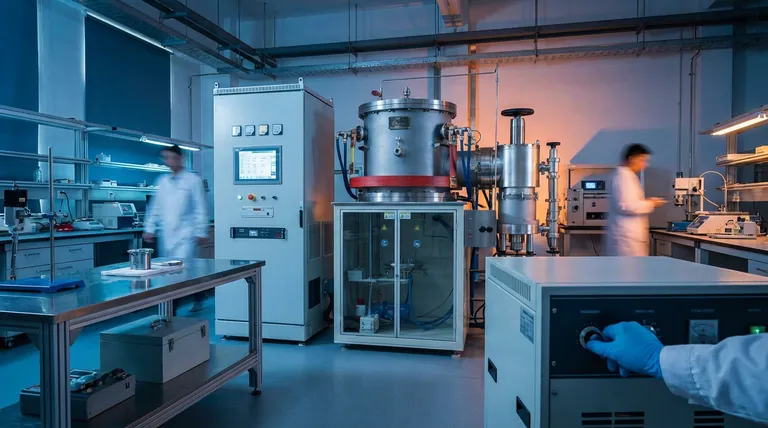
The Psychology of Perfect Heat
Heat treatment is often perceived as a brute-force process: make something hot, then cool it down.
This is a dangerous oversimplification. At its heart, advanced heat treatment is a delicate dance with physics and chemistry. The goal isn't just to alter a material's temperature, but to precisely dictate its final crystalline structure, and therefore its strength, hardness, and longevity.
The real challenge isn't applying heat. It's controlling every variable that could possibly interfere with the intended outcome. It's a process driven by a healthy paranoia—a desire to eliminate randomness.
Fighting an Invisible War: The Problem of Atmosphere
The most significant and unpredictable variable in any high-temperature process is the one we take for granted: the air itself.
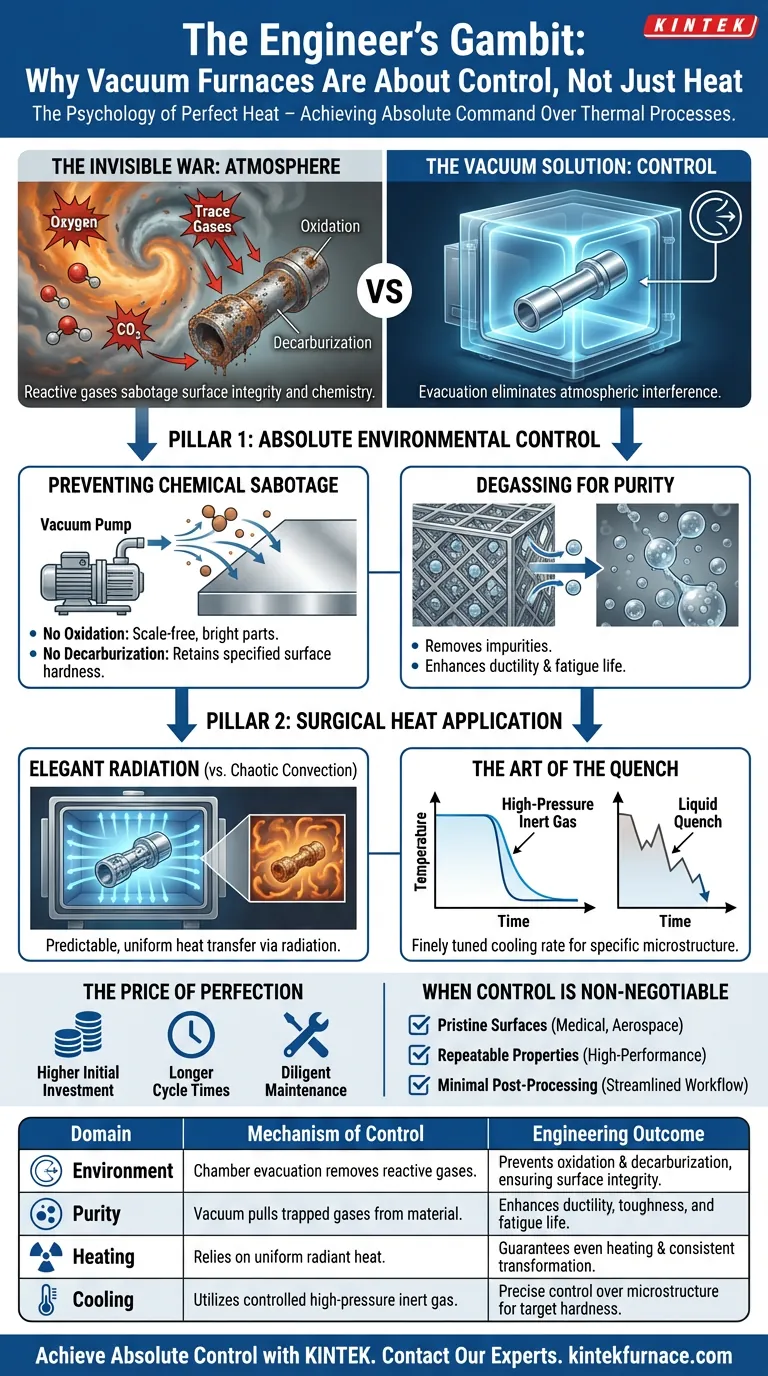
Imagine designing a critical aerospace component or a biocompatible medical implant. At treatment temperatures, the oxygen and trace gases in a standard atmosphere become aggressive saboteurs. They react with the metal's surface, creating an oxide scale (oxidation) and depleting its carbon content (decarburization).
These are not minor cosmetic flaws. They are fundamental changes to the material's chemistry that weaken the surface, compromise its integrity, and can lead to premature failure. You've engineered a perfect alloy, only to have it corrupted in the final step by an invisible enemy.
This is where the vacuum furnace changes the game. It’s not just a furnace; it's a sterile environment engineered to win this invisible war.
Pillar 1: Achieving Absolute Environmental Control
The first act of a vacuum furnace is not to create heat, but to create nothingness. By evacuating the chamber, it systematically removes the atmospheric variables that cause defects.
Preventing Chemical Sabotage
A deep vacuum starves the environment of reactive gases.
- No Oxidation: Without oxygen, the formation of scale is impossible. Parts emerge from the furnace clean, bright, and dimensionally accurate, often eliminating the need for secondary cleaning processes like sandblasting or acid etching.
- No Decarburization: The material's surface retains its specified carbon content, ensuring its hardness and wear resistance are exactly as designed.
The result is a surface that is chemically identical to the core material—a perfect expression of the alloy's intended properties.
The Deep Clean: Degassing for Structural Purity
The vacuum does more than protect the surface; it actively purifies the bulk material. As the workpiece heats in the vacuum, trapped gases like hydrogen and oxygen are pulled from within the metal's structure.
This degassing process removes impurities that can act as initiation points for microscopic cracks, enhancing the material's ductility, toughness, and fatigue life. You are left with a cleaner, more robust version of your material.
Pillar 2: The Surgical Application of Heat
With the environment completely stabilized, the furnace can apply thermal energy with surgical precision. The vacuum itself becomes an ally in this process.
From Chaotic Convection to Elegant Radiation
In a traditional furnace, heat transfer is a messy combination of conduction, radiation, and convection (air currents). Convection is chaotic, creating hot and cold spots that lead to non-uniform treatment.
In a vacuum, convection is eliminated. Heat transfer occurs almost purely through radiation. This is a far more predictable and uniform method, allowing energy to evenly blanket complex geometries and ensure the entire workload reaches the target temperature at the same time. It replaces a turbulent storm with the clean, predictable light of pure energy.
Precision Beyond Temperature: The Art of the Quench
Controlling the cooling rate is just as critical as controlling the heating. Vacuum furnaces master this by backfilling the chamber with a high-purity inert gas (like nitrogen or argon) at a precisely controlled pressure.
This high-pressure gas quenching allows for rapid, uniform cooling without the thermal shock or distortion associated with liquid quenching. The cooling rate can be finely tuned, allowing metallurgists to lock in a specific microstructure and achieve the exact desired hardness and strength. It’s a controlled descent, not an uncontrolled drop.
The Price of Perfection
This level of control is not without its trade-offs. It's a specialized tool, and its power comes with specific demands.
- Higher Initial Investment: The complexity of vacuum pumps, seals, and advanced control systems means a higher capital cost compared to atmosphere furnaces.
- Longer Cycle Times: The time required to pump the chamber down to a deep vacuum adds to the overall process duration.
- Diligent Maintenance: The integrity of the vacuum system is paramount and requires a rigorous, specialized maintenance schedule.
When Control is Non-Negotiable
The decision to use a vacuum furnace is a strategic one. You opt for this technology when the cost of uncertainty is higher than the cost of the equipment.
It becomes the only logical choice when your application demands:
- Pristine Surfaces: For medical, aerospace, or advanced electronics where surface chemistry is critical.
- Repeatable Mechanical Properties: For high-performance components where every batch must meet identical, exacting standards.
- Minimal Post-Processing: When eliminating secondary cleaning and finishing steps can streamline the entire production workflow.
Achieving this level of control requires more than just hardware; it requires a deep understanding of materials science and process engineering. At KINTEK, our foundation in R&D and manufacturing is built around this principle. We engineer customizable Muffle, Tube, Vacuum, and CVD furnace systems not just as heating devices, but as precision instruments designed to give researchers and engineers absolute command over their thermal processes.
The table below summarizes how a vacuum furnace establishes control:
| Domain | Mechanism of Control | Engineering Outcome |
|---|---|---|
| Environment | Chamber evacuation removes reactive gases. | Prevents oxidation and decarburization, ensuring surface integrity. |
| Purity | Vacuum degassing pulls trapped gases from the material. | Enhances ductility, toughness, and fatigue life. |
| Heating | Relies on uniform, predictable radiant heat transfer. | Guarantees even heating and consistent metallurgical transformation. |
| Cooling | Utilizes controlled high-pressure inert gas quenching. | Allows for precise control over microstructure to achieve target hardness. |
If your work demands certainty and your results cannot be left to chance, then you understand the value of absolute control. Contact Our Experts
Visual Guide
Related Products
- Vacuum Hot Press Furnace Machine Heated Vacuum Press Tube Furnace
- Vacuum Hot Press Furnace Machine Heated Vacuum Press
- 600T Vacuum Induction Hot Press Vacuum Heat Treat and Sintering Furnace
- 2200 ℃ Tungsten Vacuum Heat Treat and Sintering Furnace
- Vacuum Heat Treat Sintering Furnace with Pressure for Vacuum Sintering
Related Articles
- How Vacuum Hot Press Furnaces Transform Advanced Material Engineering
- How to Select the Right Vacuum Hot Pressing Furnace Temperature for Your Materials
- Beyond the Parts List: The Real Reason Your Vacuum Hot Press Fails (And How to Fix It)
- Why Your High-Temperature Materials Fail: The Hidden War Inside Your Furnace
- Is Your Material Data Real? Why Temperature Gradients Are Sabotaging Your Cu2Se Resistivity Measurements



















